What Are NFA Weapons and How Are They Regulated in Every State in the USA
NFA weapons include machine guns, short-barreled rifles and shotguns, suppressors, and destructive devices. These are all federally regulated under the National Firearms Act of 1934. You must register these with the ATF, pass background checks, and pay a tax stamp.
Federal rules are uniform, but state laws vary widely. Some states like Texas allow full ownership. Others like New York heavily restrict them.
Understanding these distinctions is essential before acquisition. Further details reveal how compliance and ownership intricacies differ across jurisdictions.
Key Takeaways
- NFA weapons include machine guns, short-barreled rifles/shotguns, suppressors, and destructive devices regulated under the 1934 National Firearms Act.
- Ownership requires federal registration, ATF Form 4 approval, and payment of a $200 tax stamp, except $5 for Any Other Weapons.
- Machine guns fire automatically; SBRs have barrels under 16 inches; SBSs have barrels under 18 inches; destructive devices exceed .50 caliber.
- State laws vary widely: Texas and Wyoming permit all NFA items, while New Jersey and New York heavily restrict or ban them.
- Federal approval does not ensure state legality; owners must comply with both federal and individual state regulations to avoid penalties.
Overview of National Firearms Act (NFA) Weapons
Although the National Firearms Act (NFA) was enacted in 1934 to impose strict controls, it specifically targets certain categories of firearms, including machine guns, short-barreled rifles and shotguns, suppressors, and destructive devices.
Under the national firearms act, these federally regulated firearms require registration with the ATF and payment of a tax stamp, usually $200 except for Any Other Weapons at $5. You must comply with nfa firearm regulations to legally possess or transfer these items, adhering to ATF firearm laws.
Understanding the classification is essential because NFA weapons are distinct from other firearms and are subject to rigorous oversight.
Failure to follow these regulations can lead to severe penalties. This framework guarantees controlled possession and strict accountability for these high-risk weapons.
Federal Regulations Governing NFA Firearms
When you acquire or transfer an NFA firearm, federal regulations require you to submit ATF Form 4 and undergo a detailed background check before receiving approval. The ATF Form 4 process guarantees strict adherence to NFA compliance requirements and federal gun registration laws.
This procedure applies to all class 3 weapons, including machine guns and silencers. You must also pay a tax stamp, usually $200, except for certain Any Other Weapons (AOWs).
| Requirement | Description |
|---|---|
| Form Submission | ATF Form 4 for transfers |
| Background Check | Extensive FBI check |
| Tax Stamp | $200 standard, $5 for AOWs |
| Registration | Mandatory NFA registry entry |
Failing to comply risks severe penalties, including fines and imprisonment. This emphasizes the critical nature of federal regulations governing NFA firearms.
Categories of NFA-Regulated Firearms and Devices
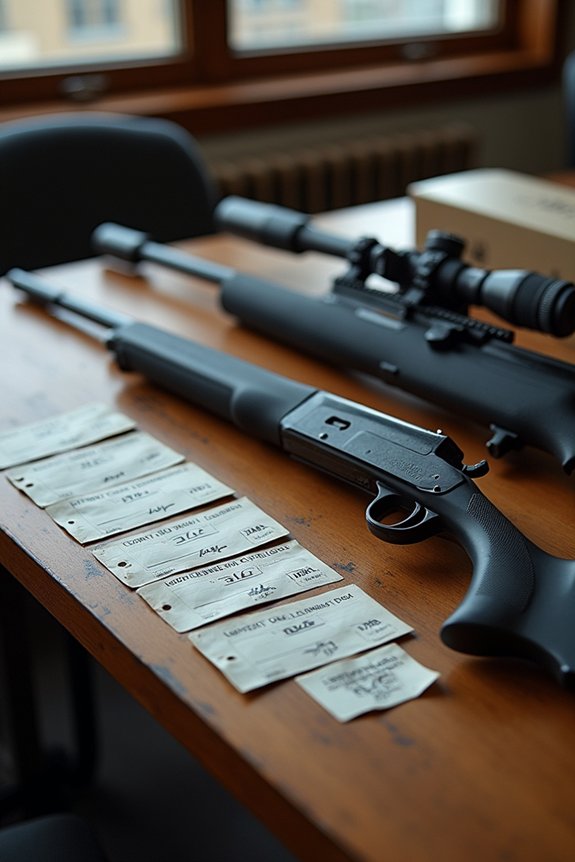
The National Firearms Act (NFA) classifies regulated firearms and devices into five distinct categories: machine guns, short-barreled rifles (SBRs), short-barreled shotguns (SBSs), suppressors, and destructive devices.
Machine guns, capable of automatic fire with one trigger pull, are strictly controlled under machine gun ownership laws.
Short-barreled rifle regulations define SBRs by barrels under 16 inches or overall length below 26 inches, while short-barreled shotgun laws apply to barrels shorter than 18 inches.
Silencer and suppressor regulations govern devices that reduce firearm noise, requiring registration and tax payment.
Destructive devices, including explosives and firearms over 0.50-inch bore diameter, face rigorous oversight.
Each category mandates ATF registration and a $200 tax (except AOWs at $5), reflecting the NFA’s thorough regulatory framework you must navigate.
State-by-State Legal Status of NFA Weapons
Because NFA regulations vary widely by state, you need to understand how each jurisdiction treats different categories of NFA weapons.
Firearm ownership legality by state fluctuates considerably, with states like Texas and Wyoming allowing all NFA items, while New Jersey and New York impose strict state restrictions on NFA items, including bans on machine guns and short-barreled shotguns.
Some states, such as Massachusetts and Michigan, permit certain NFA firearms only under specific conditions or prior registration dates.
Furthermore, Minnesota restricts machine guns and SBSs unless classified under destructive device classification or as Curios and Relics.
Maneuvering federal vs state gun laws requires careful consideration of these nuances, as federal approval doesn’t guarantee state-level legality.
You must consult local statutes to ascertain compliance and lawful possession.
Compliance and Ownership Considerations for NFA Items
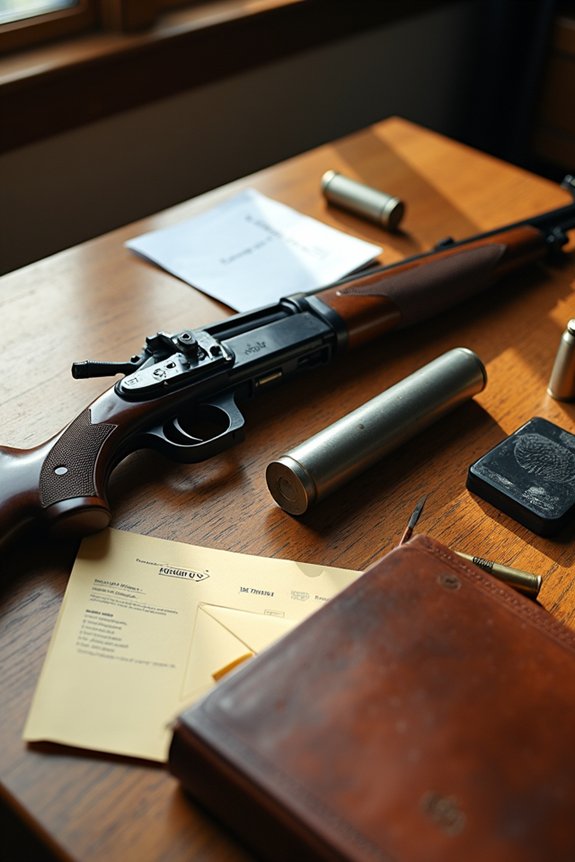
Although federal registration and tax payments are mandatory for owning NFA items like short-barreled rifles, machine guns, and suppressors, you must also navigate varying state laws that may impose stricter controls or outright bans.
Compliance hinges on completing the NFA tax stamp process accurately and adhering to firearm transfer regulations. This includes submitting ATF Form 4 for ownership transfers and ATF Form 5320.20 for interstate transport.
Accurate NFA tax stamp processing and proper form submission are crucial for lawful firearm transfers and transport.
Title II firearms, encompassing the any other weapon category, demand careful attention to both federal and state restrictions.
Utilizing a gun trust or corporation can streamline ownership and transfers, ensuring compliance with complex regulations.
Failure to observe these layered legal requirements can result in severe penalties, making thorough due diligence essential before acquiring or transferring any NFA item.
Frequently Asked Question
Can NFA Weapons Be Used for Self-Defense in Emergencies?
Yes, you can use NFA weapons for self-defense in emergencies, but you must follow both federal and state laws closely.
Your NFA firearm needs to be properly registered, and you must comply with tax stamp requirements.
Keep in mind, states vary widely on legal use, and authorities may scrutinize NFA weapon use more than standard firearms.
Make sure you fully understand your specific state’s laws and complete all registration steps before relying on these weapons for defense.
How Does the NFA Affect Firearm Insurance Policies?
You know what they say: “Forewarned is forearmed.”
The NFA impacts your firearm insurance by requiring specialized policies for NFA items like suppressors and machine guns.
Insurers demand proof of registration, compliance, and often charge higher premiums reflecting these weapons’ value and risk.
If you don’t disclose your NFA firearms, you risk claim denial or policy cancellation.
Being transparent guarantees your coverage stands strong when needed most.
Are There Specific Storage Requirements for NFA Firearms?
Yes, you must store NFA firearms securely to prevent unauthorized access.
While federal law doesn’t impose specific storage rules, many states have their own regulations you need to follow.
You should use gun safes or locked cabinets and maintain records of your storage practices.
Doing so not only guarantees compliance with local laws but also improves safety for you and others, reducing risks associated with these regulated weapons.
Can Non-U.S. Citizens Legally Own NFA Weapons?
You absolutely can own NFA weapons as a non-U.S. citizen, but it’s no walk in the park.
You’ll need a special ATF permit, prove legal residency, and pass a thorough background check.
Keep in mind, some states slam the door tighter with extra restrictions.
Consulting legal experts familiar with both federal and state laws isn’t just smart; it’s essential to avoid costly mistakes and remain fully compliant.
What Penalties Exist for Illegal Possession of NFA Items?
If you possess unregistered NFA items, you face up to 10 years in prison and hefty fines.
Running a business involving NFA firearms without proper SOT registration can lead to similar penalties.
Willfully evading taxes on these items risks five years in prison and fines up to $250,000.
Altering serial numbers or ignoring state-specific rules adds severe criminal charges.
You must comply fully to avoid these serious consequences.
Conclusion
Understanding NFA weapons is vital because over 200,000 transfers of these firearms occur yearly under strict federal oversight. You must navigate both complex federal regulations and varying state laws to legally own them.
While the National Firearms Act sets a uniform baseline, states differ widely in restrictions, making compliance essential. By staying informed and following registration procedures, you can responsibly manage NFA items without risking legal consequences.