How to Choose a Rifle Scope in Steps
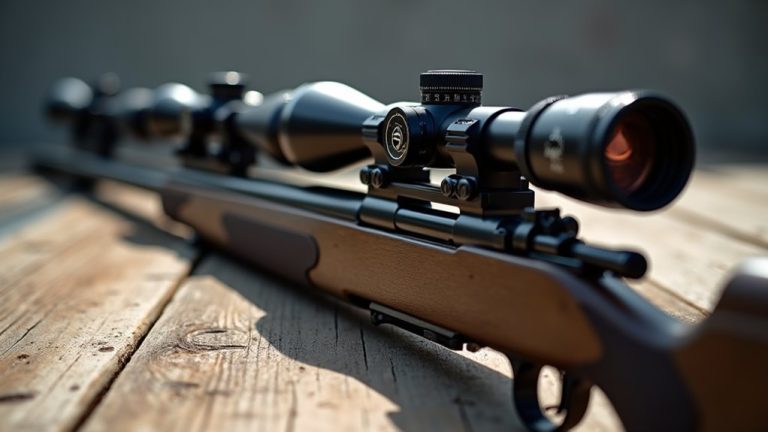
To choose a rifle scope, start by identifying the right magnification based on your shooting range.
Consider whether a fixed or variable power scope suits your needs.
Evaluate the objective lens size for ideal light transmission and look for quality lens coatings.
Choose a reticle type that matches your shooting style.
Assess the build quality and durability before selecting a mounting system.
Finally, set a budget that fits your requirements.
There’s more to explore on this topic!
Key Takeaways
– Determine the appropriate magnification based on your shooting range:
1-4x for close,
3-9x for medium, and
6-18x for long-range.
– Choose an objective lens size that balances light transmission and visibility,
with 40mm being a versatile option for various conditions.
– Select a reticle type that suits your shooting style,
such as duplex for hunting or BDC for long-range accuracy.
– Ensure the scope is built from durable materials,
features weatherproofing, and has reliable turret mechanisms for consistent adjustments.
– Set a budget around $500 to invest in quality optics that enhance performance and shooting experience
while avoiding low-quality options.
Understanding Magnification and Power Types
When you’re choosing a rifle scope, how do you determine the right magnification for your needs?
Start by considering your shooting scenarios. For close-range shooting (0-100 yards), a magnification of 1-4x gives you a wide field of view, making target acquisition easier.
Consider your shooting scenarios: for close-range (0-100 yards), a 1-4x magnification provides a wide field of view for easier target acquisition.
If you’re into medium-range shooting (100-300 yards), a 3-9x magnification is ideal. For long-range shooting (300+ yards), look at higher magnifications like 6-18x to effectively identify distant targets.
Fixed power scopes offer a single magnification level, perfect for specific distances, while variable power scopes allow you to adjust between magnifications.
Just remember, excessively high magnification can narrow your field of view and reduce image brightness, complicating shot stabilization.
Choose wisely!
Choosing Between Fixed and Variable Power Scopes
How do you decide between fixed and variable power scopes?
Start by considering your intended use. Fixed power scopes offer a single magnification level, making them simple and durable, ideal for consistent shooting at a specific distance.
They’re lighter and more compact, perfect for quick shots in dense environments.
On the other hand, variable power scopes provide adjustable magnification levels, allowing flexibility for diverse shooting conditions and different shooting scenarios.
This adaptability can help with distance estimation and identifying targets at varying ranges.
However, be cautious with high magnification, as it can reduce your field of view.
Ultimately, weigh your needs against the advantages of each type to make the best choice for your shooting style.
Evaluating Objective Lens Size for Light Transmission
When you’re choosing a rifle scope, the size of the objective lens can make a big difference in visibility.
Larger lenses generally let in more light, which is essential for low-light conditions.
Sizes like 40mm offer a good balance for various hunting scenarios.
Understanding how these sizes affect your shooting can help you pick the right scope for your needs.
Impact on Visibility
The objective lens size of a rifle scope plays an essential role in determining visibility, particularly in low light conditions.
Larger lenses generally enhance light transmission, offering brighter images. For hunting scopes, a 50mm lens improves low-light performance, while a 40mm lens balances weight and visibility.
| Objective Lens Size | Effect on Visibility |
|---|---|
| 28mm or under | Limited visibility |
| 40mm | Good balance |
| 50mm | Enhanced brightness |
The exit pupil is vital, as it measures light reaching your eye; larger exit pupils considerably increase visibility.
Scopes with high-quality coatings can achieve impressive light transmission rates, ensuring you won’t miss that critical shot in challenging conditions.
Recommended Sizes by Use
Choosing the right objective lens size for your rifle scope can greatly enhance your shooting experience.
For low power scopes, an objective lens size of 28mm or under is recommended to guarantee maneuverability and reduce weight.
If you’re using firearms with recoil, a 30-44mm objective lens offers better performance in low light conditions and suits high power scopes well.
For long-range shooting or high magnification, aim for an objective lens size of 50mm and above, as it enhances light transmission and visibility.
A commonly favored 40mm objective lens strikes a balance between weight and light-gathering capability, assuring shooting comfort.
Importance of Lens Coatings in Scopes
When choosing a rifle scope, lens coatings matter more than you might think.
They not only reduce glare but also enhance light transmission, which can dramatically improve your visibility in various conditions.
Understanding the different types of coatings and their impact on clarity is vital for making an informed decision.
Types of Lens Coatings
Three main types of lens coatings can greatly impact your shooting experience with a rifle scope.
First, coated lenses have one layer on at least one surface, while fully-coated lenses feature a single layer on all exterior surfaces.
Next, multi-coated lenses offer several layers on at least one surface, enhancing light transmission.
Finally, fully multi-coated lenses provide multiple layers on all surfaces, maximizing visibility and light transmission rates up to 98%.
Choosing a scope with quality coatings is vital, especially in low-light situations, as they reduce glare and improve shooting accuracy.
Additionally, these coatings enhance durability, protecting your optics from scratches and environmental factors.
Prioritize high-quality lens coatings for the best performance in the field.
Impact on Visibility
Lens coatings play an essential role in enhancing visibility and performance when using a rifle scope.
These coatings improve light transmission and reduce glare, making a significant difference, especially in low-light conditions.
Basic coated lenses offer some glare reduction, but fully multi-coated lenses maximize clarity and brightness by applying multiple layers on all surfaces.
High-quality lens coatings can achieve light transmission rates of up to 98%, which directly impacts shooting accuracy.
With better clarity, you can identify targets more effectively in various environments, like dawn or dusk.
Hence, it’s vital to scrutinize the quality of lens coatings, as they directly affect your ability to see and acquire targets efficiently, ensuring a successful shooting experience.
Exploring Different Reticle Types
There are several reticle types available, each designed to meet specific shooting needs and preferences.
Understanding these options can enhance your experience and effectiveness in the field.
| Reticle Type | Description | Best For |
|---|---|---|
| Duplex Reticle | Simple crosshair for quick target acquisition | General hunting, target shooting |
| BDC Reticle | Markings for bullet drop estimation | Long-range shooting |
| Mil-Dot Reticle | Dots for distance estimation | Military, law enforcement |
| MOA Reticles | Fine adjustments for precision shooting | Windage, elevation adjustments |
| Illuminated Reticles | Enhanced visibility in low-light conditions | Dawn or dusk hunting |
Choosing the right reticle type can greatly impact your target acquisition and distance estimation.
This makes your shooting experience more precise and enjoyable.
Assessing Eye Relief for Comfort and Safety
How important is eye relief when it comes to your shooting comfort and safety?
Proper eye relief guarantees you can shoot accurately without risking injury from scope bite, especially with higher recoiling rifles.
Here are some key points to take into account:
- Standard scopes usually offer 3 to 3.5 inches of eye relief, but higher recoiling rifles need up to 4 inches.
- Intermediate Eye Relief (IER) scopes require 9-12 inches, while Long Eye Relief (LER) scopes can need 16-20 inches for handguns.
- Adequate eye relief maintains a consistent head position, which helps prevent parallax errors and improves visibility.
Choosing the right eye relief is essential for both your comfort and safety while aiming through your scope.
Understanding Parallax and Its Impact on Accuracy
Parallax can greatly affect your shooting accuracy, especially when the reticle seems to shift as you change your head position.
Most scopes are corrected for parallax at standard distances, but you might notice more errors at shorter ranges.
Understanding how to adjust for parallax will help you maintain a consistent aim and improve your overall performance.
Parallax Explained
When you’re aiming with a rifle scope, the alignment of your head can dramatically affect your accuracy due to parallax.
This phenomenon occurs when the crosshairs seem to shift against your target, leading to potential aiming inaccuracies.
To guarantee peak performance, consider the following:
- Most scopes are parallax corrected at 100 or 150 yards, but errors can worsen at closer shooting distances.
- Using adjustable objectives allows for precise parallax adjustment, fine-tuning your optics for various distances.
- Proper eye alignment is vital, especially with high-powered scopes, as it directly impacts shot placement.
Understanding parallax and addressing parallax errors will enhance your shooting accuracy, making it essential for any serious shooter.
Correcting Parallax Errors
Understanding the nuances of parallax is key to improving your shooting accuracy. Parallax occurs when the crosshairs seem misaligned with the target due to your head position, which can lead to accuracy issues.
Most scopes are parallax corrected at distances of 100 or 150 yards, but this can be problematic for close distances. To guarantee precise alignment, consider using scopes with adjustable objectives, especially if you’re shooting at higher magnification levels.
This allows for effective correction of parallax errors. Always check your eye position relative to the ocular lens, as minor misalignments can cause missed shots.
Factors to Consider for Build Quality and Durability
Choosing a rifle scope involves several vital factors, but build quality and durability should be at the forefront of your decision-making process.
You need a scope that can withstand the elements and the rigors of shooting. Consider these features:
- Material: Aluminum is lightweight and corrosion-resistant, while steel offers superior durability for high-recoil rifles.
- Weatherproofing: Look for waterproof, fog-proof, and shockproof capabilities to guarantee performance in varying conditions.
- Protection: Anodized coatings enhance longevity by providing protection against wear and corrosion.
Additionally, high-quality turret and adjustment mechanisms are essential for reliable elevation and windage changes.
Regular maintenance and field testing will help preserve your scope’s functionality and durability over time.
Selecting the Right Mounting System for Your Scope
Selecting the right mounting system for your rifle scope is fundamental to achieving peak performance and accuracy.
You’ll want to evaluate different mounting systems like rings, one-piece mounts, and rail systems. Proper ring height is essential for eye alignment, ensuring comfort while aiming.
Here’s a quick comparison:
| Mount Type | Stability | Durability |
|---|---|---|
| Rings | Moderate | Variable |
| One-Piece Mounts | High | High |
| Rail Systems | Varies | Varies |
Ensure your choice matches your rifle’s base for a secure fit.
High-quality screws and fasteners are crucial to withstand recoil, with some mounts featuring recoil lugs for added stability.
Choose wisely for peak performance!
Setting a Budget for Your Rifle Scope
When you’re setting a budget for your rifle scope, aim to spend about the same amount as your firearm—around $500 is a good target for quality performance.
Remember, the price of scopes can vary widely, so it’s essential to balance cost with features.
The price of rifle scopes can differ significantly, making it crucial to weigh cost against essential features.
Here are a few key considerations for your budget:
- Quality Performance: Invest in scopes that offer superior light transmission and clarity, especially for low-light conditions.
- Long-Term Value: A well-made scope can last years and enhance your shooting experience, making it a worthwhile investment.
- Usability and Accuracy: Avoid low-quality options that could compromise your accuracy and overall shooting enjoyment.
With these factors in mind, you’ll make a more informed decision on your rifle scope budget.
Testing and Validating Your Scope Before Use
Before you head out to the range, it’s essential to test and validate your scope to confirm it performs as expected.
Start with bore sighting to align your scope with the rifle barrel, ensuring initial accuracy.
Next, test the scope at various magnifications to check clarity and consistency in target acquisition.
Perform a zeroing procedure by shooting at a target, adjusting the windage and elevation turrets for precise shot placement.
Also, shoot at different distances to check for parallax errors, confirming that the reticle stays on target regardless of head position.
Finally, regularly inspect the scope for any signs of misalignment or damage to confirm it maintains its performance and reliability in the field.
Frequently Asked Questions
What Does the 3 9×40 Mean on a Scope?
The “3-9×40” on a scope indicates its magnification range and objective lens size.
The “3” means you can zoom in to three times the original size, while “9” allows for nine times magnification.
The “40” refers to the objective lens diameter in millimeters, which helps with light transmission.
This range makes the scope versatile, letting you easily switch between close and long-range targeting, ideal for various shooting conditions.
Is 10X Enough for 1000 Yards?
A 10X scope might let you see a target at 1000 yards, but it’s not ideal for precision shooting.
Imagine squinting at a distant speck, struggling to make out details—frustrating, right?
While you can spot it, your accuracy will likely suffer without the clarity and detail a higher magnification provides.
For serious long-range work, you’d benefit from a scope with 20X or more, ensuring those adjustments for wind and bullet drop are spot-on.
Is 4×12 Scope Better Than 3×9?
A 4-12x scope can be better than a 3-9x, depending on what you need.
If you’re shooting at longer distances, the extra magnification helps with target identification and accuracy.
However, if you’re mostly shooting close range, the 3-9x might give you a wider field of view, making it easier to track moving targets.
Consider your specific shooting scenarios and conditions before deciding which scope suits you best.
Should I Get a Mil or MOA Scope?
You’d think choosing between a mil and MOA scope is as simple as picking a favorite color, right?
Well, it’s not that straightforward!
If you’re into long-range shooting, a mil-dot might suit you better with its easy distance estimation.
On the other hand, if you prefer hunting or target shooting, MOA could be your jam for precise adjustments.
Ultimately, it’s about what feels right for your style—trust your instincts!
Conclusion
So, after maneuvering through the murky waters of rifle scope selection, you might feel like a knight gearing up for battle—only to realize your trusty steed is a rusty bicycle.
Remember, the right scope is your golden armor against the wild unknown of the shooting range.
Don’t skimp on quality; you wouldn’t want to miss that trophy buck because your scope’s as reliable as a three-legged dog chasing its tail.
Go forth, and aim wisely! Choosing the right rifle scope is essential for your success in the field.