Can You Carry a Concealed Weapon in Florida?
You can carry a concealed weapon in Florida without a permit if you’re at least 21 and legally allowed to possess firearms. Since July 1, 2023, permitless carry applies, but you must avoid prohibited places like schools and courthouses.
If you prefer, you can still get a concealed carry permit, which helps with reciprocity in other states. Understanding your responsibilities and the law’s nuances is essential for safe and legal firearm use in Florida.
Key Takeaways
- Florida allows permitless concealed carry for eligible individuals aged 21 and older starting July 1, 2023.
- Concealed carry includes handguns, knives, and electronic weapons but excludes machine guns.
- Carrying concealed weapons in schools, courthouses, police stations, and jails is strictly prohibited.
- A concealed carry license, valid for seven years, is optional and required for reciprocity in other states.
- Violating concealed carry restrictions can result in misdemeanor charges, fines, and possible jail time.
Overview of Florida Concealed Carry Laws
Starting July 1, 2023, Florida lets you carry a concealed firearm without a permit, as long as you meet specific eligibility criteria similar to those required for obtaining a concealed carry license.
Under Florida concealed carry laws, a concealed weapon includes handguns, knives, electronic weapons, and billy clubs; however, machine guns are excluded. You must comply with strict regulations, including prohibitions on carrying firearms in designated areas like schools, courthouses, and polling places.
Although you don’t need a permit to carry concealed in Florida under this new law, obtaining a Florida concealed carry license remains an option. This license is valid for seven years and facilitates carrying concealed in states that mandate permits, ensuring you remain compliant with relevant firearms laws.
Eligibility Requirements for Concealed Carry
While Florida now allows concealed carry without a permit for eligible individuals, understanding the specific requirements to obtain a concealed carry license remains important. Meeting Florida CCW permit requirements guarantees you legally carry with confidence.
You must be at least 21, a U.S. resident, and physically capable of handling a firearm safely. Felony or domestic violence convictions disqualify you. You’ll also need to complete approved training and undergo fingerprinting for a background check.
| Requirement | Description | Notes |
|---|---|---|
| Age & Residency | 21+ years, U.S. resident | |
| Criminal History | No felonies or domestic violence | Background check enforced |
| Training | Approved firearm competence course | Hunter or NRA course |
| Fingerprinting | Required for background check | $5 maximum fee |
Permitless Carry in Florida
Starting July 1, 2023, you can carry a concealed firearm in Florida without needing a permit, as long as you meet certain eligibility criteria. For example, you must be at least 21 years old and legally allowed to possess a firearm.
Now, while permitless carry means you don’t have to go through a background check or training, getting a concealed carry permit can still be beneficial.
Why? Because it offers perks like reciprocity with other states, which means your permit might be recognized when you travel.
Eligibility Requirements
Florida’s permitless carry law, effective July 1, 2023, allows you to carry a concealed firearm without a permit if you meet specific eligibility criteria.
To qualify under permitless carry Florida 2025, you must be at least 21 years old and a U.S. resident.
You can’t be prohibited from possessing firearms by state or federal law, aligning with previous concealed carry permit standards. You must also comply with all local, state, and federal firearm regulations while carrying.
Keep in mind, even with permitless carry, you can’t carry firearms in restricted areas such as schools, courthouses, and polling places.
Understanding these eligibility requirements guarantees you exercise your rights responsibly and avoid legal consequences.
Permit Advantages
Meeting the eligibility requirements allows you to carry a concealed firearm without a permit under Florida’s permitless carry law.
If you’re at least 21, a U.S. resident, and legally allowed to possess firearms, you can carry concealed without obtaining a concealed firearm license Florida.
This offers significant convenience by removing the application, training, and fee requirements associated with permits.
However, holding a concealed firearm license Florida still provides advantages, such as reciprocity when traveling to states that require permits and expedited law enforcement interaction.
Remember, permitless carry doesn’t relax firearm purchase laws. You’ll still face background checks and waiting periods.
Maintaining a permit remains valuable if you intend to carry across state lines or prefer formal documentation, despite the broad freedoms permitless carry grants within Florida.
Applying for an Optional Concealed Carry Permit
To apply for an optional concealed carry permit in Florida, you must be at least 21 years old, a U.S. resident, and prove your competence with firearms through approved training.
Submit your application to the Florida Department of Agriculture, including fingerprints, with a maximum $5 fee for fingerprinting by law enforcement. The department processes applications within 90 days.
You’re disqualified if you have felony convictions, domestic violence offenses, or active injunctions against you.
Once granted, your permit lasts seven years. To continue carrying legally, you’ll need to file for a concealed weapon permit renewal Florida before it expires.
Staying on top of renewal deadlines is essential to maintain your rights and avoid lapses in your concealed carry privileges.
Firearm Safety Training Requirements
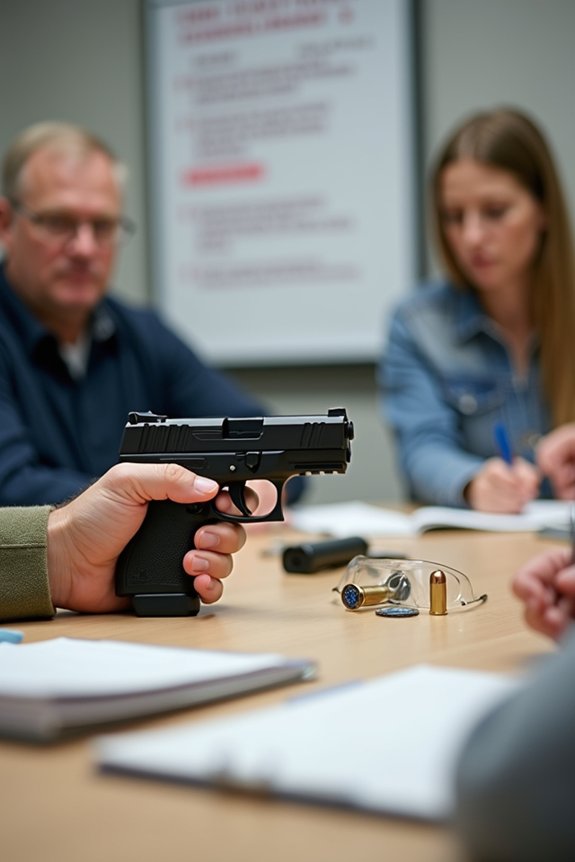
Before submitting your application for a concealed carry permit, you’ll need to prove your competence with firearms through approved safety training. Florida’s firearm safety training requirements mandate that you complete recognized courses such as hunter education, NRA training, or law enforcement-led classes.
Alternatively, certified instructors can provide qualified training that meets state standards. If you have relevant experience, participation in shooting competitions or military service can also satisfy these requirements.
Meeting the firearm safety training requirements is crucial; failure to do so renders you ineligible for a concealed carry license.
This prerequisite guarantees that all applicants demonstrate safe and responsible firearm handling, reinforcing public safety and legal compliance throughout the concealed carry process in Florida.
Renewal Process and License Duration
Although your Florida concealed carry license remains valid for seven years from the date it’s issued, you must stay vigilant about the renewal process to maintain your legal carrying rights.
Renewal forms arrive at least 90 days before expiration, giving you ample time to act. Failing to renew on time means you’ll need to reapply fully, including background checks.
Staying updated on legal changes is essential, especially given Florida concealed carry reciprocity agreements with other states.
Keep these points in mind:
- Renewal is mandatory every seven years.
- Forms are mailed 90 days prior to expiration.
- Late renewals require full reapplication.
- Eligibility must be maintained throughout.
- Monitor changes in reciprocity and state laws.
Following these steps guarantees uninterrupted lawful concealed carry in Florida.
Locations Where Concealed Carry Is Prohibited
You can’t carry a concealed weapon in certain public places like police stations, courthouses, schools, and polling locations.
These spots are off-limits to keep everyone safe. Now, judges do have some specific exceptions, but for most folks, it’s important to stick to these rules to avoid getting into legal trouble.
Prohibited Public Places
When carrying a concealed weapon in Florida, you must avoid specific public places where the law explicitly prohibits firearms.
Florida concealed weapon restrictions are clear about locations where carrying a concealed firearm is forbidden to guarantee public safety and compliance with legal standards.
You can’t carry concealed weapons in:
- Police, sheriff, or Highway Patrol stations, detention facilities, prisons, and jails
- Courthouses and courtrooms, except for certain judicial officers
- Polling places during elections and government body meetings
- School facilities, colleges, and university grounds
- Areas licensed for alcohol consumption
Violating these restrictions is a second-degree misdemeanor, so it’s essential to know and respect these prohibited public places to avoid legal consequences.
Exceptions and Enforcement
Since Florida law strictly defines specific locations where carrying a concealed weapon is prohibited, understanding these exceptions is essential for lawful concealed carry. Florida concealed carry restrictions ban firearms in sensitive areas to guarantee public safety and legal compliance. Violating these restrictions results in a second-degree misdemeanor.
| Prohibited Location | Reason for Restriction | Legal Consequence |
|---|---|---|
| Police stations, jails | Security in law enforcement areas | Second-degree misdemeanor |
| Polling places, government meetings | Safety during civic activities | Second-degree misdemeanor |
| Schools, colleges | Protect educational environments | Second-degree misdemeanor |
| Bars and establishments serving alcohol | Prevent alcohol-fueled incidents | Second-degree misdemeanor |
Always verify these restrictions before carrying concealed to avoid legal penalties.
Responsibilities of Concealed Carry License Holders
Although holding a concealed carry license grants you the legal right to carry a firearm, it also demands strict adherence to all local, state, and federal laws governing firearm possession.
You must be aware of the concealed carry age limit Florida enforces, ensuring you meet eligibility requirements.
Your responsibilities include complying fully with all firearm laws at every jurisdictional level. You should exercise diligent gun safety and secure firearms to prevent access by minors.
Always carry valid identification alongside your concealed carry license at all times. It’s important to stay updated on evolving firearm regulations to maintain lawful carry.
Accept personal accountability because law enforcement, such as the Jacksonville Sheriff’s Office, doesn’t assume responsibility for unlawful carrying decisions.
Fulfilling these duties protects you and upholds legal standards.
Legal Consequences of Unauthorized Carrying
If you carry a concealed weapon in places where you’re not allowed—like schools or courthouses—you could be charged with a second-degree misdemeanor.
Law enforcement takes these rules very seriously. So, if you break them, you might face fines or even get arrested.
It’s really important to know where you can and can’t carry to avoid running into serious legal trouble.
Misdemeanor Charges Explained
You frequently face serious legal consequences when carrying a concealed weapon without proper authorization in Florida. Violating Florida concealed weapon restrictions can lead to second-degree misdemeanor charges, which carry fines and potential jail time. Law enforcement rigorously enforces these rules to maintain public safety.
Key points to understand include:
- Carrying concealed without a valid license is illegal.
- Specific areas like courthouses, polling places, and school zones are prohibited.
- Violations are classified as second-degree misdemeanors.
- Penalties include fines and up to 60 days in jail.
- Immediate arrest can occur upon detection by authorities.
Understanding these restrictions guarantees you comply with the law and avoid misdemeanor charges related to unauthorized concealed carrying.
Prohibited Locations Enforcement
When carrying a concealed weapon in Florida, you must recognize that certain locations strictly prohibit it. These include courthouses, schools, police stations, detention facilities, polling places, and establishments licensed for alcohol consumption.
Violating Florida concealed weapon restrictions results in a second-degree misdemeanor. Law enforcement actively enforces these restrictions to maintain public safety and guarantee compliance with Florida firearm laws.
| Prohibited Location | Enforcement Action |
|---|---|
| Courthouses and Schools | Arrest and misdemeanor charges |
| Police Stations and Detention | Immediate law enforcement |
| Polling Places & Bars | Strict compliance checks |
Understanding these restrictions is crucial to avoid legal consequences. You must adhere to designated laws to prevent arrest and uphold lawful concealed carry in Florida.
Penalties for Violations
Violations of Florida’s concealed carry laws carry serious legal consequences that can affect your freedom and rights. Understanding the penalties for violations is essential to avoid harsh repercussions under Florida concealed weapon restrictions.
If you carry a concealed firearm in unauthorized places, such as police stations or schools, you risk facing a second-degree misdemeanor. Consequences include fines and potential jail time, revocation of your concealed weapon license, and additional charges if other laws are broken during the incident.
Law enforcement agencies actively enforce these rules, and violations can lead to a permanent criminal record impacting your future rights and privileges.
You must strictly comply with these restrictions to avoid severe legal trouble and protect your ability to carry concealed weapons lawfully in Florida.
Disclosure and Privacy of Concealed Carry Information
Although Florida law allows law enforcement agencies access to concealed carry license information for legitimate duties, it strictly protects your personal identifying details from public disclosure.
The Florida Department of Agriculture maintains an automated listing of license holders accessible only to law enforcement under confidentiality measures in concealed carry license protocols.
Your personal identifying information remains confidential and exempt from public records, safeguarding your privacy.
Disclosure of your concealed carry information requires your written consent or a court order, ensuring controlled access.
Law enforcement can verify your license status for lawful purposes while adhering to these confidentiality provisions.
These measures guarantee that your concealed carry information isn’t exposed to the public, maintaining your privacy and security throughout the process.
Understanding these protections helps you exercise your rights responsibly in Florida.
Differences Between Open Carry and Concealed Carry
Because Florida law generally prohibits open carry, you’ll find that concealed carry offers a distinct legal pathway to carrying firearms in public.
Under Florida public carry laws, open carry is mostly unlawful, while concealed carry permits allow you to carry discreetly, meeting set eligibility criteria.
Since July 1, 2023, permitless concealed carry lets qualified individuals carry without a permit, unlike open carry which demands special licensing.
Key differences include:
- Open carry is visible; concealed carry remains out of sight
- Concealed carry permits apply in sensitive locations; open carry is banned there
- Concealed carry requires adherence to strict storage and safety rules
- Public perception varies: open carry may attract attention, concealed carry is more discreet
- Permitless concealed carry expands your options, open carry remains heavily restricted
Understanding these nuances is essential for compliance with Florida public carry laws.
Resources for Florida Firearm Owners
Maneuvering Florida’s firearm laws requires access to accurate resources that help you stay informed and compliant. The Florida Department of Agriculture issues the Florida Department of Agriculture firearm license, essential for concealed carry across states requiring permits.
You must understand eligibility, renewal every seven years, and prohibited locations for carrying firearms. Utilize official resources from the Florida Department of Agriculture and local law enforcement to educate yourself on regulations.
| Resource | Purpose |
|---|---|
| Florida Department of Agriculture | Apply/renew firearm license |
| Local Law Enforcement | Clarify local firearm regulations |
| Official State Website | Access updated legal statutes |
| Concealed Carry Classes | Practical training and compliance |
These resources empower you to carry responsibly and legally in Florida.
Frequently Asked Question
Can Tourists Carry Concealed Weapons in Florida Without a Permit?
Yes, you can carry a concealed weapon in Florida without a permit if you’re at least 21 and not legally prohibited from possessing firearms.
The law that started July 1, 2023, allows both residents and tourists to carry concealed firearms permitlessly.
However, you must strictly follow Florida’s specific firearm laws, avoid restricted areas, carry valid ID, and understand how these rules differ from your home state to stay fully compliant during your visit.
Are There Any Restrictions on the Types of Firearms for Concealed Carry?
Think of Florida’s concealed carry rules like a carefully pruned garden. Only certain plants thrive. You can carry most firearms concealed, but machine guns are off-limits.
You must avoid prohibited weapons and make certain your firearm type complies with all laws.
Even with permitless carry, you still need to meet eligibility criteria.
How Does Florida Recognize Concealed Carry Permits From Other States?
Florida recognizes concealed carry permits from certain states that meet its criteria.
You must check the Florida Department of Agriculture’s official list to confirm if your state’s permit is accepted.
If it is, you’re allowed to carry concealed in Florida but must follow all Florida laws and restrictions just like a Florida permit holder.
Ignoring these rules can lead to legal trouble, so stay informed and compliant at all times.
Can Concealed Carry Licenses Be Revoked for Non-Criminal Behavior?
Yes, your concealed carry license can be revoked for non-criminal behavior in Florida.
If authorities find you’re a danger to yourself or others, or if you display unsafe firearm handling, they can take your license away.
You must also keep your information updated and follow all safety regulations.
Failure to comply or demonstrate responsibility can lead to revocation, even without a criminal conviction.
Stay vigilant about your conduct and legal obligations.
What Should I Do if Stopped by Law Enforcement While Carrying Concealed?
Stay calm, stay clear, and stay compliant. When stopped, immediately inform the officer you’re carrying a concealed firearm if asked or when appropriate. Present your valid ID and concealed carry permit if you have one.
Avoid sudden movements, follow all instructions carefully, and don’t argue or resist. Doing so helps build trust, prevents misunderstandings, and guarantees you respect the law, reducing the risk of legal complications or escalation.
Conclusion
Understanding Florida’s concealed carry laws is essential before you carry a weapon. While permitless carry gives you more freedom, meeting eligibility and training requirements guarantees you stay on the right side of the law.
Remember, ignorance isn’t a defense so don’t let your guard down. By knowing the rules and respecting legal boundaries, you’ll be well-prepared to carry responsibly and avoid serious consequences. Stay informed, stay safe, and don’t cut corners.