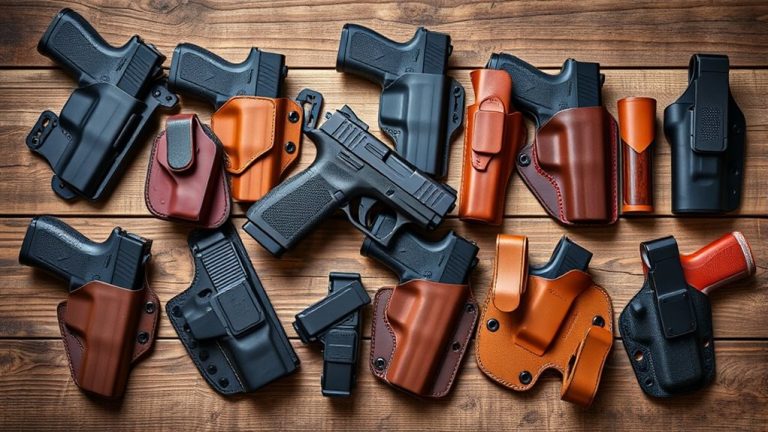
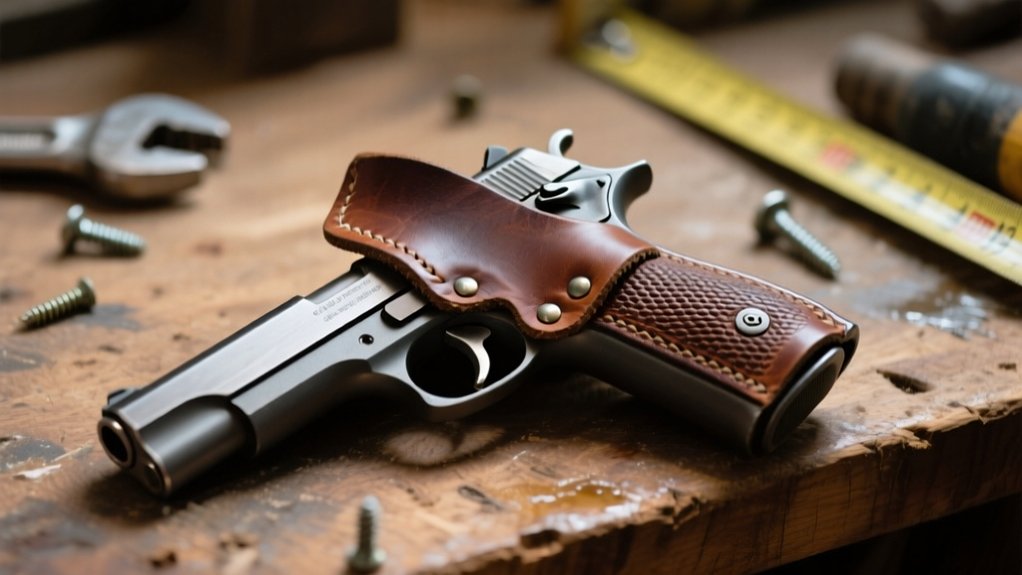
Does Holster Claw Mechanics Work?
Yes, holster claw mechanics work by applying counterpressure against a rigid gun belt to push the firearm grip inward. This greatly enhances concealment and reduces printing, especially in appendix carry positions.
The claw’s effectiveness depends on precise alignment with the holster clip and the quality of your gun belt. Soft belts undermine its function.
Made from durable polymers, claws also help distribute weight for comfort. Understanding these factors will clarify how holster claws improve your carry setup.
Understanding the Function of a Holster Claw
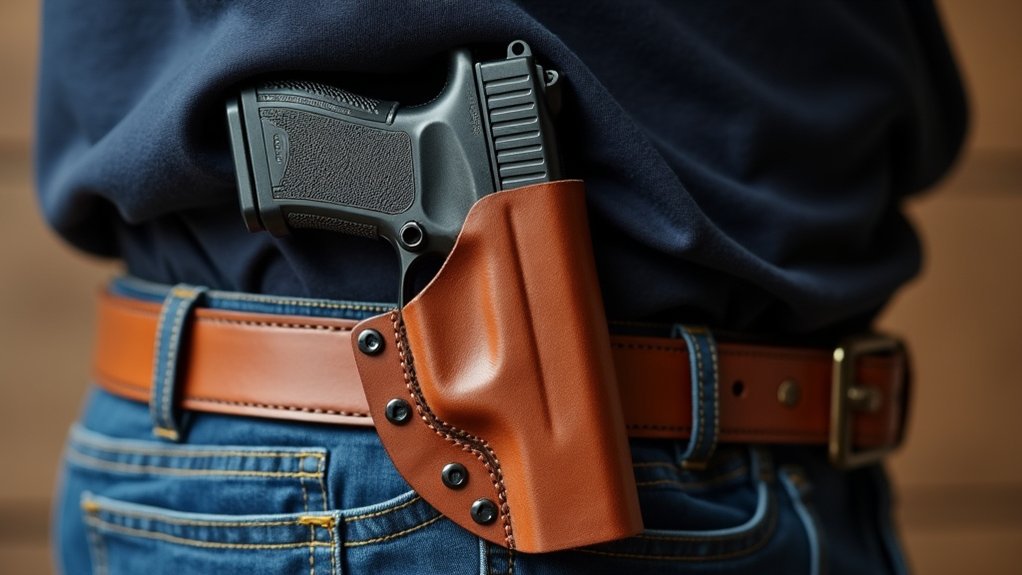
Although you mightn’t notice it at first, the holster claw plays a critical role in enhancing firearm concealment. The holster claw works by applying counterpressure through tension against a sturdy gun belt, pushing the firearm’s grip inward toward your body.
This inward angling considerably improves grip concealment, reducing the firearm’s profile and minimizing printing under clothing. For ideal concealment, precise alignment between the holster claw and belt clip is essential; misalignment diminishes the claw’s effectiveness.
Moreover, the quality of your gun belt directly impacts how well the holster claw works. Soft or loose belts fail to provide adequate counterpressure, compromising concealment.
Understanding this mechanism guarantees you maximize your holster’s concealment capabilities by properly integrating the holster claw into your carry setup. For best results, always ensure the adjustable claw is tailored to your body type and carry position, as this customization enhances both comfort and concealment.
Key Carry Positions Compatible With Holster Claws
When you choose a holster claw, you release improved concealment across multiple carry positions such as appendix carry (AIWB), 3-5 o’clock, and 7-9 o’clock.
Holster claws effectively angle the grip inward, greatly reducing printing, which is especially critical in AIWB where concealment is paramount.
You can adjust ride height and cant to optimize comfort and maximize the claw’s effectiveness for your specific carry style.
This adaptability guarantees holster claws perform well whether you position your firearm at the front, side, or back of your waist.
Keep in mind, holster claws improve concealment by pushing the grip closer to your body, but they require precise fitting and alignment.
Their modular design allows removal or replacement, giving you flexibility to tailor your carry setup as needed.
For best results, it’s important to select IWB holsters compatible with claw installation, as these models ensure proper mounting and optimal grip concealment.
The Role of the Gun Belt in Holster Claw Effectiveness
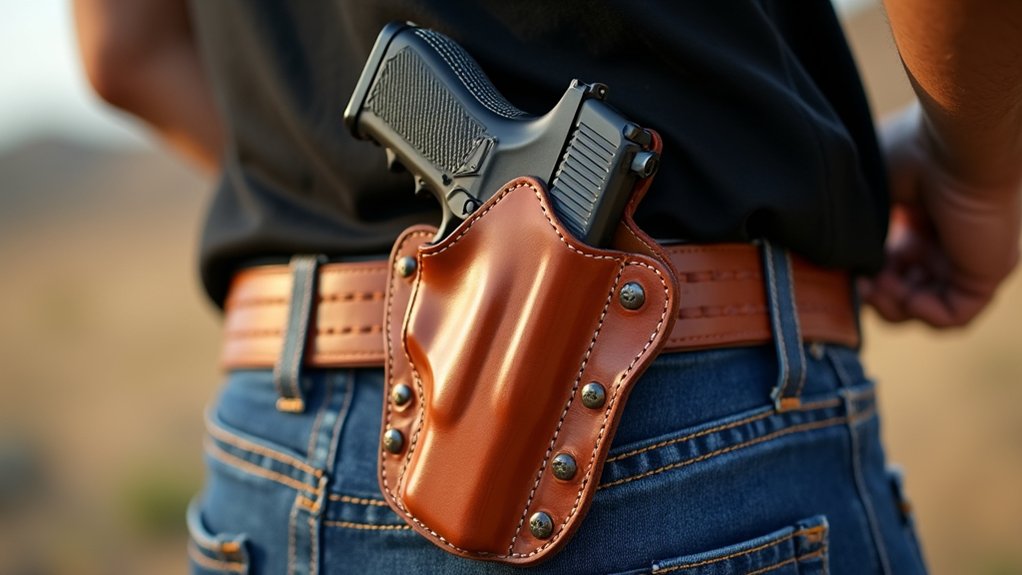
You need a gun belt that’s strong enough to support the holster claw’s counterpressure and keep the firearm snug against your body.
It really comes down to how rigid and durable the belt is. Softer or looser belts just don’t cut it—they can weaken the claw’s grip and make concealment a challenge.
Belt Strength Importance
A sturdy gun belt plays a critical role in maximizing the effectiveness of a holster claw by maintaining the necessary tension that pushes the firearm grip inward against your body.
The belt strength directly influences how well the holster claw can apply consistent pressure, which is essential for reducing printing and stabilizing the firearm.
Standard fashion belts typically lack the rigidity to support the weight and stress of concealed carry, causing the holster claw to underperform.
Gun belts designed specifically for concealed carry provide the durability and structural integrity needed to withstand these forces.
When you choose high-quality gun belts, you guarantee the holster claw functions effectively, maintaining proper grip positioning and improving your overall concealment and comfort during carry.
It’s important to pick a sturdy gun belt designed to handle holster weight, as this ensures both the holster and the claw remain stable and secure throughout daily activities.
Belt Compatibility Factors
Although the holster claw relies heavily on the gun belt’s strength, its compatibility with the belt’s dimensions and material is likewise critical for ideal performance. You need a gun belt around 1.5 inches wide to guarantee the holster claw’s clip secures firmly, providing the necessary counterpressure to push the firearm grip inward.
Standard fashion belts lack the rigidity required, compromising concealment and claw effectiveness. A quality gun belt must resist shifting under weight to maintain stability and optimize concealment.
| Factor | Requirement | Impact on Holster Claw |
|---|---|---|
| Width | ~1.5 inches | Secure clip attachment |
| Material Rigidity | High stiffness | Maintains counterpressure |
| Load Capacity | Supports firearm weight | Prevents shifting |
| Thickness | Moderate | Fits holster clips correctly |
| Flexibility | Low | Improves concealment and stability |
Material Strength and Durability of Holster Claws
You rely on holster claws made from advanced composite polymers because they offer consistent strength and durability, even with daily wear and tear.
Manufacturers typically use two-part resin blends, which really help improve the material’s integrity and make it more resistant to bending or breaking.
Knowing these material qualities is key. It ensures your holster keeps a secure grip and helps minimize printing when you’re carrying concealed.
Material Composition Quality
Holster claws rely on high-strength plastic polymers or composite materials engineered to endure the stresses of daily concealed carry without deforming or failing. Their material composition directly impacts durability and concealment effectiveness, as only robust materials maintain consistent tension against the belt.
Manufacturers employ advanced two-part resin composites to improve strength and resistance to wear.
When evaluating material composition quality, consider the polymer or composite type and its tensile strength, the manufacturing process including resin curing and molding precision, and resistance to environmental factors like moisture and temperature fluctuations.
These factors guarantee the claw’s integrity under regular use, preventing deformation that could compromise concealment.
High-quality material composition assures that the claw sustains reliable performance, maintaining the necessary tension to reduce printing and improve your concealed carry experience.
Durability Under Stress
Since concealed carry demands consistent reliability, the durability of holster claws under stress becomes paramount. You rely on holster claws crafted from advanced composite polymers and two-part resins, engineered to resist bending or breaking during normal use.
Manufacturers like Vedder Holsters rigorously test these claws through repeated draw and re-holster cycles, ensuring they maintain structural integrity. This durability directly impacts concealment, as a claw that retains its shape secures your firearm firmly, preventing shifts that compromise concealment and user confidence.
Material quality and design improvements have continuously enhanced holster claw performance, with warranties reflecting manufacturers’ commitment to strength.
When selecting holster claws, prioritize those proven to withstand operational stresses, as their durability underpins both secure carry and effective concealment.
Comfort Considerations When Using a Holster Claw
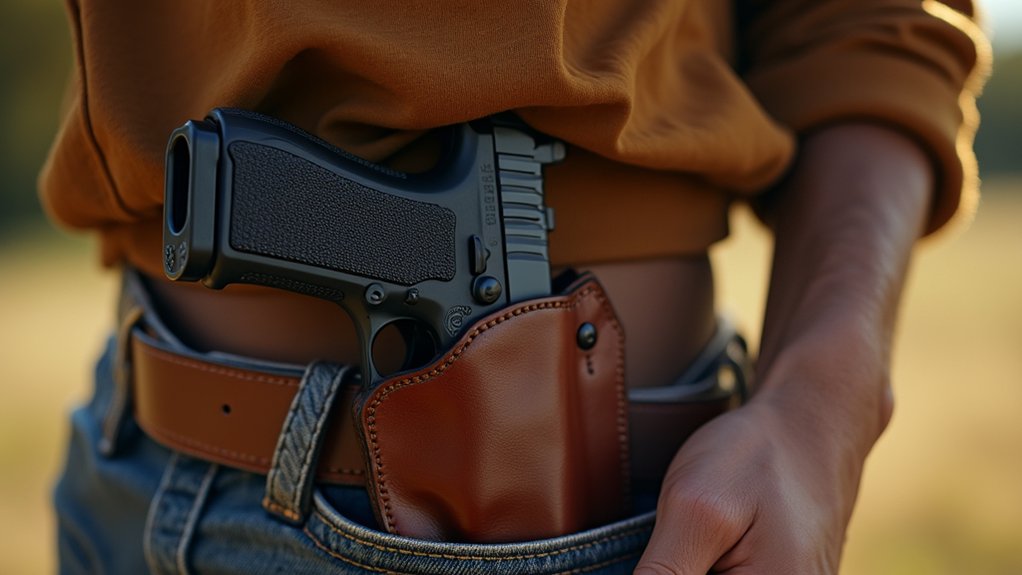
How does a holster claw impact your comfort during everyday carry? The holster claw plays an essential role in distributing the firearm’s weight.
A holster claw significantly improves comfort by effectively distributing the firearm’s weight during everyday carry.
Often, it enhances your comfort by balancing the load against your body. Its design pushes the grip closer to you, improving concealment benefits and potentially providing a more secure carry feel.
However, comfort considerations vary by individual factors like body shape and sensitivity. To optimize comfort, focus on adjusting ride height and cant for a tailored fit.
Also, monitor belt tightness to prevent pressure points. Finally, evaluate claw aggressiveness to avoid discomfort during movement.
Comparing Holsters With and Without Claws
Anyone considering everyday carry must weigh the benefits of a claw-equipped holster against those without one. Holster claws improve concealment by angling the firearm’s grip inward, markedly reducing printing, especially in appendix carry.
This inward pressure tucks larger handguns closer to your body, enhancing stability and consistent grip positioning. Conversely, holsters without claws often allow the grip to protrude more, increasing printing and visibility through clothing.
Though they can offer a sleeker design and potentially greater comfort in 3 or 5 o’clock positions. Your body type and carry style heavily influence which option suits you best.
Testing both holster types is essential to balance concealment, comfort, and retention effectively, ensuring your everyday carry setup aligns with your specific needs and priorities. Regularly evaluating carry positions and adjustments can further optimize your concealment and comfort, regardless of whether you use a claw-equipped holster.
Selecting the Right Holster Setup for Your Carry Needs
Choosing the right holster setup depends largely on your carry position and personal preferences. Holster claws excel in appendix carry, effectively pushing the grip inward to improve concealment.
To optimize comfort and concealment, focus on a setup that integrates a holster claw with a sturdy gun belt providing necessary rigidity.
Key considerations include:
- Selecting an inside-the-waistband (IWB) holster compatible with holster claws, as outside-the-waistband (OWB) options lack claw suitability.
- Choosing adjustable holster claws to customize angle and depth, accommodating your body type and ensuring comfort.
- Opting for an appropriately sized claw that tucks the grip without excessively increasing the holster’s footprint.
Frequently Asked Question
Can Holster Claws Damage My Firearm’s Finish?
Yes, holster claws can damage your firearm’s finish if they’re not properly fitted or maintained.
You need to guarantee the claw is made from durable, non-abrasive materials and mounted securely to minimize contact and friction.
Regularly inspect the claw and mounting for wear or misalignment, and keep both your firearm and holster clean.
Doing this prevents scratches and preserves your firearm’s finish effectively.
Are Holster Claws Compatible With All Firearm Sizes?
Holster claws aren’t universally compatible with all firearm sizes. They work best with mid-size to full-size handguns, enhancing concealment by pulling the grip closer to your body.
Smaller firearms may not align properly with the claw, which reduces their effectiveness.
You need to consider your firearm’s dimensions and the holster’s design to ensure proper claw integration.
This step is essential for both comfort and ideal concealment.
How Do Holster Claws Affect Quick Draw Speed?
Wondering how holster claws affect your quick draw speed? They can slow you down initially since you need to adjust your grip due to the inward angle and added belt tension.
However, the secure fit boosts control, and with consistent practice, you’ll improve your speed.
Do Holster Claws Require Special Maintenance?
Holster claws don’t require special maintenance beyond routine checks.
You should regularly inspect screws and mounting points for tightness and wear to guarantee consistent performance.
Keep the claw aligned with the belt clip for ideal concealment and quick access. If you notice looseness or misalignment, simply re-tighten with a Philips head screwdriver.
Clean off any dirt or debris to maintain functionality, and replace the claw immediately if you detect bending or damage.
Can Holster Claws Be Added to Existing Holsters?
Adding holster claws to existing holsters is like fitting a puzzle piece that wasn’t designed for the set. It’s tricky but possible.
Most holster claws are integrated into the holster’s design, so you’ll need a compatible model or custom modifications.
If your holster supports it, you’ll install the claw using screws under the trigger guard.
Be prepared for precise work. Without experience, it might challenge your skills.
Conclusion
If you’re aiming for a stable, secure carry, much like a knight trusts his shield, you’ll find that a holster claw truly improves retention by minimizing printing and movement. Its effectiveness hinges on proper positioning, a sturdy gun belt, and durable materials.
While comfort varies, the claw’s mechanical advantage often outweighs minor trade-offs. Ultimately, choosing the right holster setup guarantees your draw is as reliable and precise as a well-oiled machine.