How Does a Paddle Holster Work?
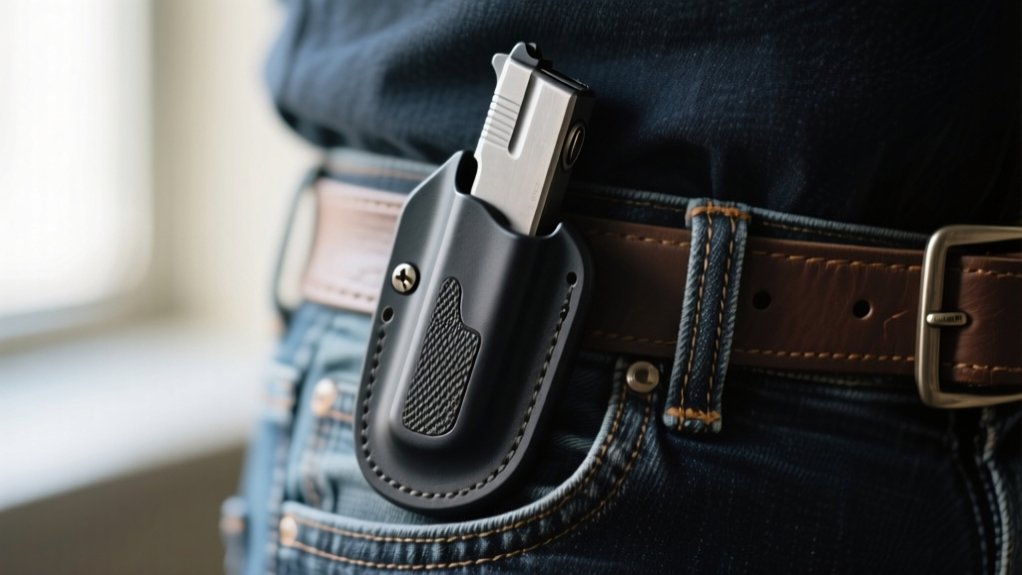
You use a paddle holster by sliding its molded paddle inside your waistband, where it grips your hip securely without needing a belt buckle. This design holds your firearm outside the waistband for quick, smooth access while distributing weight evenly to improve comfort.
You can adjust the cant and ride height to fit your body and preferences. With these features, paddle holsters offer convenience and stability, especially for active use.
Keep exploring to understand installation, benefits, and concealment tips.
Understanding the Design of a Paddle Holster
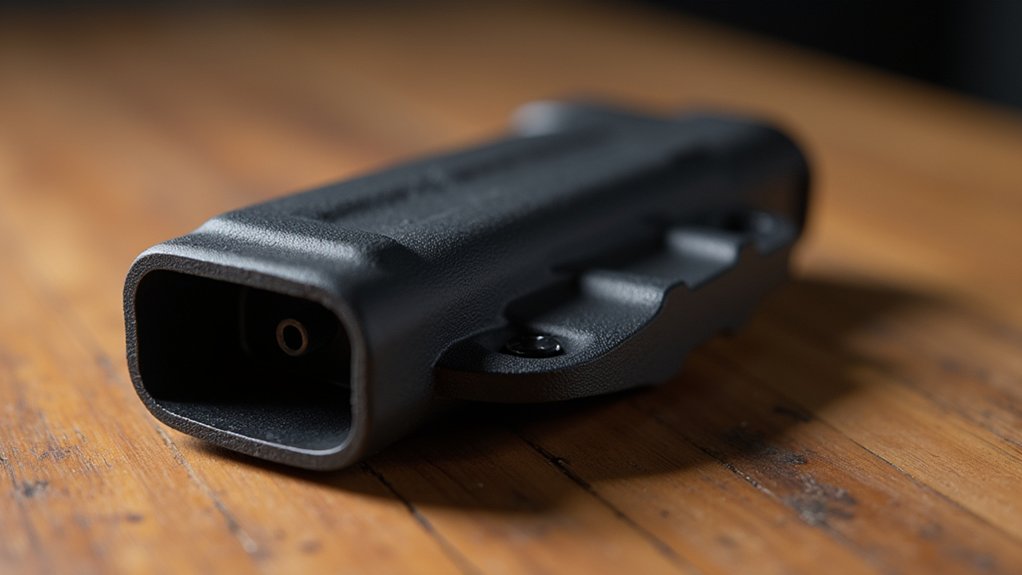
The core of a paddle holster’s design lies in its molded polymer paddle, which fits securely against your hip while the holster body holds your firearm outside the waistband.
A molded polymer paddle secures the holster firmly to your hip, positioning your firearm outside the waistband.
This paddle design features a curved shape that slides smoothly inside the waistband, distributing weight evenly to minimize movement.
Its attachment system allows you to quickly secure or remove the holster without unbuckling your belt, boosting convenience during use.
You can adjust the cant, the angle at which your firearm sits, to optimize drawing speed and comfort.
Moreover, many paddle holsters offer adjustable ride height for a personalized fit.
Positioned outside the waistband, this setup guarantees your firearm remains accessible yet stable throughout daily activities, combining practicality with reliable retention.
Key Components and Their Functions
You’ll first notice the paddle attachment, which is molded to fit your hip and keep the holster secure inside your waistband.
It’s designed to distribute weight evenly, so you get stability and comfort while you move around.
Then, there are the holster retention mechanisms.
These make sure your firearm stays firmly in place, striking a good balance between quick access and reliable security.
Paddle Attachment Design
Although paddle holsters come in various designs, their attachment relies on a molded polymer paddle shaped to fit your hip’s contours, ensuring both stability and comfort.
This paddle attachment is essential for a holster that uses a secure yet easily removable system. Here’s how it works:
- The paddle slips inside your waistband, using a small hook to press against your lower garments, anchoring the holster firmly and preventing unwanted movement.
- It distributes the weight of the firearm evenly across your hip, which reduces pressure points and improves comfort during extended wear.
- Many paddles offer adjustable cant and ride height, allowing you to customize the angle and position of the holster for best accessibility and personal preference.
Proper holster positioning is crucial for both stability and comfort, ensuring the paddle holster remains secure during movement and daily activity.
Understanding these design elements helps you maximize both security and comfort.
Holster Retention Mechanisms
Once the paddle secures the holster firmly to your waistband, retention mechanisms take over to keep your firearm safely in place.
Paddle holsters typically rely on friction retention, where the holster’s precise fit around your gun creates enough resistance to hold it securely.
Many models include adjustable retention, letting you customize tightness for maximum security and smooth draws.
Quality paddle holsters often feature retention features such as thumb releases or locking mechanisms that require deliberate action to disengage, enhancing safety.
The paddle itself stabilizes the holster by sliding inside your waistband, preventing unwanted movement.
Reinforced paddle clips and retention-enhancing geometry further guarantee your firearm stays secure while allowing quick, confident access when needed.
Understanding these key retention components helps you choose and use your paddle holster effectively.
Installation and Attachment Process
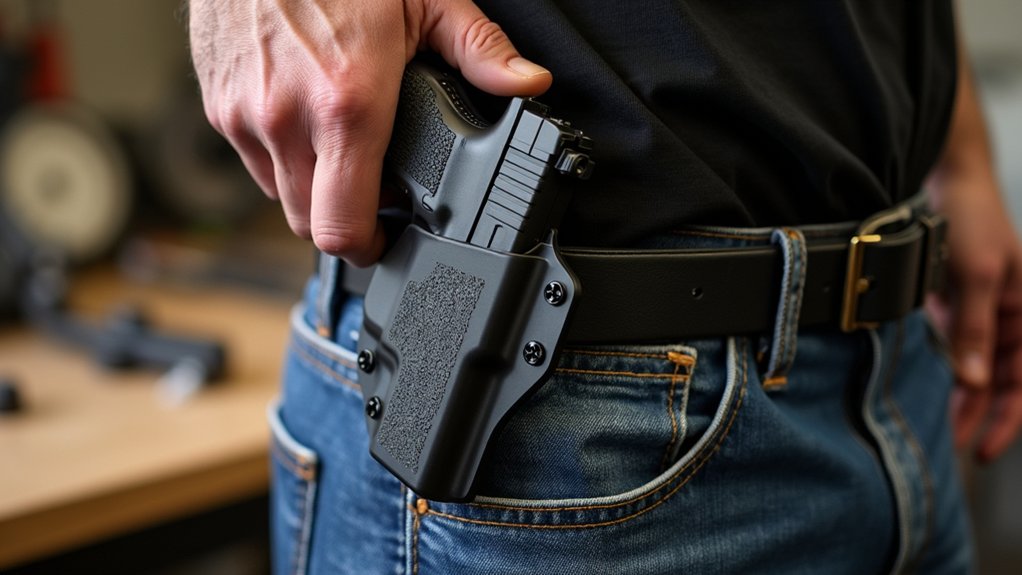
When installing a paddle holster, securing it properly assures both comfort and reliability during use.
Begin by aligning the holster with the paddle attachments, confirming the three-hole pattern matches perfectly.
Use a screwdriver and hex key during installation to fasten the holster securely to the paddle.
Before tightening screws fully, set the adjustable cant to your preferred angle to enhance draw speed and comfort.
Finally, verify the secure attachment by testing the paddle’s hook; it should anchor firmly inside your waistband without excessive movement.
Follow these steps precisely:
- Align holster with paddle attachments and insert screws.
- Adjust cant for ideal angle.
- Tighten screws to confirm a secure attachment and stable fit.
This method assures your paddle holster stays dependably in place throughout use.
Adjusting Cant and Ride Height for Comfort
You’ll want to set the cant of your paddle holster somewhere between 0° and 15°. This range helps you find the angle that feels most comfortable and gives you the best access to your firearm.
Next, adjust the ride height to position the gun higher or lower on your waist. This is all about finding the sweet spot between keeping it well concealed and being able to draw quickly when you need to.
Don’t be afraid to experiment with these settings a bit. Keep tweaking until the holster feels stable when you move around and matches your body shape just right.
Optimal Cant Settings
How should you set the cant and ride height of your paddle holster to maximize comfort and accessibility? The ideal cant setting is essential for natural firearm access and overall comfort. Here’s how to fine-tune it:
- Adjust the cant angle up to 15° forward or backward to reduce wrist strain and guarantee a smooth draw.
- Set the ride height so the holster sits securely without hindering quick access, balancing concealment and ease of draw.
- Test different cant and ride height combinations while moving to confirm the holster remains stable and your draw remains efficient.
Ride Height Adjustment
Since comfort and accessibility hinge on proper positioning, adjusting the ride height of your paddle holster is essential.
Most paddle holsters come with adjustable ride height, letting you raise or lower the holster on your hip for ideal comfort and quick access.
Use the built-in adjustment mechanism, usually requiring a screwdriver or hex key, to set the ride height that suits your body type and draw style.
In addition to ride height, fine-tune the cant, or angle, to personalize your draw further.
Proper adjustments improve stability and retention, ensuring the holster stays secure during movement.
Similarly significant, correct ride height and cant reduce printing, enhancing concealment under various clothing styles.
Regularly assess and adjust these settings to maintain comfort, accessibility, and discreet carry.
Benefits of Using a Paddle Holster
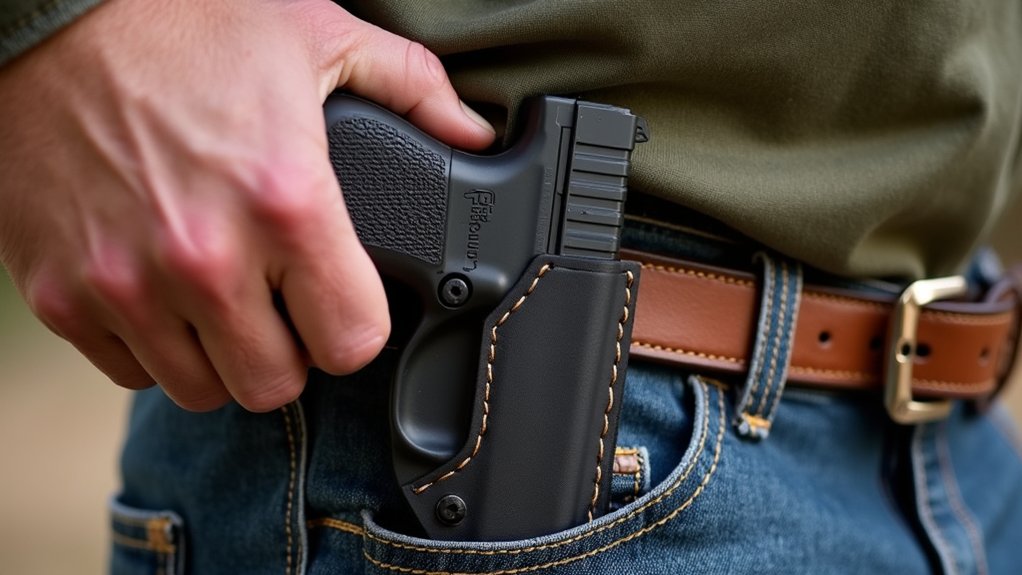
Although many holster types offer secure carry, paddle holsters stand out by combining quick on-and-off access with superior comfort and stability.
If you’re looking for a concealed carry holster that adapts to everyday carry needs, a paddle holster delivers unmatched versatility.
Here are three key benefits you’ll appreciate:
- Effortless Removal: The paddle design lets you remove the holster without unbuckling your belt, perfect for temporary carry or changing environments.
- Enhanced Comfort: It contours to your hip, evenly distributing weight and minimizing movement during daily activities.
- Customizable Fit: Adjustable cant and ride height allow you to tailor your carry position for maximum usability.
It’s important to pair your paddle holster with a sturdy gun belt to ensure optimal support and prevent sagging during everyday use.
Using paddle holsters guarantees secure retention while maintaining fast access, making them ideal for a variety of carry scenarios.
Situations Ideal for Paddle Holster Use
When do you need quick access to your firearm without the hassle of removing your belt? The Paddle Holster Right is perfect for situations like firearm training or competitions, where you want the flexibility to easily put on or remove your holster.
Need fast firearm access without removing your belt? The Paddle Holster Right offers effortless on-and-off convenience.
It’s ideal for open carry on private property or rural areas, providing fast access without deep concealment. If you carry part-time or shift between environments with different rules, paddle holsters let you adapt quickly.
Unlike inside your waistband options, paddle holsters allow swift gear swaps during training or when entering restricted buildings. They also work well for casual wear under loose clothing, offering comfort and accessibility.
In all these scenarios, a paddle holster guarantees you maintain quick access while balancing convenience and readiness.
Concealment Considerations With Paddle Holsters
While paddle holsters offer quick access and ease of use, they present specific challenges for concealment that you need to address.
Because paddle holsters sit outside the waistband, they increase the risk of printing, especially with tight clothing.
To optimize concealment, consider these key points:
- Clothing choices: Opt for baggy or layered clothing to effectively mask the paddle holster’s bulk and reduce visible outlines.
- Adjust cant and ride height: Use the adjustable features on your paddle holster to position the firearm closer to your body and minimize exposure.
- Body type awareness: If you have a larger midsection, be aware that printing may be more pronounced, requiring more strategic clothing and positioning.
Choosing a Quality Paddle Holster
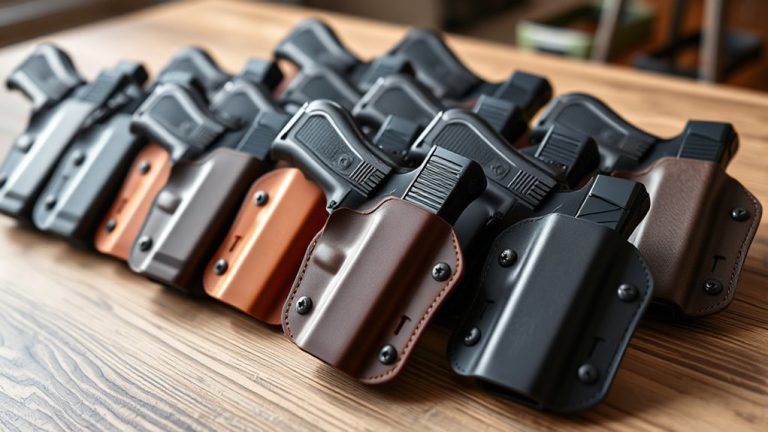
Choosing a quality paddle holster starts with focusing on durable materials like Kydex, which offers lightweight, heat-molded precision tailored to your specific firearm. Look for an adjustable cant and paddle mount with reinforced construction to guarantee stability and comfort.
Verify retention geometry to prevent dislodging during movement. Always review user reviews and warranty options to confirm reliability and brand confidence.
| Feature | Importance | What to Look For |
|---|---|---|
| Material | Durability & fit | Heat-molded Kydex holster |
| Adjustable Cant | Custom comfort & draw angle | Easily adjustable settings |
| Paddle Mount | Stability & retention | Reinforced, secure attachment |
| User Reviews | Reliability & performance | Positive feedback and warranty |
Prioritize these aspects to select a paddle holster that balances functionality, comfort, and safety.
Frequently Asked Question
Can Paddle Holsters Be Used With All Firearm Types?
No, paddle holsters can’t be used with all firearm types. You need to take into account holster materials and retention features tailored to your firearm’s size for proper security.
Different firearm sizes require specific molding, so choose a holster designed for your model.
User preferences also matter. Some prefer leather for comfort, others Kydex for durability.
Always verify compatibility to confirm safe, reliable carry and peak performance.
How Durable Are Paddle Holsters in Extreme Weather Conditions?
In terms of durability, keep in mind that “a stitch in time saves nine.”
You’ll find paddle holsters excel in weather resistance thanks to high material quality like Kydex, which withstands temperature extremes without warping or cracking.
They handle moisture impact far better than leather, resisting rust and corrosion.
To keep yours reliable, clean and maintain it regularly, especially after exposure to rain or freezing conditions.
This proactive care guarantees long-lasting performance.
Are Paddle Holsters Compatible With Body Armor?
Yes, paddle holsters offer versatility and can be compatible with body armor, but you’ll need to take into account body armor fit carefully.
Adjust the paddle holster’s ride height and cant to maintain ideal firearm accessibility while wearing your tactical gear.
Since compatibility varies with armor design and your body type, test your setup thoroughly before relying on it in the field.
Proper adjustments guarantee seamless integration of your paddle holster with body armor.
Can Paddle Holsters Cause Discomfort During Prolonged Wear?
Wearing a paddle holster is like carrying a sturdy backpack on one side. It can rub and press, causing discomfort during prolonged wear.
You might face side effects such as skin irritation or pressure points, especially without proper adjustment.
To improve paddle holster comfort, focus on adjusting the paddle fit and tweaking cant and ride height to match your body shape.
These tweaks can reduce issues from prolonged wear and make your carry experience much smoother.
Do Paddle Holsters Affect Firearm Accuracy When Drawing Quickly?
Yes, paddle holsters can affect your firearm accuracy when drawing quickly. Proper holster retention and positioning support a smooth drawing technique, which directly improves accuracy.
You’ll want to focus on speed training to develop muscle memory, ensuring your draw stays consistent and fluid.
Keep in mind, an ill-fitted holster can hinder your draw, so adjust the cant and retention to optimize both speed and accuracy during rapid deployment.
Conclusion
Using a paddle holster is like fitting a tailored glove to your side. It’s secure, quick, and comfortable. By understanding its design and fine-tuning the cant and ride height, you’ll carry with confidence and ease.
Whether for daily use or specific situations, this holster offers reliable accessibility without sacrificing comfort. Invest in quality, adjust precisely, and you’ll have a seamless extension of your gear, ready whenever you need it most.