What Science Does a Rifle Scope Rely On to Work?
Rifle scopes rely on key principles of optics and engineering to enhance your shooting accuracy.
These rifle scopes use glass lenses to magnify images and improve visibility by collecting light.
Various components, like the objective lens and erecting tube assembly, help focus and orient the image correctly.
Plus, adjustments for windage and elevation allow you to fine-tune your aim.
Interested in how these features affect performance in different conditions? There’s plenty more to explore!
Key Takeaways
- Rifle scopes utilize optics science, employing glass lenses to magnify and clarify distant images for improved shooting accuracy.
- The arrangement and coatings of internal lenses enhance light transmission, reduce glare, and optimize image quality in various lighting conditions.
- The erecting tube assembly flips and focuses the image while maintaining reticle alignment, crucial for accurate shot placement.
- Windage and elevation adjustments are based on geometry and physics, compensating for bullet drift and drop over distance.
- Parallax adjustments minimize reticle shift with eye movement, ensuring a steady aim and precise targeting at various distances.
Understanding the Basics of Rifle Scopes
Rifle scopes are essential tools for serious shooters, enhancing your ability to hit distant targets with precision.
At the heart of a scope are its glass lenses, which work together to provide magnification and a clear image of your target.
The objective lens diameter plays a significant role in light collection, guaranteeing you see your target clearly, even in low light.
The ocular lens then magnifies this image for your viewing.
You’ll also rely on the reticle, your aiming reference, to help you line up your shot.
Different reticle styles can aid in range estimation.
Finally, the parallax adjustment knob is critical, correcting for any reticle movement when your head position shifts, which ensures your accuracy remains sharp.
Key Components of a Rifle Scope
When you’re using a rifle scope, understanding its key components can really enhance your shooting experience.
The lens configuration affects image quality, while the magnification adjustment mechanism lets you tailor your view.
Plus, the reticle design serves as your aiming reference, essential for precision shooting.
Lens Configuration and Function
Understanding the lens configuration of a rifle scope is vital for anyone looking to enhance their shooting accuracy.
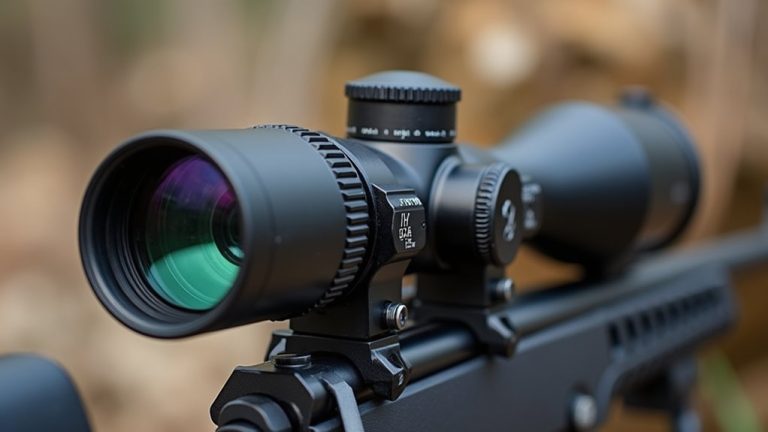
A rifle scope features multiple lenses, including the objective lens, which is at the front and gathers light to form the initial image.
The image is then flipped and magnified by the erector lens system before reaching the ocular lens, which is closest to your eye.
This ocular lens further magnifies the image, allowing you to aim precisely through the reticle.
Proper alignment and configuration of these lenses are significant, as is the reticle placement at the focal point.
This guarantees that you achieve accurate targeting and peak performance in various shooting scenarios.
Magnification Adjustment Mechanism
Magnification adjustment is a key feature that enhances the versatility of a rifle scope, allowing you to tailor your view based on shooting conditions.
The magnification adjustment mechanism typically includes a power ring that lets you switch between fixed and variable magnification levels, like 3x to 9x.
In variable power scopes, the Erector Tube Assembly plays an essential role by adjusting the position of internal optics to magnify the image as you rotate the power ring.
Higher magnification settings bring the target closer, while lower settings widen your field of view.
The quality of internal optics, including lens coatings and alignment, affects the clarity and brightness of the image you see through the ocular lens, ensuring peak performance and accuracy.
Reticle Design and Purpose
A rifle scope’s reticle, often referred to as the crosshair, is a crucial component that provides you with a precise aiming point, essential for accurate shot placement at various distances.
Reticles come in different designs, such as Duplex for quick target acquisition and Mil-Dot for range estimation and windage adjustments.
The reticle’s placement at the focal point guarantees alignment with your target when magnified.
Advanced options like Bullet Drop Compensation (BDC) reticles include markings that help you account for bullet drop and wind drift, facilitating swift adjustments.
Additionally, reticle illumination enhances visibility in low-light conditions, with an adjustable brightness knob letting you customize the reticle’s visibility for peak performance during your precision rifle shooting.
The Role of Optical Lenses in Magnification
When you’re looking through a rifle scope, the optical lenses play an essential role in magnifying your target.
The objective lens gathers light and creates a clear image, while the internal lens arrangement fine-tunes that image before it reaches your eye through the ocular lens.
Understanding how each lens functions can greatly enhance your shooting accuracy and overall experience.
Objective Lens Functionality
The objective lens plays a pivotal role in the functionality of a rifle scope, acting as the initial point of light collection from your target.
These objective lenses are vital for several reasons:
- Gather Light: A larger diameter gathers more light, enhancing image brightness and clarity, especially in low-light conditions.
- Focal Point: The focal point created by the objective lens is essential for aligning your reticle, ensuring accurate aiming at your target.
- Image Quality & Field of View: High-quality coatings improve light transmission, reducing glare and enhancing image sharpness, while a wider field of view helps track moving targets or scan your environment more effectively.
In essence, the objective lens is foundational for achieving precise shooting and ideal visibility.
Internal Lens Arrangement
Understanding the internal lens arrangement of a rifle scope is vital for grasping how magnification works.
A rifle scope uses a combination of internal lenses—the objective lens, erector lens, and ocular lens—to magnify the image and enhance clarity for the shooter.
| Lens Type | Function |
|---|---|
| Objective Lens | Gathers light and focuses the image |
| Erector Lens | Flips the image for proper orientation |
| Ocular Lens | Further magnifies the focused image |
| Internal Lenses | Impact overall optical performance |
| Magnification | Adjusted via the power ring for zoom |
This arrangement is significant because it directly influences brightness, clarity, and field of view, allowing you to see your target in detail.
Ocular Lens Importance
Ocular lenses play a pivotal role in the magnification process of a rifle scope, taking the image produced by the objective lens and making it visible to the shooter.
They effectively magnify the image, ensuring clarity for distant targets.
Here are three key aspects of ocular lenses:
- Optical Performance: High-quality ocular lenses enhance image clarity and sharpness, vital for accurate shooting.
- Diopter Adjustment: This feature allows you to customize focus for your eyesight, ensuring a precise view of the reticle and target.
- Eye Relief: Proper alignment with your eye is essential for comfort and safety, preventing issues like scope bite during recoil.
Understanding these elements helps you appreciate the importance of the ocular lens in your rifle scope.
How Light Travels Through a Rifle Scope
As light enters a rifle scope through the objective lens, which is the largest lens at the front, it begins its journey toward focusing the image.
The light then travels through a series of internal lenses, including the erector lens, which refracts and inverts it for clarity.
Positioned at the focal point, the reticle provides an aiming reference that overlays the focused image of your target.
After passing through these lenses, the ocular lens magnifies the final image, making it visible for you to see.
Ensuring proper alignment and zeroing is essential, as it helps the reticle correspond accurately to the point of impact on your target, minimizing parallax errors and enhancing your shooting accuracy.
The Function of the Erector Tube Assembly
The Erector Tube Assembly is an essential component of a rifle scope that guarantees you see a correctly oriented view of your target.
This assembly plays a vital role in several ways:
- Image Orientation: It flips the inverted image created by the objective lens, providing a true view of your target.
- Magnification Control: The assembly contains lenses that allow you to adjust magnification levels, like shifting from 3x to 9x, while maintaining clarity.
- Focal Plane Maintenance: As you adjust magnification, the Erector Tube Assembly moves within the scope, ensuring the reticle remains aligned with the point of impact, preventing optical distortion.
High-quality assemblies enhance image clarity, contributing to better shooting accuracy and overall performance.
The Importance of Reticles in Aiming
While many components contribute to a rifle scope’s performance, the reticle stands out as the primary aiming reference that helps you align your shot with precision.
It’s essential for precise aiming, enabling you to accurately gauge your point of aim against the target. Different reticle designs, such as duplex, mil-dot, and bullet drop compensators (BDC), offer functionalities for range estimation and compensation for bullet trajectory.
The placement of the reticle within the focal plane affects its appearance at various magnifications, influencing your ability to make adjustments.
Additionally, illuminated reticles enhance visibility in low-light conditions, greatly improving target acquisition. Understanding the reticle’s markings and their relation to bullet drop is vital for effective shooting, especially at varying distances.
Adjusting for Windage and Elevation
When you’re out shooting, understanding windage adjustments can make all the difference in your accuracy.
You’ll also want to master elevation compensation techniques to counteract the bullet’s drop over distance.
Plus, considering parallax is essential for ensuring your reticle remains aligned with your target at various ranges.
Understanding Windage Adjustments
Understanding windage adjustments is vital for accurate shooting, especially in windy conditions.
These adjustments help you compensate for the horizontal drift of a bullet, ensuring your shot aligns with the point of impact.
Here are three key aspects to keep in mind:
- Measurement: Windage is usually measured in Minutes of Angle (MOA), where each click of the turret typically adjusts by 1/4 MOA at 100 yards.
- Wind Effects: Understanding wind speed and direction is critical, as even slight changes can greatly affect bullet trajectory, particularly in long-range shooting.
- Zeroing: To effectively zero your scope, adjust the windage until the reticle aligns with the point of impact, ensuring precision in your shots.
Elevation Compensation Techniques
Effective elevation compensation techniques are fundamental for accurate shooting, especially as distances increase.
You’ll need to adjust your scope’s reticle to account for bullet drop, which varies with the shooter’s distance. Each click of your elevation turret typically corresponds to a specific distance adjustment, often 1/4 MOA at 100 yards, making click value measurements critical for precision.
Don’t forget about windage adjustments; they counteract lateral bullet drift caused by wind, and they use similar measurements. To guarantee accuracy, proper zeroing of the scope is essential, aligning your reticle with the rifle’s point of impact at a known distance.
Always consider factors like bullet weight and environmental conditions when making these elevation and windage adjustments.
Parallax Considerations Explained
Although parallax might seem like a minor detail, it can considerably impact your accuracy if not properly addressed.
Parallax refers to the apparent shift of the reticle against the target when your shooter’s eye moves.
Here’s what you need to know:
- Adjust your scope: Use the parallax adjustment knob to align the reticle with your target distance, reducing parallax error.
- Keep your eye steady: Maintain a consistent eye position to guarantee that the reticle stays on target.
- Make windage and elevation adjustments: Align the reticle with the bullet’s point of impact, typically measured in MOA or MIL, for precision.
The Impact of Parallax on Accuracy
Parallax can greatly affect your shooting accuracy, especially when your eye position shifts while aiming.
This phenomenon, known as parallax error, causes the reticle to appear misaligned against your target, leading to decreased accuracy.
High-quality rifle scopes are designed to minimize this error at specific distances, typically around 100 yards, ensuring the reticle remains aligned with your target.
For long-range precision shooting, correctly adjusting for parallax is vital; even slight misalignments can result in significant deviations in bullet impact.
Some advanced scopes come with parallax adjustment knobs, allowing you to fine-tune the settings to match the distance to your target, effectively reducing parallax effects and improving your overall shooting performance.
Enhancing Visibility in Low Light Conditions
When you’re out in the field during twilight hours, having a rifle scope that enhances visibility can make all the difference.
To guarantee you’re equipped for low light conditions, consider these key features:
Ensure you’re prepared for low light conditions by focusing on essential features for your rifle scope.
- Objective Lenses: Larger objective lenses, like 50mm, greatly boost light-gathering capability, providing brighter images compared to smaller options.
- Illuminated Reticles: These give you a clear aiming point, helping maintain accuracy when visibility is low.
- Anti-Reflective Coatings: High-quality coatings maximize light transmission and reduce glare, enhancing clarity.
Additionally, advanced optical designs, such as aspherical lenses, minimize distortion, guaranteeing you see the best possible image even in dim surroundings.
With these features, you’ll be ready to take your shot when it counts.
Waterproofing and Durability Features
While you’re maneuvering through challenging terrains, having a rifle scope that’s both waterproof and durable is essential for ensuring reliable performance.
Many high-quality scopes feature O-ring seals that block moisture and dust, keeping the internal components safe. Additionally, gas filling with nitrogen or argon prevents fogging, ensuring clarity even in humid conditions.
The construction materials used in premium scopes are designed for durability, allowing them to withstand harsh impacts and rough handling while maintaining optical integrity.
Many of these scopes undergo rigorous testing to meet waterproof standards, often rated to endure submersion at several feet without losing functionality.
Finally, their robust design typically includes shock resistance, enabling them to handle the recoil of powerful firearms without misalignment or damage.
Choosing the Right Rifle Scope for Your Needs
Choosing the right rifle scope involves understanding your specific needs and preferences. Here are three key factors to take into account:
1. Magnification Type: Decide between fixed power for consistency or variable power for versatility, depending on your shooting distance.
2. Objective Lens: Choose a larger diameter for better light gathering, especially in low-light conditions.
However, keep in mind the added weight.
3. Eye Relief and Reticle Styles: Look for longer eye relief to avoid scope bite.
Select reticle styles like Duplex or Mil-Dot based on your shooting goals.
Lastly, verify your scope is waterproof and fog-proof.
This feature is vital for maintaining clarity in various weather conditions, making sure you’re always ready for that perfect shot.
Frequently Asked Questions
How Do Rifle Scopes Work?
Rifle scopes work by using a series of lenses that magnify your target.
Light enters through the objective lens, and internal lenses adjust the image for clarity.
The reticle helps you aim accurately, while the ocular lens further magnifies what you see.
You can adjust windage and elevation using turret mechanisms to zero in on your shot.
Just remember, proper alignment with your eye is essential to avoid parallax errors.
How Do Optics Relate to Physics?
Think of optics as the magic lens that turns a blurry world into a vivid masterpiece.
Optics relates to physics because it’s all about how light behaves. You’re dealing with refraction, reflection, and the way lenses bend light to focus images.
When you grasp these principles, you reveal the secrets to seeing clearly, whether through a rifle scope or your own eyes.
It’s the science that helps you understand and manipulate your visual experience.
Why Do Scopes Lose Their Zero?
Scopes lose their zero mainly due to physical impacts, temperature changes, and recoil.
If you drop or bump your rifle, the internal components can misalign.
Extreme temperatures can cause materials to expand or contract, affecting accuracy.
Powerful ammunition’s recoil might shift the scope’s settings.
Plus, improper mounting or loose rings can lead to instability.
To maintain precision, you should regularly check and re-zero your scope after any significant movement or environmental shifts.
How Does Rifle Scope Magnification Work?
Rifle scope magnification works by using a series of lenses that gather light and enlarge the image of your target.
The objective lens captures light and forms an image, which is then magnified through the Erector Tube Assembly before reaching your eye via the ocular lens.
This process allows you to see details at greater distances.
The magnification power, like 3x or 9x, indicates how much larger the target appears compared to what you see unaided.
Conclusion
To sum up, understanding the science behind rifle scopes can greatly enhance your shooting experience.
Remember, “you get what you pay for.” Investing in quality optics not only improves accuracy but also boosts confidence in the field.
Whether you’re hunting or target shooting, the right scope can make all the difference.
So, take your time to choose wisely, and you’ll see how the right equipment elevates your skills and enjoyment in every shot you take.
A quality rifle scope can truly transform your shooting experience.