9 Simple Steps to Adjust Your Rifle Scope for Perfect Accuracy
To adjust your rifle scope for perfect accuracy, start by guaranteeing it’s securely mounted.
Stabilize your shooting platform for minimal movement.
Check eye relief for a clear view, then align your crosshairs using bore sighting.
Make elevation adjustments for vertical corrections and windage adjustments for horizontal shifts.
Fine-tune magnification and parallax settings for clarity.
After these adjustments, confirm your zero at long range to guarantee precision.
There’s more to perfecting your setup that you won’t want to miss!
Key Takeaways
- Securely mount your rifle scope to maintain zero and ensure accurate shooting performance.
- Adjust the ocular lens for a sharp reticle view and set parallax to infinity for long-range accuracy.
- Use the elevation and windage turrets to align your point of aim with point of impact.
- Fire three-shot groups to assess accuracy, adjusting turrets based on grouping patterns.
- Regularly confirm zero and make adjustments for environmental factors like wind and humidity.
Understanding Your Rifle Scope
A rifle scope is your key to precision when shooting at long distances. Understanding how it works is vital for achieving accuracy.
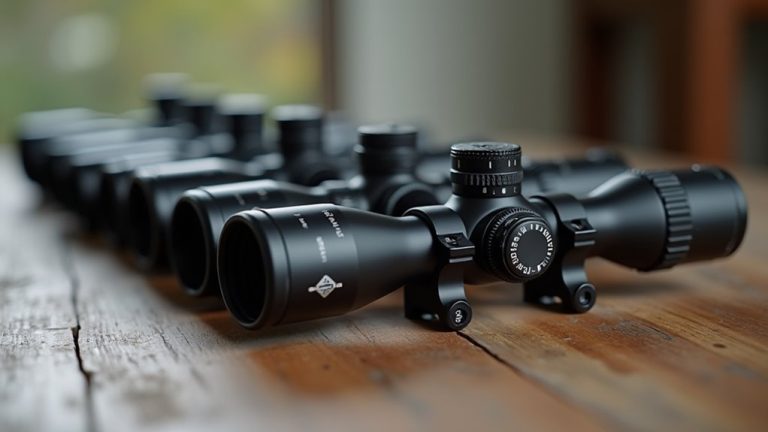
The scope enhances your ability to see the target clearly, but it’s the adjustments that make a real difference. Familiarize yourself with the turrets for elevation and windage; these allow you to align your point of aim with the actual point of impact.
Understanding the turrets for elevation and windage is essential for aligning your aim with the target’s impact.
Height over bore is also important, typically measuring 1.5 to 2 inches, as it affects your shots’ trajectory. Different scopes cater to various needs, so choose one that fits your shooting style.
Proper installation guarantees your rifle maintains zero, maximizing your accuracy and effectiveness in the field.
Preparing for Adjustment
Before making adjustments to your rifle scope, it’s important to verify everything is in place for peak performance.
Start by confirming your scope is properly mounted and securely attached to prevent loss of zero.
Adjust the ocular lens for a sharp reticle view and set the parallax adjustment to the appropriate distance, usually infinity for long-range shooting.
Familiarize yourself with the turret adjustments for windage and elevation, knowing which direction to adjust before your first shot.
| Action | Purpose | Notes |
|---|---|---|
| Check mounts | Confirm accuracy | Tighten if loose |
| Adjust ocular lens | Clear reticle view | Focus until sharp |
| Set parallax | Eliminate parallax error | Use infinity setting |
Stabilizing Your Shooting Platform
While it might seem like a small detail, stabilizing your shooting platform is vital for achieving accurate shots.
Using a stable shooting platform, like a benchrest or bipod, minimizes rifle movement and enhances shot consistency.
Incorporate sandbags or shooting rests to support the forearm and buttstock, reducing recoil effects and improving accuracy.
Make sure your rifle is positioned at a comfortable height, allowing for proper cheek rest and eye alignment with the scope.
Maintain a relaxed grip on the rifle to avoid unnecessary muscle tension that can affect shot placement.
Finally, practice shooting in various positions, such as standing or kneeling, to improve stability and adaptability in different shooting scenarios.
This foundation is essential for precision shooting.
Checking and Adjusting Eye Relief
How do you guarantee that your eye relief is properly adjusted for ideal shooting?
Start by understanding that eye relief is the distance between the ocular lens of your scope and your eye, typically needing to be 3 to 4 inches.
Settle into your shooting position and check that the reticle is clear and crisp while maintaining a comfortable distance.
This guarantees you have a full field of view without dark spots, which is essential for a clear sight picture.
If you notice any discomfort or eye strain, adjust the scope mount until you achieve the best distance.
Once you’ve found the right setting, mark your eyepiece to retain your adjustments, preventing any loss if the scope is inadvertently moved.
Aligning Your Crosshairs With Bore Sighting
Bore sighting is an essential step in aligning your crosshairs for accurate shooting. It helps you make initial adjustments and provides a solid starting point for zeroing your scope.
Here’s how to effectively bore sight your rifle:
Effectively bore sighting your rifle is crucial for achieving precise alignment and enhancing shooting accuracy.
- Stabilize Your Rifle: Secure your rifle to prevent any movement while you make adjustments.
- Use a Laser Bore Sighting Device: Insert it into the muzzle, projecting a beam towards your target, typically at 25 yards.
- Adjust the Turrets: Align your crosshairs so the point of aim (POA) matches the point of impact (POI) indicated by the laser using the windage and elevation turrets.
Once you’ve completed these steps, confirm accuracy by firing a few rounds at your target.
Making Elevation Adjustments
When you’re ready to make elevation adjustments, start by using the top turret on your scope.
Turning it clockwise raises your point of impact, while counterclockwise lowers it.
Understanding how these adjustments correspond to bullet drop can help you achieve greater accuracy at varying distances.
Elevation Turret Functionality
To guarantee your shots hit the target accurately, understanding the elevation turret’s functionality is essential. This turret allows you to make elevation adjustments to align your crosshairs with the bullet’s point of impact (POI).
Here are some steps to follow:
- Identify the POI: Observe where your shots land relative to the target.
- Turn the turret: Adjust it clockwise to raise the impact point or counterclockwise to lower it.
- Know your MOA adjustments: Typically, each click is 1/4 MOA, equating to about 0.25 inches at 100 yards.
Once you’ve zeroed your rifle, these adjustments are usually key for precise shooting at varying distances.
Familiarize yourself with the direction indicators to guarantee effective scope adjusts.
Adjusting for Bullet Drop
Adjusting for bullet drop is essential if you want to maintain accuracy at longer distances.
Start by determining your zero distance, usually set at 100 yards. Use the elevation turret to modify your point of impact (POI).
Turn the adjustment clockwise to raise the POI and counterclockwise to lower it. Each click of the turret typically adjusts by 1/4 MOA, about 0.25 inches at 100 yards.
Here’s a simple reference table to help you visualize your adjustments:
| Distance (yards) | Bullet Drop (inches) |
|---|---|
| 100 | 0 |
| 200 | 2.5 |
| 300 | 7 |
| 400 | 15 |
| 500 | 25 |
After adjustments, fire three shots, assess, and adjust as necessary.
Correcting Windage Errors
When it comes to correcting windage errors, understanding the basics of windage adjustments is key.
You’ll want to know how to use the side turret effectively to shift your crosshairs and correct any horizontal shooting mistakes.
Let’s also address some common windage mistakes that can throw off your aim.
Windage Adjustment Basics
Understanding how to make windage adjustments is essential for improving your rifle’s accuracy, especially when external factors like wind can affect your shot placement.
Here are some key steps to help you with this process:
- Use the Side Turret: This controls the horizontal movement of your crosshairs to correct the point of impact (POI).
- Know the Angular Measurement: Each click usually equals 1/4 MOA, allowing precise alignment of your point of aim (POA) with the POI.
- Verify Adjustments: Fire multiple shots to observe the group pattern on the target, enabling fine-tuning during the zeroing process.
Common Windage Mistakes
How often do shooters overlook the impact of wind speed and direction on their windage adjustments?
A common mistake is adjusting the turret without confirming your zeroed rifle, leading to cumulative errors. Instead of making constant corrections after every shot, shoot a group and analyze the overall impact pattern.
This approach can save time and improve accuracy. Also, using the reticle to account for wind can be more efficient, especially in dynamic situations, rather than continually adjusting the turret.
Fine-Tuning Magnification and Parallax
To guarantee your shots hit the mark, fine-tuning both magnification and parallax is essential.
Understanding these adjustments will enhance your shooting precision, especially when target shooting at varying distances.
Here’s how to get it right:
1. Magnification Range: Adjust the rear ring around the ocular lens to increase or decrease image size.
Remember, higher magnification decreases your field of view.
2. Parallax Adjustment: Use the side turret to ascertain the reticle aligns with your point of aim (POA), even when your eye shifts.
3. Focal Plane Focus: Adjust until the reticle appears stable and sharp on your target, ensuring minimal movement with head shifts.
Master these steps, and you’ll improve your accuracy notably.
Confirming Your Zero at Long Range
After fine-tuning magnification and parallax, the next step is confirming your zero at long range.
Start by moving your target to 100 yards, the standard distance for zeroing. Fire three-shot groups to assess the accuracy of your shots in relation to your point of aim (POA) and point of impact (POI).
If your shots consistently group above or below the target, turn the elevation turret to adjust accordingly, dialing in the necessary clicks.
For horizontal shifts, use the windage turret to center your grouping on the bullseye.
Don’t forget to take into account environmental factors like wind and humidity, as these can impact trajectory and may require additional adjustments to truly confirm your zero.
Frequently Asked Questions
What Is the Basic Rule for Sight Adjustment?
The basic rule for sight adjustment is to align your point of aim (POA) with the point of impact (POI).
You’ll need to make precise adjustments using the elevation and windage turrets based on where your bullet strikes the target.
For elevation, turn the turret clockwise to raise the POI and counterclockwise to lower it.
For windage, clockwise moves the impact right, while counterclockwise shifts it left.
Consistency is key, so shoot in groups.
How Many Clicks Is 1 Inch on a Scope?
Ever wondered how precise your adjustments need to be?
If your rifle scope has 1/4 MOA adjustments, it takes 4 clicks to move the point of impact 1 inch at 100 yards.
On the other hand, if it’s set to 1/2 MOA, you’ll only need 2 clicks for the same adjustment.
Always double-check your scope’s manual to confirm its specific click value, ensuring you’re dialed in perfectly for your next shot.
What Is the Correct Zeroing Point?
The correct zeroing point for most rifles is typically set at 100 yards. This distance guarantees that your point of aim (POA) aligns with your point of impact (POI), making it easier to hit targets accurately.
Zeroing at 100 yards helps you account for bullet drop and wind drift, which is essential for hunting and long-range shooting.
Always verify your adjustments with three-shot groups to confirm consistent accuracy before heading out.
What Are the Three Adjustments on a Scope?
The three main adjustments on a scope are elevation, windage, and magnification.
Elevation lets you adjust the vertical alignment of the crosshairs, so you can raise or lower your point of impact.
Windage allows for horizontal adjustments, compensating for wind or misalignment.
Finally, magnification lets you zoom in or out, affecting your field of view and clarity.
Mastering these adjustments is essential for ensuring your shots hit where you aim.
Conclusion
By following these nine simple steps, you’ll transform your rifle scope into a precision instrument, ready to hit the mark every time.
Just remember, adjusting a scope is like tuning a fine instrument; it takes patience and practice.
With each adjustment, you’re one step closer to that perfect shot.
So, take your time, enjoy the process, and soon you’ll find your aim sharp as a hawk’s gaze, ensuring every shot counts in the great outdoors.
In conclusion, mastering these nine simple steps will enhance your rifle scope adjustments, leading to greater accuracy with every shot.