9 Essential Steps to Calibrate Your Rifle Scope for Accuracy
To calibrate your rifle scope for accuracy, start by understanding its key components essential for precise shooting.
Perform a bore sighting for initial alignment and choose the right zeroing distance based on your goals.
Set up your target and position for stability. Fire initial shots to gather data, then adjust windage and elevation according to your shot group.
Confirm your final zero with controlled groups.
Finally, record your data regularly to enhance accuracy.
There’s more to mastering the process ahead.
Key Takeaways
- Use a bore sighter to align your scope with the rifle’s bore for accurate initial setup.
- Choose the appropriate zeroing distance based on your shooting goals, such as hunting or precision shooting.
- Fire initial three-shot groups to establish a baseline and document the point of impact for adjustments.
- Regularly record environmental conditions and adjustments on a range card for future reference and recalibration.
- Maintain your scope with proper cleaning and storage to ensure consistent performance and accuracy over time.
Understand the Key Components of Your Rifle Scope
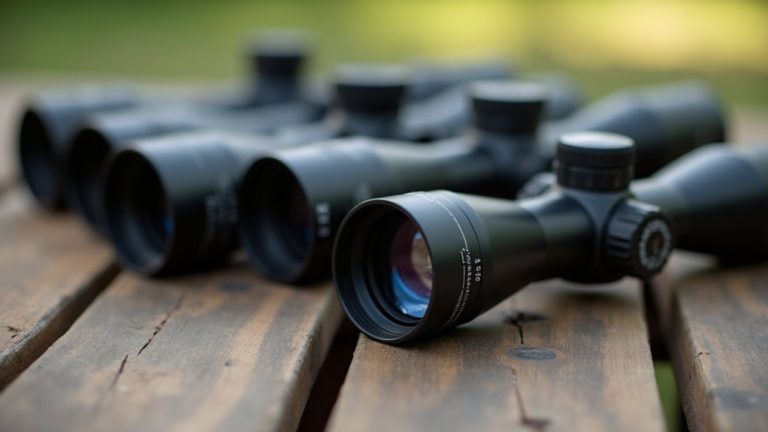
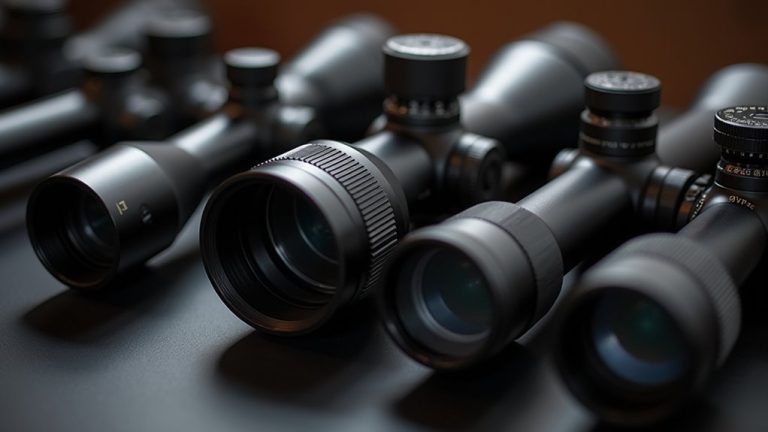
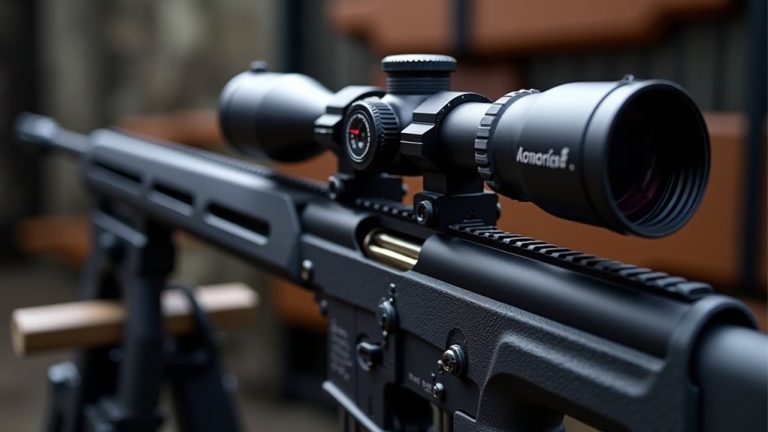
When you’re setting up your rifle scope, understanding its key components is vital for achieving accuracy.
The objective lens gathers light, enhancing visibility and greatly impacting the clarity of your target image through the scope.
The objective lens is crucial for light gathering, significantly improving visibility and target clarity through your scope.
At the rear, the ocular lens magnifies the image, allowing you to aim precisely at distant targets.
The reticle, or crosshair, acts as your aiming point, with various designs tailored to different shooting applications.
Elevation turrets help you adjust the vertical alignment of the reticle, compensating for bullet drop,
while windage turrets adjust the horizontal alignment to counteract wind or drift.
Familiarizing yourself with these aspects, including MOA or MRAD adjustments, is essential for making accurate corrections
and aligning your scope with your rifle’s trajectory.
Perform Bore Sighting for Initial Alignment
To guarantee your scope is accurately aligned, start by using the right tools like a bore sighter or collimator.
Stabilize your rifle in a gun vice or with sandbags; this keeps it level during the alignment process.
Once set up, you’ll be ready to adjust the scope’s turrets for precise alignment with the bore.
Use Proper Tools
Bore sighting is an essential first step in calibrating your rifle scope, as it aligns the reticle with the rifle’s bore. This guarantees that your initial adjustments are spot on.
To do this effectively, you’ll want to use the right tools. Optical bore sighters provide grid visuals for alignment, while laser bore sighters project a dot, helping you guarantee precise reticle positioning.
After you’ve set up your bore sighter, you can make scope adjustments to the windage and elevation turrets. This aligns the reticle with the point of aim indicated by the bore sighter’s dot.
Proper bore sighting can greatly reduce the number of shots needed to zero your rifle, making the calibration process much more efficient.
Stabilize Your Rifle
Achieving accurate bore sighting requires a steady rifle setup. Start by stabilizing your rifle using a gun vice or sandbags; this keeps it secure and prevents unnecessary movement during the procedure.
Bore sighting aligns your scope with the rifle’s bore, letting you make initial adjustments without firing rounds, which saves both time and ammunition.
Utilizing a bore sighter or collimator, carefully adjust your scope’s elevation and windage turrets to align the reticle with the bore sighter’s dot.
Before you begin, verify your rifle is level and zeroed on the aim point for the best results. A well-executed bore sighting can get you on paper quickly, reducing the number of shots needed for zeroing your scope.
Choose the Right Zeroing Distance
Choosing the right zeroing distance is essential for getting the most out of your rifle.
Depending on your shooting goals—whether hunting or precision shooting—you’ll want to select a distance that fits your needs.
Knowing how different conditions affect your shots will help you make an informed decision.
Optimal Distance Selection
When it comes to selecting the right zeroing distance for your rifle scope, understanding your shooting goals is crucial.
The ideal distance selection can greatly affect your accuracy. Here are some considerations:
- Purpose: If you’re hunting, a point blank zero at 200 yards may suit you best, allowing for manageable bullet drop within your effective range.
- Precision Shooting: For consistent data collection, choose a 100-yard zeroing distance, which simplifies calculations for longer shots.
- Initial Confirmation: Zeroing at a closer range, like 25 yards, helps verify your shots are on paper before adjusting for further distances.
Purpose-Driven Zeroing Choices
While selecting the right zeroing distance for your rifle, it’s essential to align your choice with your specific shooting objectives.
For most hunting rifles, a 100-yard zeroing distance strikes a balance between close and long-range accuracy.
If you’re a precision shooter, consider a 200-yard zero to minimize bullet drop beyond 300 yards.
Defensive shooters might prefer a point-blank zero, keeping their point of impact within 0-300 yards without needing elevation adjustments.
Zeroing at 25 yards can also help guarantee your shots hit paper at longer distances, making it easier to fine-tune your scope turrets.
Ultimately, your choice should reflect your rifle’s purpose, the ammunition type, and the distances you expect to encounter in the field.
Set Up Your Target and Position
Setting up your target and position is essential for accurate rifle scope calibration. To guarantee you’re properly aligned, follow these steps:
- Choose the Right Distance: Set up your target at about 100 yards, making sure it’s clearly visible and stable for accurate shooting.
- Align the Target Height: Position the target at the same height as your rifle’s bore. This makes adjustments easier during calibration.
- Ensure Stability: Use a gun vice or sandbags to secure your rifle, minimizing movement while you aim at the target.
Finally, double-check that the target is vertical, as any tilt can affect your aim point and lead to inaccurate adjustments.
This setup is essential for a successful calibration process.
Fire Initial Shots and Gather Data
To kick off the calibration process, fire an initial three-shot group at your target from the predetermined distance of 100 yards.
This will establish a baseline for your scope’s performance.
After firing, carefully record the point of impact for each shot to identify the average grouping location.
Use this recorded data to adjust the elevation and windage turrets according to the manufacturer’s specifications.
Each click should correspond to the expected MOA or mils.
Once adjustments are made, fire additional groups to verify changes and confirm your point of impact aligns with your point of aim.
Continuously document each session’s data on a range card, tracking changes and aiming for consistent accuracy over time.
Adjust Windage and Elevation Based on Shot Group
After analyzing your shot group, you can determine the necessary adjustments for windage and elevation to align your point of impact with your point of aim.
After assessing your shot group, you can adjust for windage and elevation to match your point of impact with your aim.
Follow these steps to make precise adjustments:
- Evaluate your shot group: Identify how far off your shots are from the point of aim.
- Calculate MOA adjustments: For every 1 MOA adjustment, your shot moves approximately 1.047 inches at 100 yards. If you’re 3 inches low, increase the elevation turret by about 3 MOA.
- Make incremental changes: Adjust windage and elevation in small increments, like 1/4 or 1/2 MOA, to fine-tune your scope settings.
Document each adjustment on a range card to track your progress and guarantee consistent accuracy over time.
Confirm Final Zero With Controlled Groups
Confirming your final zero is crucial for ensuring your rifle is accurately sighted in.
Firing a controlled group of five shots at a target set at your chosen distance—typically 100 yards—is essential.
After your initial shots, make small adjustments to your windage and elevation turrets based on the shot group’s center relative to the target’s center.
Fire another group to see if your shots align with your newly adjusted aim.
Repeat this process, aiming for around 20 shots to reliably confirm your zero.
| Shot Number | Adjustment Made |
|---|---|
| 1 | None |
| 2 | Adjust Windage |
| 3 | Adjust Elevation |
| 4 | Adjust Both |
Record Data for Future Reference
While you might be tempted to skip the note-taking after sighting in your rifle, keeping detailed records is essential for maintaining accuracy over time.
You need to know that documenting your adjustments and performance helps you understand your rifle’s behavior, especially when the scope is mounted. Here’s what you should focus on:
- Environmental Conditions: Record data for future reference, including temperature, wind, and density altitude during your shooting sessions.
- Shot Results: Document each shot’s elevation and windage adjustments to create a thorough history.
- Range Card: Utilize a structured format noting data in 50-yard increments from 150 to 1,000 yards for quick reference.
Making sure you have accurate records will enhance your whole zeroing process and future accuracy.
Regularly Recalibrate and Maintain Your Scope
Maintaining the accuracy of your rifle scope is essential for consistent performance in the field.
You should regularly inspect the zero of your riflescope, especially after travel or fieldwork. Environmental factors can nudge your zero off alignment, so make recalibration checks after significant weather changes or long periods of stationary use.
When you get a new scope, utilize no-fire calibration techniques like laser bore sighting; this saves time and ammunition while reducing wear on your firearm.
Always store your scope in padded, waterproof cases and clean the lenses with soft microfiber cloths to prevent scratches.
Frequently Asked Questions
How Many Clicks Is 1 Inch on a Scope?
One inch on a scope typically requires 4 clicks if it’s calibrated to 1/4 MOA.
If it’s 1/2 MOA, you’ll need 2 clicks for the same adjustment.
It’s important to check your specific scope’s adjustment value, as it can vary by manufacturer and model.
You should also conduct a “shoot-the-box” test to confirm that your clicks align with the bullet’s point of impact for precise shooting accuracy.
Should I Zero at 100 or 200 Yards?
You should zero at 100 yards if you mainly shoot at closer distances, as it’s practical for both hunting and general target shooting.
However, if your focus is on precision or long-range shooting, a 200-yard zero might be better, offering a flatter trajectory.
Consider your typical shooting scenarios and the ballistic performance of your ammunition to make the best choice for your needs.
Ultimately, it’s about what aligns with your shooting style.
How Are Scopes Calibrated?
Calibrating a scope involves aligning it with your rifle’s bore, often using a bore sighter initially.
You’ll need to adjust the windage and elevation turrets, with each click affecting your shot’s trajectory. It’s a precision game.
While you might think once is enough, regular recalibration is vital, especially after heavy use or environmental changes.
Testing your adjustments against a target helps guarantee your shots hit where you aim, building your confidence over time.
What Are Common Mistakes When Zeroing a Scope?
Common mistakes when zeroing a scope include failing to level the scope properly, which can cause significant aim errors.
You might also neglect to verify that each adjustment click aligns with the expected MOA or mils, leading to miscalculations.
Ignoring environmental factors like wind and temperature can skew your results.
Finally, not double-checking your zero after adjustments or forgetting to record data can leave you unsure of your scope’s true accuracy.
Conclusion
If you follow these nine steps, you’ll be the proud owner of a rifle scope that’s as accurate as a laser-guided squirrel sniper.
Just remember, it’s not just about hitting the target; it’s about impressing your friends with your newfound “expertise.”
After all, who wouldn’t want to be the one who can recalibrate a scope while blindfolded?
Now go out there and show that bullseye who’s boss—just don’t forget to actually aim!
And remember, mastering how to calibrate your rifle scope is key to achieving precision and enhancing your shooting skills.