How to Read a Rifle Scope – A Step-by-Step Guide
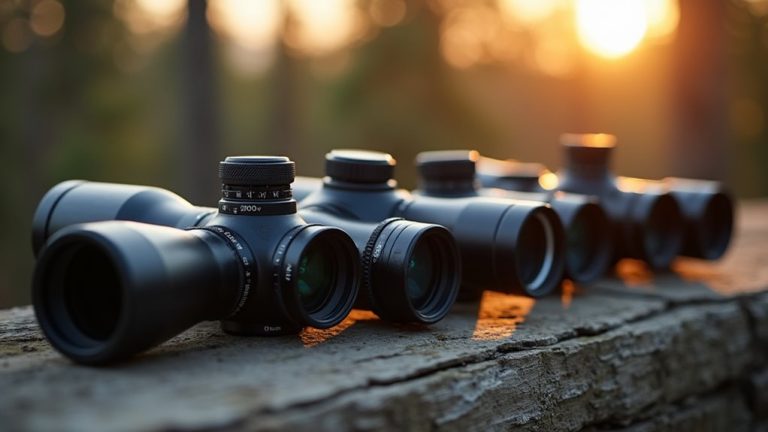
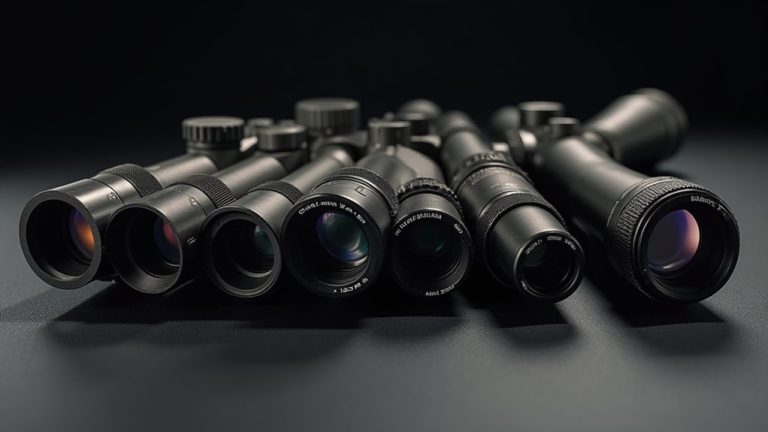
To read a rifle scope effectively, start by understanding its key components, like the ocular and objective lenses, and the reticle.
Guarantee proper scope mounting for accuracy, and learn how to adjust the ocular lens for a clear view.
Get familiar with elevation and windage adjustments for bullet drop and wind drift.
Explore different reticle designs and magnification settings to enhance your shooting.
By mastering these steps, you’ll improve your accuracy and performance in no time.
Keep going for more tips!
Key Takeaways
- Identify the ocular and objective lenses to understand how they focus and magnify the target image for clear viewing.
- Familiarize yourself with the reticle type and its function in aligning shots and estimating bullet impact.
- Adjust the ocular lens for a sharp reticle view, especially if wearing corrective lenses, and consider lighting conditions.
- Learn to use elevation and windage turrets to make precise adjustments for bullet drop and wind drift.
- Practice regularly at varying distances while accounting for environmental factors that may influence accuracy, such as wind and temperature.
Understanding the Key Components of a Rifle Scope
When you immerse yourself in the world of rifle scopes, understanding their key components is essential for enhancing your shooting experience.
The ocular lens is important as it focuses the image for your eye, allowing for a clear view of your target. On the other hand, the objective lens gathers light, creating a magnified image that’s critical for spotting distant targets.
Additionally, familiarize yourself with the reticle, or crosshair, which helps align your shot and estimate bullet impact. Various reticle designs, like duplex and mil-dot, cater to different shooting styles.
The Importance of Proper Scope Mounting
Proper scope mounting is essential for achieving the best accuracy and performance from your rifle.
If your screws aren’t tightened correctly, you may struggle to achieve a repeatable zero, which can seriously impact your shooting precision.
Make certain all components, including scope rings and bases, are securely fastened to prevent any movement that could throw off your zero.
Ensure all components, such as scope rings and bases, are tightly secured to maintain your zero accuracy.
Using a torque wrench guarantees you apply the right amount of pressure to the mounting screws, as specified by your scope’s manufacturer.
Additionally, verify the scope is level and aligned with your rifle’s bore to avoid parallax errors.
Familiarize yourself with your scope’s specific adjustments, as different optics have varying specifications for elevation and windage.
Proper scope mounting is key to accurate shooting.
How to Adjust the Ocular Lens for Clarity
Adjusting the ocular lens of your rifle scope is crucial for achieving a clear and sharp sight picture, especially if you’re wearing corrective lenses.
To start, look through the scope at a target. Then, rotate the ocular lens until the reticle appears sharp and clear.
It’s important to do this at the beginning of each shooting session, as lighting conditions and distance can change.
| Step | Action |
|---|---|
| 1. Look through scope | Find a target that’s clear and distinct. |
| 2. Rotate lens | Adjust until the reticle is sharp. |
| 3. Check clarity | Verify the sight picture is strain-free. |
A well-focused ocular lens enhances target acquisition, improving your shooting accuracy.
Utilizing Elevation and Windage Adjustments
Now that you’ve got your ocular lens adjusted, it’s time to tackle elevation and windage adjustments.
Understanding how to compensate for bullet drop and wind drift is essential for hitting your target accurately.
Let’s explore practical techniques that will help you master these adjustments and improve your shooting precision.
Understanding Elevation Adjustment
Understanding elevation adjustments is essential for accurate shooting, especially since bullet drop can greatly affect your aim over varying distances.
The elevation adjustment on your rifle scope compensates for this drop, allowing you to align your shot precisely. Most scopes measure elevation in MOA (Minutes of Angle), where 1 MOA generally equals about 1.047 inches at 100 yards.
To adjust, simply turn the elevation turret clockwise to raise the point of impact or counterclockwise to lower it. Each click usually corresponds to a specific increment, often 1/4 MOA.
Mastering this adjustment will help you achieve a proper zero, aligning your reticle with the bullet’s trajectory for enhanced accuracy and consistency during your shooting sessions.
Mastering Windage Adjustment
Mastering windage adjustment is essential for hitting your target, especially when wind can shift your bullet’s path.
This adjustment allows you to compensate for wind drift by moving the reticle horizontally, which is critical for long-range accuracy with your precision rifle.
Each click of the windage turret typically alters your point of impact by a specific distance, so understanding how clicks relate to distance is important.
Observe wind conditions and estimate the wind speed, as even a gentle breeze can affect bullet trajectory.
Practice making windage adjustments in various shooting positions to develop a feel for how wind influences your shots.
Regularly confirm your adjustments at different distances and conditions to refine your skills and improve overall accuracy.
Practical Adjustment Techniques
Windage adjustments are only part of the equation when it comes to achieving accuracy in your shots.
Elevation adjustments are just as vital, allowing you to compensate for bullet drop over distances.
Here’s a quick reference table to help you understand how these adjustments work:
| Adjustment Type | Increment | Effect at 100 Yards |
|---|---|---|
| Elevation | 1/4 MOA | 0.25 inches |
| Elevation | 1/2 MOA | 0.5 inches |
| Windage | 1/4 MOA | 0.25 inches |
| Windage | 1/2 MOA | 0.5 inches |
| Verify | Range Practice | Confirm adjustments |
To adjust, turn the turret per the markings, ensuring you practice regularly for accuracy in your elevation and windage settings.
Exploring Different Reticle Designs
When it comes to reticle designs, you’ll find several common types like duplex, mil-dot, and BDC, each tailored for different shooting situations.
Choosing the right reticle style can make a big difference in your accuracy and ease of use.
Let’s explore how these designs can enhance your shooting experience.
Common Reticle Types
As you explore the world of rifle scopes, understanding common reticle types can greatly enhance your shooting experience.
The duplex reticle is popular for its thicker outer crosshairs that aid quick target acquisition while providing a fine center for precision aiming.
Mil-dot reticles feature evenly spaced dots on the crosshairs, helping you estimate distances and adjust for bullet drop and wind drift.
BDC (Bullet Drop Compensator) reticles simplify adjustments with markings tied to specific distances.
If you’re into long-range shooting, the Christmas tree reticle offers graduated markings for elevation and windage.
Finally, illuminated reticles improve visibility in low-light conditions, making target acquisition easier.
Each reticle serves a unique purpose depending on your shooting needs.
Choosing Reticle Style
With a solid grasp of common reticle types, you’re ready to explore how to choose the right reticle style for your shooting needs.
Reticle styles greatly influence your shooting experience. If you prioritize quick target acquisition, consider a duplex reticle, which excels in low light due to its thick outer posts.
For range estimation and adjustments, a mil-dot reticle might be your best bet, as it features dots that help you calculate windage and elevation at various distances.
If you’re using specific ammunition, a BDC (bullet drop compensator) reticle can provide preset aiming points for different ranges, eliminating the need for scope adjustments.
Ultimately, the best reticle style aligns with your shooting scenarios and personal preferences.
Zeroing Your Scope: A Step-by-Step Process
Zeroing your rifle scope is essential for accurate shooting, and starting the process at a closer range, like 25 yards, helps guarantee your shots hit the target.
First, fire five shots to create an initial grouping. Based on where your shots land, adjust the elevation and windage turrets accordingly.
Each click usually represents a specific distance change (e.g., 1/4 MOA or 1 MOA at 100 yards). After making adjustments, confirm your zero at your desired distance, such as 100 yards, until your shots consistently hit the center.
Finally, document your zero details, including rifle, scope, ammunition, and environmental conditions.
| Step | Action |
|---|---|
| 1. Initial Shots | Fire five shots at 25 yards |
| 2. Adjust Turrets | Elevation and windage |
| 3. Confirm Zero | Test at 100 yards |
Magnification Settings and Their Impact on Shooting
Once you’ve zeroed your scope, understanding magnification settings becomes essential for enhancing your shooting experience.
The first number in a scope’s magnification setting indicates minimum power, while the second shows maximum power—like 3-9x, which means it can magnify from 3 to 9 times.
Higher magnification allows for improved detail and accuracy at longer distances, making it easier to pinpoint distant targets.
However, keep in mind that each increase in magnification decreases your field of view, which can hinder quick target acquisition, especially in dynamic situations.
For close quarters or moving targets, lower magnification is beneficial.
Choose a setting that suits your shooting distance to avoid distortion or reduced brightness.
Your success depends on the right balance of magnification and field of view.
Practicing With Your Scope: Techniques for Improvement
Although you may have a solid understanding of your rifle scope, practicing with it is essential for honing your skills and improving your shooting performance.
Focus on adjusting your magnification settings and experimenting with different shooting positions, like prone or sitting, to find what works best for you.
Conduct drills at varying distances, starting at 25 yards and moving to 100 yards, to fine-tune your point of impact.
Utilize purpose-built targets for easy measurement of adjustments, and document your sessions to identify patterns in your shooting accuracy.
| Distance (Yards) | Position | Notes |
|---|---|---|
| 25 | Prone | Stable, easy aim |
| 50 | Sitting | Moderate stability |
| 100 | Standing | Challenging, adjust |
Environmental Factors Affecting Scope Performance
When you’re out shooting, don’t underestimate how weather conditions can affect your accuracy.
Wind, temperature, and humidity can all alter a bullet’s trajectory and impact your shot.
Additionally, light conditions like glare or shadows can obscure your target, making it essential to adjust your scope settings accordingly.
Weather Impact on Accuracy
While you might be focused on your technique and equipment, it’s essential to remember that weather conditions can dramatically affect your shooting accuracy.
Wind is particularly impactful; even a light breeze can deflect your bullet, requiring you to adjust your aim to compensate for drift, especially at longer distances.
Temperature also plays a role—warmer air is less dense, creating less drag on the bullet, while colder air increases drag.
High humidity can further alter your bullet’s trajectory, adding more moisture to the air and affecting its path.
To guarantee your shooting accuracy remains consistent, always confirm the zero of your rifle scope at the start of each session, accounting for these varying environmental factors.
Light Conditions Considerations
Effective shooting requires not just skill and precision but also an understanding of how light conditions can impact your scope’s performance.
In low-light situations, like dawn or dusk, a larger objective lens gathers more light, helping you see your target clearly.
Conversely, bright sunlight can create glare, washing out your view and hindering aiming accuracy. To combat this, high-quality lens coatings are vital to reduce reflections.
Don’t forget that atmospheric factors, such as humidity and temperature, can also affect light transmission, potentially diminishing clarity.
Finally, be aware that wind can distort your perception of the target, making it essential to account for its effects during your shooting sessions.
Properly evaluating light conditions guarantees improved performance and accuracy.
Enhancing Your Shooting Skills With Technology
As technology continues to evolve, shooters can leverage various innovative apps to greatly enhance their skills and accuracy.
These applications provide essential ballistic data and trajectory calculations, allowing you to input specific details for improved shooting performance.
Here are some features that can elevate your shooting experience:
- Bullet flight path visualization on connected devices
- Environmental factor analysis, including wind and temperature
- Range finding capabilities for precise distances
- Reticle customization tailored to your preferences
Frequently Asked Questions
What Does the 3 9×40 Mean on a Scope?
The “3-9×40” on a scope means it has adjustable magnification from 3 to 9 times, giving you versatility for different shooting distances.
The “3” provides a wider field of view for close-range shots, while the “9” is ideal for long-range targeting.
The “40” indicates the diameter of the objective lens in millimeters, which helps gather more light, improving visibility, especially in low-light conditions.
This makes it a great choice for various shooting scenarios.
What Does 6 24X50 Mean on a Scope?
Imagine you’re a hawk, soaring high, spotting every detail below.
The “6” in “6 24×50” is your keen sight at six times magnification, bringing distant prey closer.
The “24” lets you zoom in even further, making the tiniest movements clear as day.
And that “50”? It’s your big, bright eye, the 50mm objective lens capturing maximum light, ensuring you see clearly, even as dusk falls.
This scope’s got your back for precision hunting!
What Does 4x12x44 Mean on a Scope?
The “4x12x44” on a scope means it offers magnification from 4 to 12 times the size of your target.
The “4” gives you a wider field of view for closer shots, while “12” helps you zoom in on distant objects.
The “44” indicates a 44mm objective lens diameter, which improves light gathering, enhancing visibility in low light.
This setup allows for versatile use depending on your shooting needs and environment.
What Do the Numbers Mean on a Rifle Scope?
Did you know that a quality rifle scope can improve your accuracy by up to 50%?
The numbers on a rifle scope indicate its magnification and objective lens size.
For instance, in a 3-9×40 scope, “3-9” means you can magnify the target 3 to 9 times, while “40” refers to the objective lens diameter in millimeters.
Understanding these numbers helps you choose the right scope for your shooting style and conditions.
Conclusion
As you peer through your rifle scope, the world transforms into a vivid tapestry of detail. Each adjustment is a brushstroke on your canvas of precision.
With every practice session, you sharpen not just your skills but your eye for the perfect shot. Remember, mastery isn’t just about the gear; it’s about the harmony between you and your rifle.
So embrace the journey, and let the thrill of the hunt guide you. As you become one with your scope, you’ll find the key to accurate shooting lies in understanding how to read a rifle scope effectively.