How to Read Rifle Scope Numbers for Better Accuracy?
To read rifle scope numbers for better accuracy, it’s essential to focus on magnification and objective lens size.
The magnification range, like 3-9x, indicates how much closer a target appears.
Meanwhile, the objective lens size plays a significant role in light gathering capabilities.
Understand the difference between fixed and variable scopes—fixed scopes offer stability, while variable scopes provide flexibility.
Knowing the right magnification for your shooting distance is also crucial.
Additionally, there’s more to learn about adjustments that can fine-tune your shooting experience.
Key Takeaways
– Understand magnification numbers: The first number indicates how much closer the target appears, while the second number shows the objective lens diameter in millimeters.
Choose appropriate magnification based on shooting distance: Use 3-9x for short to mid-range, and 10x or higher for long-range shooting.
– Consider objective lens size: Larger lenses gather more light and improve visibility in low-light conditions, affecting clarity and brightness.
Evaluate lens coating quality: Fully multi-coated lenses enhance light transmission and low-light performance, crucial for accurate shooting in various conditions.
– Familiarize yourself with adjustment mechanisms: Know how elevation and windage turrets work to make precise adjustments for improved accuracy on targets.
Understanding Rifle Scope Specifications
When you’re looking to buy a rifle scope, understanding the specifications is essential.
The numbers you see, like 3-9x, represent the magnification range and objective lens diameter. The first number indicates how much you can zoom in; for example, 3-9x means you can magnify the image from three to nine times its actual size.
The second number, measured in millimeters, shows the diameter of the objective lens, which affects how much light the scope gathers. Larger lenses typically provide brighter images, especially in low-light conditions.
The Importance of Magnification Numbers
Understanding rifle scope specifications sets the stage for grasping the importance of magnification numbers.
The first number you see, like in a 3-9x scope, indicates the minimum magnification, meaning your target appears three times closer.
The second number shows the maximum magnification, allowing targets to appear up to nine times closer.
Higher magnification levels are vital for long-distance shooting, as they provide greater detail and enhance accuracy.
When you know how magnification affects your view, you can select a scope that meets your specific needs, whether you’re hunting in close range or shooting targets at a distance.
Choosing the right magnification can greatly impact your shooting experience and overall success.
Adjustable Magnification Explained
Adjustable magnification allows you to customize your shooting experience, providing flexibility for different scenarios.
This feature is essential when considering your target distance and the type of shooting you’ll be doing.
Here are some key points about adjustable and variable magnification:
- The first range of numbers in a scope’s designation, like 3-9x, shows the magnification range.
- Higher settings, like 9x, are great for long-distance shots, enhancing detail.
- Lower settings, such as 3x, widen your field of view, helping to track moving targets easily.
- Variable magnification scopes adapt to various shooting needs, offering versatility in different environments.
Understanding adjustable magnification can greatly improve your accuracy and overall shooting experience.
Objective Lens Size and Its Impact
The size of the objective lens plays an essential role in your shooting experience, especially in varying light conditions.
The objective lens diameter, measured in millimeters, determines how much light enters your scope. A larger objective lens generally enhances visibility, providing better clarity and brightness for accurate shooting in low light.
However, keep in mind that larger objective lenses can add weight and cost to your setup. It’s important to balance size with your shooting preferences for best performance.
| Objective Lens Size | Impact on Light Gathering |
|---|---|
| 32mm | Good for daylight shooting |
| 40mm | Better clarity in twilight |
| 50mm | Excellent low-light performance |
| 56mm | Best for extreme conditions |
Understanding Fixed vs. Variable Magnification
When choosing a rifle scope, understanding the difference between fixed and variable magnification is essential.
Fixed scopes offer consistency with a set magnification level, perfect for specific shooting scenarios.
On the other hand, variable scopes provide the flexibility to adjust zoom levels, making them suitable for a range of distances and target sizes.
Fixed Magnification Advantages
While many shooters opt for variable magnification scopes, fixed magnification offers distinct advantages that can enhance your shooting experience.
With a consistent level of magnification, you’ll find the reticle remains stable, improving your accuracy.
Plus, fixed scopes typically provide a wider field of view, making it easier to track moving targets.
Here are some key benefits of fixed magnification scopes:
- Fewer moving parts for increased durability and reliability
- Lighter weight, making them more convenient to carry
- Cost-effective, often priced lower than variable scopes
- Ideal for short-range shooting, where clarity and simplicity shine
Choosing a fixed magnification scope can elevate your shooting performance in various scenarios, ensuring you stay on target.
Variable Magnification Flexibility
Variable magnification scopes offer a level of flexibility that can greatly enhance your shooting experience, especially in diverse environments.
Unlike fixed scopes that offer a single magnification power, variable magnification allows you to adjust the zoom range to fit different distances and situations.
For instance, a scope marked 3-9x provides a zoom range from 3 to 9 times the actual size, making it ideal for both close and long-range targets.
This adaptability is essential in dynamic scenarios, allowing quick adjustments for moving targets.
However, keep in mind that variable scopes can be heavier and more complex than their fixed counterparts.
Understanding these differences will help you choose the right scope based on your shooting needs and preferences.
How to Choose the Right Magnification
Choosing the right magnification for your rifle scope is crucial to enhance your shooting experience, especially since your typical shooting range plays a significant role in this decision.
Start by considering your shooting distance and style to choose the right magnification setting. Here are some key points to help you:
- Lower magnifications (1-6x, 3-9x) are great for short to mid-range (up to 300 yards).
- Higher magnifications (10x and above) are necessary for long-range shooting (500 yards+).
- For targets at 1000 yards, aim for 12-25x magnification for clarity.
- Variable scopes (like 4-16x) offer flexibility for varying shooting scenarios.
Understanding these factors will guarantee you select the best magnification for your needs.
Reading the Numbers on Your Scope
Understanding the numbers on your rifle scope can seem intimidating at first, but it’s crucial for optimizing your shooting experience.
The first number in the scope designation indicates magnification power. For instance, in a 3-9x scope, the “3” means the image appears three times closer than with the naked eye.
The second number represents the diameter of the objective lens in millimeters. A larger number, like “40” in a 3-9×40 scope, means better light-gathering ability.
If you see a range like 4-12x, it means you can adjust your magnification from 4x to 12x. Understanding how magnification and objective size work together guarantees you select a scope that fits your shooting needs, whether for close-range or long-distance shots.
The Role of Lens Quality in Performance
While you might focus on magnification and objective size when selecting a rifle scope, the quality of the lenses is just as important for achieving peak performance.
High-quality lenses enhance your shooting experience by improving image clarity and brightness. Here are some key aspects of lens quality to take into account:
High-quality lenses significantly improve image clarity and brightness, enhancing your overall shooting experience.
- Light Transmission: Coated lenses allow more light to pass through, vital for low-light conditions.
- Optical Glass Quality: Premium materials like ED glass reduce chromatic aberration for sharper images.
- Construction: Thicker, well-curved lenses provide a wider field of view.
- Confidence: Superior lens quality enhances overall shooting performance, boosting your confidence in target acquisition.
Investing in a scope with excellent lens quality can truly elevate your accuracy on the range or in the field.
Evaluating Additional Features of a Scope
When you’re evaluating a rifle scope, pay attention to lens coating quality, as it impacts light transmission and clarity.
Also, consider the construction material for durability, ensuring it can withstand tough conditions.
Finally, check the adjustment mechanism type, which can greatly enhance your shooting precision in various situations.
Lens Coating Quality
Evaluating lens coating quality is essential for maximizing a rifle scope’s performance, especially in challenging lighting conditions.
The right coatings enhance light transmission and improve your overall shooting experience. Here are some key factors to take into account:
- Anti-reflective coatings increase light transmission by up to 95%.
- Fully multi-coated lenses treat all air-to-glass surfaces for peak performance.
- Hydrophobic coatings repel water and dirt, keeping your lenses clear.
- Low-light performance is greatly enhanced with high-quality coatings.
Construction Material Durability
Durability is a crucial aspect of any rifle scope, as it directly affects your ability to rely on the equipment in the field. The construction material plays a significant role in this durability, with options like aluminum, magnesium, and reinforced composites.
High-quality rifle scopes often use aircraft-grade aluminum, providing robust yet lightweight performance under harsh conditions. Look for features like shockproof, waterproof, and fog-proof capabilities, achieved through durable seals and gas purging to keep moisture out.
Additionally, lens coatings such as anti-reflective and scratch-resistant treatments enhance durability and overall performance.
Finally, evaluating the warranty and the manufacturer’s reputation can give you insight into the expected durability of your chosen scope, ensuring you make a sound investment.
Adjustment Mechanism Type
Understanding the adjustment mechanism type of a rifle scope is essential for achieving accuracy in the field.
The way elevation and windage dials are designed can greatly impact your shooting experience.
Here are some key features to reflect on:
- Capped Turrets: Protect settings from accidental changes.
- Exposed Turrets: Allow for quick adjustments while in the field.
- Adjustment Measurement: Most scopes use MOA (Minute of Angle) for simplicity, favored by many American hunters.
- Zero Stop Function: Lets you easily return to your original zero setting after adjustments.
Additionally, parallax adjustment can help fine-tune your reticle’s focus relative to your target, enhancing accuracy at various distances.
Understanding these features will improve your shooting precision.
Practical Examples of Scope Specifications
When you’re looking at rifle scopes, it’s essential to grasp how their specifications relate to your shooting preferences.
For example, a scope labeled 3-9×40 offers a variable scope magnification from 3x to 9x and features an objective lens diameter of 40mm, which enhances light entry for better visibility.
If you prefer something fixed, a 4×32 provides a constant 4x magnification with a 32mm objective lens, ideal for specific distances.
For long-range shooting, consider a 6-24×50 scope, which expands your magnification range and provides a larger 50mm lens for various lighting conditions.
Understanding these numbers helps you match the scope to your shooting needs effectively, ensuring peak performance in the field.
Common Mistakes When Choosing a Scope
When choosing a scope, it’s easy to make some common mistakes that can affect your shooting experience.
Ignoring magnification requirements and overlooking objective lens size can leave you struggling to see your target clearly.
Plus, neglecting the quality of the glass can lead to disappointing image clarity and overall performance.
Ignoring Magnification Requirements
Choosing the right rifle scope can be intimidating, especially if you ignore your specific magnification requirements.
Many shooters make the mistake of not considering their shooting distances, which can lead to selecting a scope with an unsuitable magnification range.
Here are some key points to keep in mind:
- For long-range shooting (beyond 500 yards), aim for at least 10x magnification.
- Higher magnification isn’t always better; it can hinder accuracy at close ranges.
- Variable magnification scopes offer flexibility, but knowing how to adjust them is essential.
- Align your scope choice with your shooting style to enhance performance.
Overlooking Objective Lens Size
Many shooters underestimate the importance of objective lens size, a critical factor that can greatly affect your shooting experience.
The objective lens size, indicated by the second number in a scope’s specification, plays a significant role in light transmission.
Larger lenses, typically from 32mm to 56mm, gather more light, enhancing clarity and detail, especially in low-light conditions.
Here’s a quick overview of how objective lens sizes impact your shooting:
| Objective Lens Size | Light Transmission Impact |
|---|---|
| 32mm | Good for daylight use |
| 40mm | Better in low light |
| 50mm | Excellent in twilight |
| 56mm | Best for extreme conditions |
| 30mm | Limited visibility |
Choosing the right size balances light-gathering ability with weight and cost.
Neglecting Quality Glass Factors
While it’s easy to get caught up in magnification and reticle options, neglecting the quality of glass in your scope can lead to significant drawbacks in performance.
Quality glass is essential for peak light transmission and image clarity, particularly in low-light conditions. Here are some key factors to take into account:
- High-quality lens coatings enhance light-gathering capability.
- Poor-quality glass can cause distortions or color fringing.
- Durable construction guarantees reliability in harsh conditions.
- Investing in superior optical glass improves long-range shooting accuracy.
Recommended Magnification for Different Distances
When it comes to selecting the right magnification for your rifle scope, understanding the distance you’ll be shooting at is essential.
For short to mid-range shooting, up to 300 yards, a magnification range of 1-6x or 3-9x works best. These options balance field of view and target acquisition speed effectively.
If you’re into long-range shooting, typically beyond 500 yards, you’ll want higher magnifications ranging from 10x to 25x for detailed target identification.
For targets up to 200 meters, a 5-8x magnification is effective, while 9-12x is ideal for precise aiming beyond that distance.
If you’re aiming considerably further, consider scopes with magnifications of 13-24x for optimal clarity and detail.
Tips for Enhancing Shooting Accuracy
Selecting the right magnification for your scope is just the beginning of achieving accuracy in shooting.
Choosing the appropriate magnification for your scope is merely the first step toward improving your shooting accuracy.
To truly enhance your performance, consider these tips:
- Understand the magnification range of your scope; it helps you choose the right level based on distance and target type.
- Opt for a larger objective lens size to improve visibility in low-light conditions, allowing you to see details clearly.
- Familiarize yourself with elevation and windage adjustments to compensate for bullet drop and wind drift.
- Practice regularly with variable magnification scopes, adapting your aim for both close and distant targets.
Resources for Further Learning on Scopes
If you want to sharpen your understanding of rifle scopes, there are plenty of online guides and video tutorials available.
These resources can break down complex concepts and show you how to apply them in practice.
Online Scope Guides
Numerous online resources can greatly enhance your understanding of rifle scopes.
These platforms provide valuable information on lens sizes, features, and specifications. It’s important to note that familiarizing yourself with these details can lead to better accuracy in the field.
- GunUniversity.com offers extensive insights into various rifle scopes.
- Scope Ring Finder Tools help you identify compatible rings and bases.
- Articles explaining the parts of a rifle scope give foundational knowledge for beginners.
- Stay updated with shooting sports news to enhance your expertise in scope selection.
Video Tutorials Available
Exploring video tutorials can greatly enhance your understanding of rifle scopes.
These resources provide visual explanations of how to interpret magnification and objective lens size numbers, making complex concepts easier to grasp.
Ryan Cleckner’s video is particularly informative, emphasizing the importance of understanding scope specifications to improve your shooting experiences and accuracy.
Additionally, GunUniversity.com offers insightful video content that breaks down various rifle scope features and functionalities.
You can also find tutorials focused on long-range shooting techniques, helping you apply different magnification levels practically.
By engaging with these video tutorials, you’ll build your knowledge and confidence, enabling you to select and use rifle scopes more effectively.
Understanding Elevation and Windage Adjustments
Understanding elevation and windage adjustments is essential for improving your shooting accuracy. Knowing how to manipulate these settings can greatly enhance your performance in the field.
Mastering elevation and windage adjustments is crucial for enhancing shooting accuracy and boosting your confidence in the field.
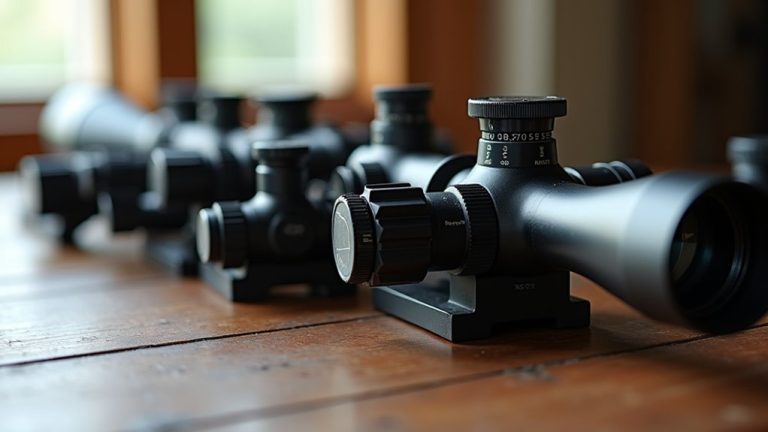
- Elevation adjustments are made with the top turret, allowing you to raise or lower your shot’s point of impact.
- Windage adjustments are located on the right turret, moving your shot horizontally to counteract wind or other lateral factors.
- Both adjustments are measured in MOA (Minute of Angle) or MILs (milliradians), with MOA being more common among American hunters.
- Remember, a standard MOA adjustment moves the point of impact by 1 inch at 100 yards, while MIL adjustments shift it by 3.6 inches.
Mastering these adjustments helps you shoot more accurately and confidently.
Frequently Asked Questions
What Does the 3 9×40 Mean on a Scope?
The 3-9×40 on a scope means it has variable magnification from 3 to 9 times closer than what you see with your naked eye.
The ’40’ indicates the objective lens diameter is 40 millimeters, which helps gather light for better visibility, especially in low-light situations.
This setup is great for versatile shooting, allowing you to track moving targets easily at close range while also giving you detail for distant shots.
What Does 4 12X50 Mean on a Rifle Scope?
Did you know that a scope with a 50mm objective lens can gather up to 70% more light than a 40mm lens?
The “4-12×50” on a rifle scope means you’ve got a variable magnification that ranges from 4 to 12 times closer than what your naked eye sees, with a 50mm diameter lens for enhanced visibility.
This setup’s perfect for both close encounters and long-range shots, ensuring you’ve got precision no matter the distance.
Is a 40MM or 50MM Scope Better?
It really depends on your shooting needs.
If you often shoot in low-light conditions, a 50mm scope’s larger objective lens gathers more light, giving you a brighter image.
However, if you prioritize weight and balance, especially for shorter distances, a 40mm scope might be the better choice.
Think about where and when you’ll be shooting to determine which size fits your style and enhances your accuracy best.
Is 4×12 Scope Better Than 3×9?
You might think a 4×12 scope is always better than a 3×9, and in many ways, it is.
With its higher magnification range, the 4×12 offers more flexibility for long-distance shooting, letting you see details that the 3×9 might miss.
If you’re aiming for targets beyond 300 yards, the 4×12 shines.
However, if you’re shooting closer, the 3×9 can still perform well.
Your choice should depend on your specific shooting needs.
Conclusion
By grasping the numbers on your rifle scope, you’re not just seeing specs; you’re revealing precision.
Imagine the clarity of a distant target, sharp and defined, versus a blurry outline that misses its mark.
With the right magnification and adjustments, you can transform uncertainty into confidence.
So, whether you’re aiming for a bullseye or tracking game, understanding your scope turns chaos into calm, ensuring each shot counts.
Embrace the numbers, and let your aim soar.
Understanding how to read rifle scope numbers is essential for improving your accuracy.