10 Steps to Perfectly Set Up Your Rifle Scope
To perfectly set up your rifle scope, start by gathering your tools and materials for the setup process.
Mount the scope securely and level it properly. Set the eye relief to prevent scope bite and adjust the eyepiece focus for clarity.
Fire initial groups at 25 yards and confirm zero at 100 yards. Finally, make any necessary adjustments and guarantee routine maintenance.
Follow these steps, and you’ll be ready to hit your targets accurately.
There’s more to explore to enhance your setup!
Key Takeaways
- Prepare your workspace with necessary tools, ensuring a clean and well-lit environment for accurate setup.
- Mount the scope securely, aligning it with the rifle’s action and ensuring proper torque on screws.
- Set eye relief to 3-4 inches for comfort and clarity, preventing potential “scope bite” during recoil.
- Bore sight your rifle using a laser or manual technique to align the reticle with your target accurately.
- Make final adjustments based on shooting results, confirming point of aim matches point of impact for improved accuracy.
Gather Your Tools and Materials
Before you plunge into setting up your rifle scope, you’ll want to gather the right tools and materials.
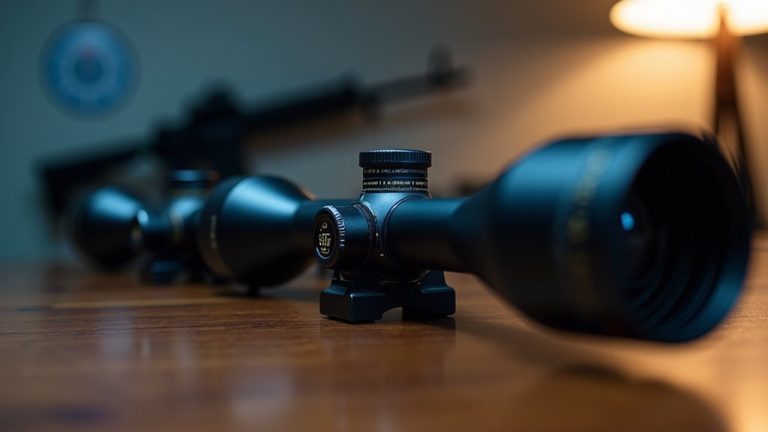
Start with a torque wrench to guarantee accurate tightening of your scope rings and mounts. A stable gun vice or bipod is essential for stabilizing your rifle during the process.
Don’t forget a leveling kit, like the Wheeler Engineering Professional Leveling Kit, which will help align your scope perfectly.
It’s also wise to have quality hand tools that match the fasteners on your scope rings. Keep Blue Loctite handy to secure base screws and prevent loosening over time.
A clean, well-lit workspace will help you avoid distractions and errors, guaranteeing a smooth mounting process.
Mount the Scope Securely
Mounting your scope securely is essential for guaranteeing accuracy and stability when shooting. Follow these steps to achieve proper scope mounting:
- Ensure the scope rings are tightened to 35-45 inch-pounds for stability.
- Use a level on the scope base to confirm proper alignment, preventing canted shots.
- Install the optic at the highest magnification without fully tightening to find the best position.
- Utilize a stable platform, like a gun vise or bipod, for steady mounting and adjustments.
- After attaching the scope, double-check all screws and ring alignments to verify there are no gaps or misalignments.
Level the Scope Properly
To guarantee your shots are accurate, it’s crucial to level the scope properly.
Start by using a bubble level or a scope leveling kit to align the scope with your rifle’s action, preventing any canting that could affect your precision.
Level the rifle by placing a reference level on the rail or scope rings, adjusting the gun until the bubble is centered.
Once that’s done, use a barrel clamp level to verify the scope matches the barrel’s level for perfect alignment.
When tightening the scope ring screws, do so in a zig-zag pattern to maintain even pressure and avoid over-tightening, which can damage your scope.
Regularly check the alignment after mounting to keep everything in line.
Set the Eye Relief
Setting the eye relief is essential for both comfort and safety when using a rifle scope.
Properly setting eye relief is crucial for ensuring both comfort and safety while using a rifle scope.
To guarantee your scope is properly mounted, follow these steps:
- Position the ocular lens 3 to 4 inches from your eye to prevent “scope bite.”
- Adjust the scope forward or backward until you see a full field of view without dark edges.
- While shouldering the rifle, check the reticle for clarity with no blurriness or distortion.
- If needed, use cheek risers or padding to achieve the ideal height for comfort.
- Test the eye relief by firing a few rounds, ensuring the scope remains at a safe distance during recoil.
Adjust the Eyepiece Focus
When adjusting the eyepiece focus, start by pointing your rifle at a neutral background to guarantee clarity.
Rotate the ocular housing until the reticle is sharp and distinct, as this clarity is essential for accurate aiming.
Remember to check your focus regularly, especially after any changes to your setup or shooting position.
Focus Adjustment Techniques
Achieving a clear reticle image is essential for accurate shooting, so adjusting the eyepiece focus is your first step.
Follow these techniques to guarantee ideal clarity:
- Point your rifle at a blank wall or neutral background to avoid focusing on distant targets.
- Rotate the ocular housing until the reticle appears sharp and distinct.
- If using a helical eyepiece, remember it lacks a lock ring, so check and adjust frequently.
- After initial adjustments, repeat the process to confirm the reticle remains clear.
- Consistently adjusting the eyepiece focus reduces eye strain, enhancing your shooting accuracy.
Reticle Clarity Importance
Reticle clarity is essential for precision shooting and can greatly impact your performance.
Adjusting the eyepiece focus is key to achieving a sharp reticle image, allowing for accurate aiming while reducing eye strain.
To focus the reticle, rotate the ocular housing until it appears clear, and don’t hesitate to repeat the process if needed.
It’s best to do this while pointing your rifle at a neutral background, like a blank wall, to avoid distractions from distant targets.
Proper eyepiece focus also helps prevent “scope bite,” ensuring a safer shooting experience.
Remember to regularly check and adjust your eyepiece focus, especially when adjusting the magnification or changing shooting positions, for consistent performance.
Bore Sight Your Rifle
Bore sighting your rifle is essential for a successful setup, and you can choose between a laser bore sighter or a manual technique.
With a laser sighter, you’ll project a dot on a target to align your scope’s reticle quickly.
Alternatively, the manual method involves aligning the reticle with the rifle’s bore, giving you control over the process.
Laser Bore Sighting Method
When you’re looking to get your rifle’s scope aligned quickly and accurately, the laser bore sighting method is an excellent choice.
Here’s how to make the most of it:
- Securely stabilize your rifle and make certain the muzzle points safely.
- Insert the laser bore sighter into the chamber.
- Activate the laser to project a point of aim downrange.
- Adjust the windage and elevation turrets until the reticle aligns with the laser dot.
- After adjustments, shoot to confirm zeroing and make further adjustments if necessary.
Using laser bore sighting notably reduces the number of rounds needed for zeroing, making certain your scope is well-aligned before you hit the range.
It’s efficient and effective for quick setup!
Manual Bore Sighting Technique
How can you guarantee your rifle’s scope is perfectly aligned without relying on technology?
You can use manual bore sighting. Start by removing the bolt and looking directly down the bore from the rear, aligning it with a target about 25 yards away.
Adjust your scope’s windage and elevation turrets so the reticle matches the point of aim you see through the bore. Once aligned, secure the scope rings and verify all screws are tightened to the manufacturer’s specifications to prevent any movement during shooting.
This technique is particularly effective at short ranges, allowing you to get on paper before making final zeroing adjustments at longer distances.
Manual bore sighting is a reliable method for initial scope alignment.
Fire Initial Groups at 25 Yards
Firing initial groups at 25 yards is essential for establishing your rifle scope’s zero.
Start by shooting a three-shot group to set a baseline. Here are some tips to guarantee accuracy:
- Use a stable shooting platform like a bench or bipod.
- Measure the distance between the bullet holes and the center of the target to find your point of impact (POI) relative to your point of aim (POA).
- Adjust the elevation knobs based on your measurements; for example, if your shots are low, turn the elevation turret clockwise to raise the POI.
- Repeat firing three-shot groups and making adjustments.
- Don’t forget to adjust the magnification to suit your shooting conditions.
Once your shots align with the target’s center, you’re ready to move on!
Confirm Zero at 100 Yards
After aligning your shots at 25 yards, it’s time to confirm your rifle’s zero at 100 yards, a distance that many hunters rely on for ideal performance.
Set up a target at this range and fire three-shot groups to assess your accuracy. Measure the distance between your shots and the bullseye to determine your point of impact (POI).
If your shots aren’t centered, you’ll need to adjust your rifle scopes. Make certain your shooting position is stable and well-supported, reducing external influences on shot placement.
To correct your POI, turn the elevation and windage turrets accordingly; for instance, a clockwise turn on the elevation turret raises the impact.
Always check your zero after re-mounting the scope or transporting your rifle.
Make Final Adjustments
To guarantee your rifle scope is finely tuned, it’s essential to make final adjustments based on your shooting results.
After firing three-shot groups, adjust the elevation and windage turrets accordingly. Here’s what to focus on:
- Make certain your shooting position is stable and aligned.
- Adjust the eyepiece focus for a sharp reticle.
- Turn the turrets: clockwise to raise and counterclockwise to lower the point of impact.
- Always check the torque of your scope mounts to maintain zero.
- After adjustments, fire again to confirm your point of aim matches the point of impact.
These steps will enhance your accuracy, making certain your rifle scope is perfectly set up for success.
Regular Maintenance and Care
Keeping your rifle scope in top shape requires regular maintenance and care.
You’ll want to clean the lenses, store it properly, and perform routine inspections to guarantee everything functions smoothly.
Let’s explore some effective cleaning techniques, storage tips, and the importance of checking your equipment regularly.
Cleaning Techniques and Tools
While it might be tempting to overlook the care of your rifle scope, regular cleaning is essential for maintaining peak performance and longevity.
Here are some effective cleaning techniques and tools to keep your scope lenses in top shape:
- Use a damp cloth or tissue to gently clean the lenses, avoiding direct spray of cleaning solution.
- Apply hydrophobic coatings to repel water and snow for clearer visibility.
- Always keep protective caps on during transit to prevent scratches and dust.
- Lightly coat steel tubes and rings with an oily cloth to prevent rust.
- Regularly check for oils or solvents on the glass to guarantee ideal maintenance.
Storage and Protection Tips
Proper storage and protection of your rifle scope can greatly enhance its lifespan and performance. Always keep the scope lenses protected with caps during transit to prevent scratches and damage.
Consider using hydrophobic coatings to repel moisture and debris. For maintenance, clean the lenses with a damp cloth or tissue, avoiding direct sprays of cleaning solutions.
Lightly oil steel tubes and rings with an oily or silicone cloth to prevent rust, but don’t apply petro-coating to alloy tubes. Regularly check and tighten the screws securing the scope to the mount to maintain zero and prevent movement that could affect accuracy.
Finally, store your rifle in a hard case, oriented correctly to avoid stress on the scope tube during transport.
Routine Inspection Importance
To guarantee your rifle scope performs at its best, regular inspection is essential. By staying on top of routine maintenance, you can ascertain everything operates smoothly.
Here are some key points to remember:
- Inspect for any damage on your scope lenses, like scratches or cracks.
- Secure all mounts and rings to prevent any loss of zero due to recoil.
- Regularly check the torque specifications of screws to avoid loosening.
- Clean the scope lenses with a damp cloth to maintain clarity.
- Apply protective coatings on metal surfaces to protect against corrosion.
Frequently Asked Questions
What Tools Do I Need for Mounting My Rifle Scope?
To mount your rifle scope, you’ll need a few essential tools.
Grab a set of screwdrivers, preferably with both flat and Phillips heads. A torque wrench is vital for ensuring you don’t overtighten screws.
You might also want some rings or mounts specific to your scope and rifle.
Finally, a leveling tool can help you align the scope properly, ensuring accuracy when you’re ready to shoot. Don’t forget to check your work!
How Do I Know if My Scope Is Level?
Imagine standing on a tightrope, every little shift feeling magnified.
To know if your scope’s level, look through it and align the reticle with a straight line in your field of view. If it looks tilted, adjust it until it’s straight.
You can also use a level tool on the scope itself; just make sure it’s set on a flat surface.
Trust your instincts, and soon you’ll hit your mark with precision!
What Is the Purpose of Parallax Adjustment?
The purpose of parallax adjustment is to guarantee that the reticle and the target are in the same plane, making your aiming more accurate.
When you adjust for parallax, you eliminate any discrepancies caused by your eye’s position relative to the scope.
This is especially important at varying distances, as it helps you avoid aiming errors that could arise from misalignment, guaranteeing you hit your target precisely when you pull the trigger.
How Often Should I Check My Scope’s Zero?
You might think checking your scope’s zero isn’t necessary if you haven’t moved it, but it’s essential to do it regularly.
Ideally, you should check it before every outing, especially after transportation or significant weather changes.
Even slight shifts can throw off your accuracy.
By ensuring your scope is properly zeroed, you’ll maintain confidence in your shots and improve your overall shooting experience.
It only takes a few minutes, so don’t skip it!
What Maintenance Is Required for My Rifle Scope?
To maintain your rifle scope, you should regularly clean the lenses with a soft cloth and lens cleaner, avoiding harsh chemicals.
Check for any signs of moisture or fogging inside the scope, as this can indicate a seal issue.
Confirm the mounting hardware’s tightness and inspect for any physical damage.
It’s also wise to store your scope in a protective case when not in use, keeping it safe from dust and impact.
Conclusion
Now that you’ve set up your rifle scope, you’re ready for some precision shooting.
Did you know that nearly 80% of shooters miss their targets due to improper scope alignment?
By following these steps, you’ll not only improve your accuracy but also enhance your overall shooting experience.
Regular maintenance will keep your scope in top shape, ensuring you hit your mark every time.
Get out there and enjoy the thrill of shooting with confidence and remember, a well-aligned rifle scope is key to achieving your best performance!