11 Simple Steps to Sight Your Rifle Scope at 25 Yards
Sighting your rifle scope at 25 yards is easy when you follow these steps.
Understanding your scope’s basics and choosing the right ammo is essential for successful sighting.
Set up in a safe shooting area, then bore sight your rifle for initial alignment.
Fire a group of three shots, then adjust windage and elevation based on your shot placement.
Fine-tune for consistency and confirm accuracy with additional groups.
Finalize your adjustments for perfect alignment.
There’s more to explore for successful sighting!
Key Takeaways
- Begin by bore sighting your rifle to align the scope reticle with the target before firing any shots.
- Fire a group of three shots at 25 yards to assess shot placement and identify necessary adjustments.
- Make windage and elevation adjustments based on the shot group analysis, keeping track of all changes.
- Allow the barrel to cool between groups to prevent heat distortion and maintain accuracy during adjustments.
- Confirm accuracy by firing another group of three shots after adjustments, ensuring alignment with the bullseye.
Understand the Basics of Rifle Scopes
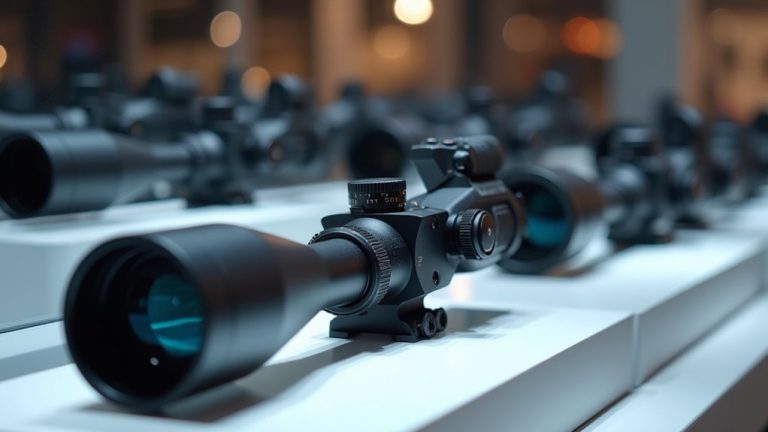
Understanding the basics of rifle scopes is essential for any shooter looking to improve their accuracy. A rifle scope typically consists of an objective lens that gathers light, an eyepiece for magnification, and a reticle that acts as your aiming point.
You’ll want to familiarize yourself with windage and elevation adjustments, which help you correct the point of impact for bullet drop and wind drift. Each click of the turrets usually adjusts by 1/4 inch at 100 yards.
Additionally, understanding height over bore is vital for aligning your shots accurately at various distances. With the right reticle design, whether simple or complex, you can enhance your target shooting experience and make precise adjustments when needed.
Choose the Right Ammunition
Choosing the right ammunition is essential for achieving accuracy with your rifle.
First, make sure you choose ammunition that matches your rifle’s caliber; using the wrong caliber can lead to malfunctions or safety hazards.
Next, pay attention to bullet weight; different weights can greatly affect your shots’ trajectory.
For initial sighting at 25 yards, full metal jacket (FMJ) bullets are often effective due to their predictable flight paths and lower cost for practice.
Additionally, consistency matters—using cartridges from the same brand and lot minimizes performance variations.
Finally, consider the velocity of the ammunition; higher velocity rounds typically provide a flatter trajectory, simplifying the sighting process.
These factors will enhance your overall shooting experience and accuracy.
Select a Suitable 25-Yard Range
After selecting the right ammunition, the next step is finding a suitable 25-yard range for sighting in your rifle.
This distance is ideal for initial sighting since it allows you to easily hit the target paper, even if your aim’s slightly off. A 25-yard range provides a solid baseline for adjustments, making it simpler to see where your shots land without complex calculations.
It’s particularly beneficial for beginners, as it streamlines the zeroing process. Many firearm and ammunition combinations stay consistent between 25 yards and longer distances, making this a practical starting point.
Prioritize Safety Measures
When you’re getting ready to sight in your rifle, prioritizing safety measures is essential to secure a safe and effective experience.
Always wear appropriate eye and ear protection to prevent injuries from recoil and noise.
Select a shooting location with a reliable backstop, confirming you know what lies behind your target to prevent accidents.
| Safety Measure | Purpose | Tips |
|---|---|---|
| Eye and Ear Protection | Prevent injuries | Always wear suitable gear |
| Reliable Backstop | Confirm safe shooting | Know the area behind the target |
| Stable Shooting Position | Enhance accuracy | Use sandbags or a shooting bench |
| Adequate Eye Relief | Prevent scope-related injuries | Adjust scope position as needed |
Begin With Initial Bore Sighting
To start your bore sighting, you need to align the scope reticle with a target feature at 25 yards while keeping your rifle stable.
If you have a laser bore sighting device, it can make this initial setup much easier.
Once you’re aligned, you’ll be ready to take your first shot and adjust accordingly.
Importance of Bore Sighting
Bore sighting is essential for ensuring your rifle scope is properly aligned with the barrel, as it saves you time and ammunition during the initial sighting process.
By aligning the rifle’s barrel with the scope’s reticle, you can make your initial shots land close to the target, minimizing adjustments.
A stable position is vital when bore sighting; any movement can lead to inaccurate initial adjustments.
You can use visual bore sighting by looking down the bore at a fixed point, ensuring both the barrel and scope are aligned.
This method helps reduce the number of shots needed to get on paper at longer distances, typically starting at 25 yards, allowing you to focus on perfecting your aim.
Tools for Bore Sighting
Several effective tools can make the process of initial bore sighting much easier.
A laser bore sighter is one of the best options; you can insert it into the muzzle, projecting a laser dot onto your target. This helps you align the scope without firing a shot.
Alternatively, you can visually align the scope reticle with a feature on the target through the bore. Just remember to do this from a stable rest to reduce movement and improve accuracy.
After completing the bore sighting, take a shot at 25 yards to establish a reference point for your initial adjustments.
These tools simplify the process and notably decrease the number of shots needed to get your scope perfectly dialed in.
Fire a Group of Three Shots
Stabilize your rifle on a shooting rest to minimize movement before you fire a group of three shots.
Stabilize your rifle on a shooting rest to reduce movement before firing a group of three shots for optimal accuracy.
This setup will help you achieve accuracy and consistency. Aim for the bullseye and focus on forming a tight shot group.
Once you’ve fired your three shots, take a close look at the target.
- Identify the center of your shot group.
- Calculate the distance from the bullseye.
- Make necessary windage and elevation adjustments on your scope.
These steps will help you understand your current accuracy and set you up to verify improvements.
Analyze Shot Placement
After you’ve fired your group of shots, it’s time to analyze shot placement.
Look closely at the distance between the center of your shot group and the bullseye; this will help you determine necessary adjustments. A tight shot group indicates good shooting consistency, while an off-center grouping suggests you may need to tweak your scope.
Measure the vertical and horizontal spread of your shots to identify if adjustments in windage or elevation are needed.
Don’t forget to keep track of the clicks made on the turrets, as each click typically represents a change of 1/4 MOA at 100 yards.
Also, consider environmental factors like wind and lighting that could impact your shot accuracy for future reference.
Make Windage and Elevation Adjustments
To guarantee your shots land where you intend, you’ll need to make precise windage and elevation adjustments. Understanding how to turn the turret will help you move your point accurately.
Follow these steps:
- Windage Adjustments: Turn the right turret; clockwise moves your impact point right and counterclockwise left.
- Elevation Adjustments: Use the top turret; counterclockwise raises your impact point, while clockwise lowers it.
- Track Click Moves: Each click typically equals 1/4 MOA, or 1/4 inch at 100 yards.
After making these adjustments, it’s essential to take a shot and analyze your group. This guarantees you’re on track for accurate shots and allows you to determine if further adjustments are needed.
Fine-Tune for Consistency
Achieving consistent shot placement requires meticulous attention to detail.
When sighting in a rifle, fire multiple groups of three shots, measuring the distance between the center of your shot group and the bullseye. This helps you assess accuracy and guarantee consistency.
After making adjustments to your scope, fire another group to verify that your shot placement aligns with your point of aim.
Allow the barrel to cool between shots to prevent heat-induced variations, and maintain a stable shooting position to minimize body movement and muscle tension.
Keep notes on all adjustments made during the sighting process; this will help you track changes and improve your shooting over time, leading to better accuracy on the range.
Confirm Accuracy With Additional Groups
Once you’ve fine-tuned your scope for consistency, it’s time to verify its accuracy with additional groups.
Once your scope is finely tuned for consistency, it’s crucial to check its accuracy with more shooting groups.
Start by shooting another group of three shots. This will help you assess the bullet impact and guarantee your scope is zeroed.
Follow these steps:
- Document the shot group centers to track your precision over time.
- If the group’s tight but off-center, adjust your scopes slightly to align the point of impact.
- Allow the barrel to cool between groups to prevent heat distortion.
These steps are essential for improving your accuracy.
Finalize Adjustments and Grouping
Now that you’ve made your initial adjustments, it’s time to analyze your shot groupings.
Look for consistency and center alignment on the target; if they’re off, you’ll need to make those final turret adjustments.
Once you’re satisfied, verify your accuracy by testing at a longer distance.
Analyze Shot Groupings
Evaluating your shot groupings is essential for fine-tuning your rifle scope.
After firing, check how well your shot group aligns with your aiming point to assess your accuracy.
Here are three key steps to contemplate:
- Tight Group: A tight shot group shows consistency in your shooting technique, confirming your adjustments are effective.
- Off-Center Group: If your shots are scattered, you may need to make additional turret adjustments based on the distance from the aiming point.
- Record Clicks: Keep track of the clicks for each adjustment; this helps refine future sighting and guarantees repeatable accuracy.
Once you’ve made adjustments, fire another group to confirm that your changes have aligned your scope with the target effectively.
Make Final Turret Adjustments
Making final turret adjustments is essential for ensuring your rifle scope is perfectly aligned with your target.
After analyzing your shot group, identify the center and calculate the necessary clicks to adjust the point of impact to match the point of aim.
Remember, at 25 yards, each click equals 1 MOA divided by 4, so adjust accordingly.
If your shot group is consistently off-center, focus on windage and elevation adjustments to bring your shots into alignment.
A tight shot group shows your adjustments are effective, while a widely dispersed group may indicate the need for further tuning.
Once you’ve made final turret adjustments, fire another group of shots to confirm that your changes have been successful.
Verify Accuracy Through Testing
Having completed your final turret adjustments, it’s time to verify your rifle’s accuracy through testing.
Start by firing a group of three shots to assess consistency. Analyze the center of your shot group in relation to the bullseye, and make necessary adjustments.
Here’s how to proceed:
- If the group’s tight but off-center, adjust the windage or elevation turrets.
- Document each adjustment and resulting shot placement for future reference.
- Allow the barrel to cool between shots to maintain accuracy.
Frequently Asked Questions
What Tools Do I Need for Sighting My Rifle Scope?
To sight your rifle scope, you’ll need a few essential tools.
First, grab a reliable rifle rest to stabilize your firearm. You’ll also want a target with clear markings for accuracy.
A screwdriver or Allen wrench is necessary for adjusting your scope’s mounts. A laser bore sight can make the process easier, too.
Finally, keep a notebook handy to track your adjustments and results for future reference.
How Do I Know if My Scope Is Mounted Correctly?
If your scope’s sitting pretty, you’ll know it’s mounted correctly.
Check the eye relief; you shouldn’t have to squint or strain to see through it.
Make sure it’s level and aligned with the rifle barrel.
When you look through the scope, the reticle should be clear and centered.
If it feels right and looks right, you’re likely in good shape.
Don’t hesitate to double-check if anything seems off!
Can I Sight in My Scope Without a Bench Rest?
Yes, you can sight in your scope without a bench rest.
While a stable platform helps, you can use a solid shooting position, like kneeling or sitting, to achieve good results.
Just make sure to control your breathing and maintain a steady hold.
If you practice consistently, you’ll still be able to get your scope dialed in accurately.
Focus on your target and make adjustments as needed for windage and elevation.
What if My Shots Are Consistently Low or High?
If your shots are consistently low or high, think of it like a dance—every adjustment counts.
You’ll want to tweak your scope’s elevation turret.
If you’re shooting low, raise your point of impact by turning the turret up; if it’s high, do the opposite.
Remember, small changes can lead to big improvements.
Keep practicing, and soon you’ll find your rhythm, hitting that target like a seasoned pro.
Stay patient; the journey’s worth it!
How Often Should I Re-Sight My Rifle Scope?
You should re-sight your rifle scope at least once a year or whenever you notice a change in performance.
Factors like temperature fluctuations, transportation, or even a fall can affect your scope’s accuracy.
If you change ammunition or if your shooting conditions vary considerably, it’s a good idea to check your zero as well.
Regular maintenance guarantees you’ll be ready for any hunting or shooting opportunity that comes your way.
Conclusion
By following these eleven easy steps, you’ll transform your rifle-sighting skills into a seamless symphony of precision.
With practice, patience, and proper procedures, you’ll hit your target with pinpoint perfection.
Remember, a well-sighted scope not only boosts your confidence but also enhances your shooting success.
So, get ready to gear up, aim accurately, and enjoy the exhilarating experience of every shot hitting the mark.
Happy shooting, and may your aim always be true!
And with these techniques, you’ll master sighting your rifle scope at 25 yards.