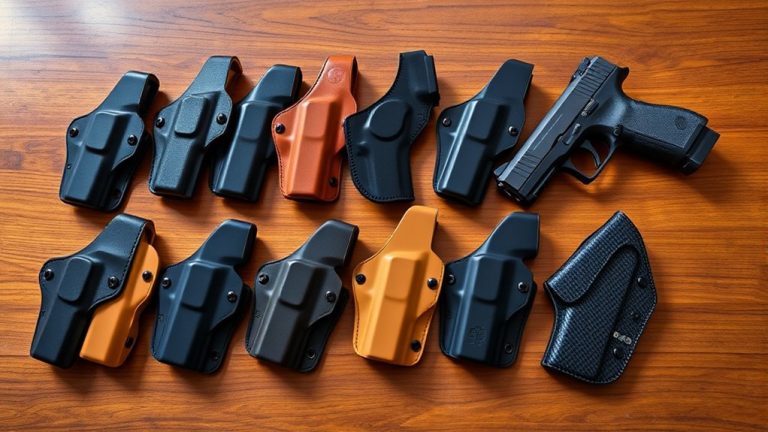
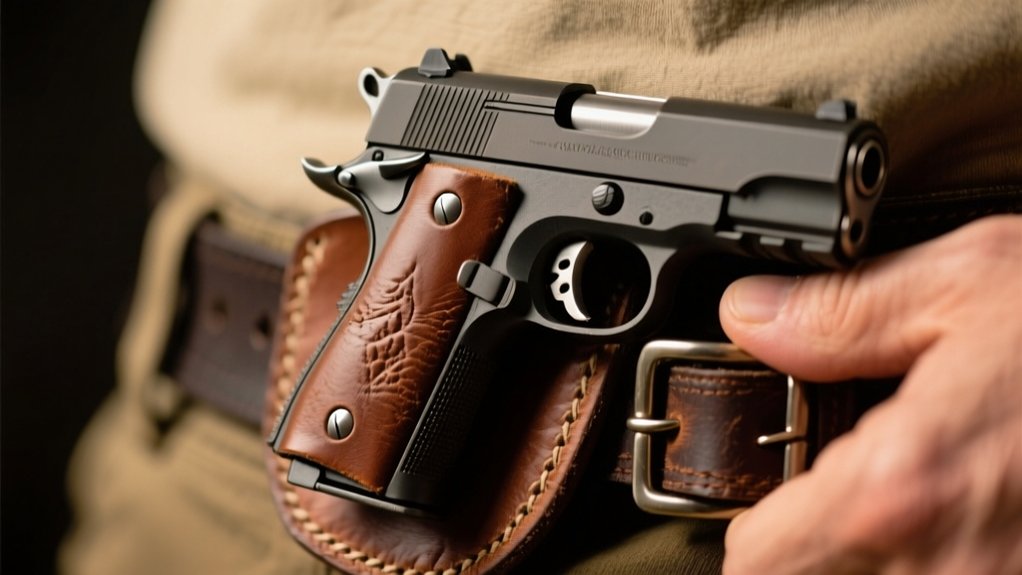
What Does a Holster Claw Do?
A holster claw tucks your firearm’s grip closer to your body, markedly reducing printing and improving concealment by using the stiffness of your gun belt as support. It attaches under the trigger guard and can be adjusted for ride height and angle to improve comfort and stability.
Made from durable composite materials, it prevents your firearm from printing or shifting during movement. If you want to optimize your carry setup, understanding how it interacts with different positions and holster types is key.
Understanding the Holster Claw Mechanism
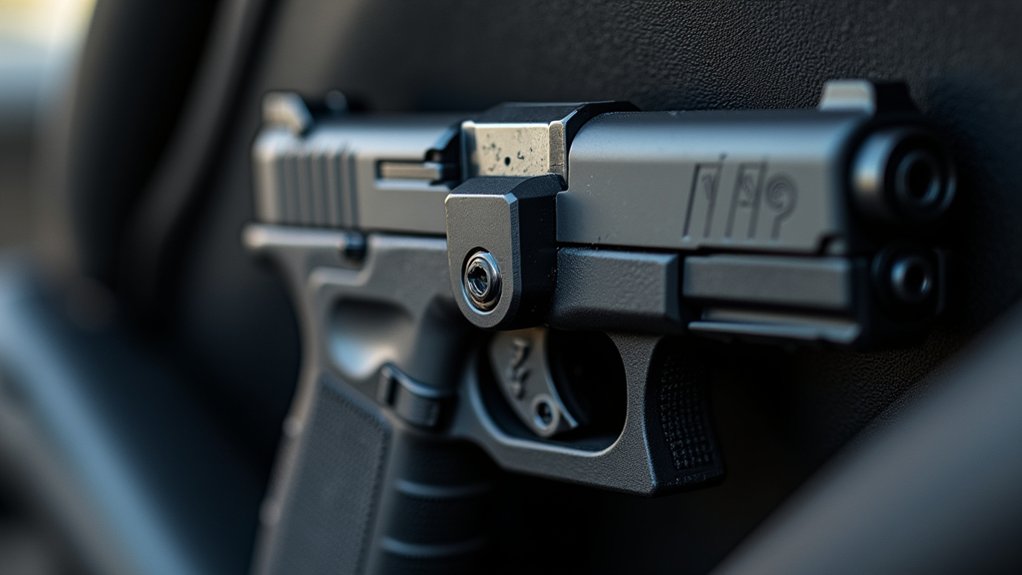
While concealed carrying, you’ll find the holster claw plays an essential role in minimizing printing by tucking your firearm’s grip closer to your body.
Holster claws use force against a sturdy gun belt to push the grip back, achieving better grip concealment and a sleeker profile. This mechanism mounts under the trigger guard of an inside-the-waistband holster, ensuring your firearm remains discreet.
You can adjust the claw’s ride height and cant to customize comfort and effectiveness based on your carry position. Made from durable composite polymer, the claw resists bending or breaking during daily wear, maintaining reliability.
Over time, various claw designs have emerged, allowing you to select one that fits your specific needs. Understanding this mechanism lets you optimize your concealed carry experience.
For best results, it’s crucial to choose holsters designed for claw compatibility and ensure the installation is secure to maximize concealment and comfort.
How the Holster Claw Improves Concealment
You’ll notice the holster claw pushes the firearm’s grip inward, which really cuts down on printing and makes the gun less visible under your clothes.
It works by using the stiffness of your gun belt to keep the firearm snug against your body. This helps shape your silhouette in a way that makes concealment much easier.
But it’s not just about hiding the firearm. This little adjustment also boosts your comfort and confidence when you’re carrying.
Holster claws are especially effective because they rely on the body’s natural curve and the leverage created by your belt to minimize printing, making them a favorite accessory among concealed carriers.
Minimizes Gun Printing
Anyone carrying a concealed firearm knows that gun printing can compromise discretion. A holster claw tackles this issue by pushing the grip inward against your body. This simple yet effective mechanism markedly reduces printing, helping you maintain a low profile.
By leveraging the rigidity of a quality gun belt, the holster claw tucks the grip closer to your waist, making the firearm less visible under clothing. Whether you carry appendix or at 3-5 o’clock, the holster claw adapts to your style and body type.
Using a holster claw helps you:
- Carry larger firearms discreetly without worry
- Reduce printing, enhancing overall concealment
- Feel confident knowing your firearm stays hidden
Enhances Body Contour
Because the holster claw presses the firearm’s grip inward against your belt, it naturally follows your body’s curve to improve concealment.
This design tucks the grip closer, boosting your body contour and reducing any visible bulge.
By aligning with your natural shape, the holster claw minimizes printing, making it easier to carry discreetly.
You can adjust the angle and depth of the claw to fit various carry positions and body types, ensuring a tailored concealment experience.
This adaptability not only boosts comfort but also secures the firearm firmly against you.
Whether you prefer appendix or another carry style, the holster claw improves concealment by molding the firearm to your body, providing a seamless, low-profile carry that’s both secure and comfortable.
Additionally, holster claws work especially well with slim profile materials, enhancing both comfort and concealment for a more discreet carry.
Different Carry Positions Compatible With a Holster Claw
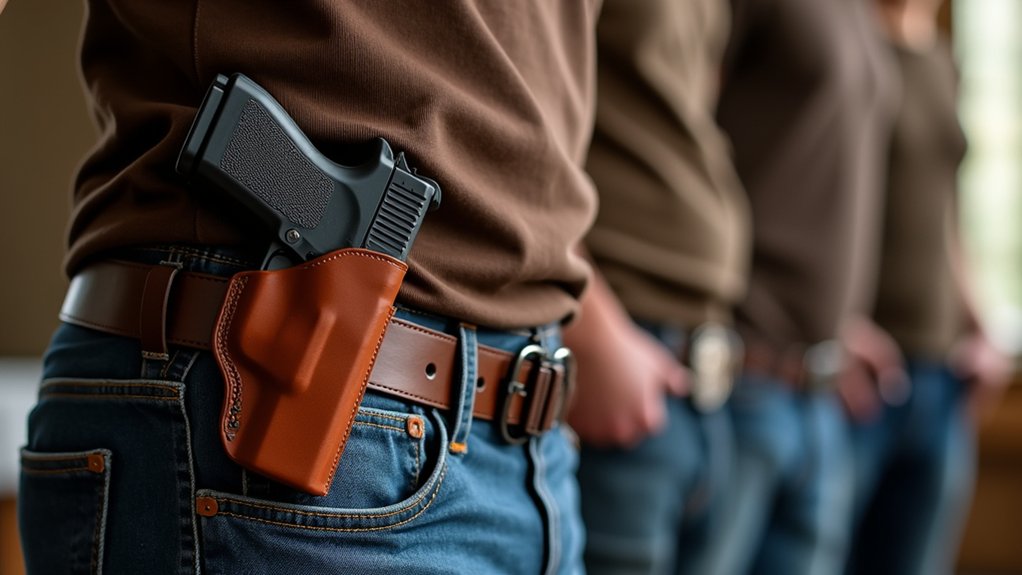
While the holster claw excels in multiple carry positions, it proves especially effective in appendix carry and along the 3-5 or 7-9 o’clock spots.
It utilizes your gun belt’s rigidity to push the grip closer to your body, reducing printing and improving concealment.
You can fine-tune ride height and cant to suit your comfort and holster options. The claw is also removable, offering flexibility when switching carry styles.
Consider these benefits when choosing your carry position:
- Improved concealment in appendix carry, minimizing grip visibility
- Enhanced comfort and accessibility in strong side 3-5 o’clock carry
- Better concealment at 7-9 o’clock, especially when seated or driving
Experiment with these positions to find what works best for your body type and wardrobe.
For increased effectiveness, make sure your holster fully covers the trigger guard to ensure safety and minimize the risk of accidental discharge.
The Importance of Wearing a Belt With a Holster Claw
You need a sturdy belt to guarantee your holster claw functions properly. That’s because it relies on the belt’s rigidity to press the firearm grip inward, which helps with better concealment.
So, choosing a high-quality gun belt really makes a difference. It improves the claw’s effectiveness by keeping the right amount of torque and stability.
Without the right belt, your holster claw can’t really do its job. It won’t reduce printing well, nor provide the comfort and support you need for reliable concealed carry.
Belt Support Necessity
Although a holster claw improves concealment by pushing the firearm grip closer to your body, it only works effectively when paired with a sturdy, well-aligned belt.
The belt provides the necessary rigidity and support for the concealment claw to hold your firearm securely against your body, minimizing printing and shifting. Without a proper belt, the claw can’t maintain tension, making concealment unreliable and uncomfortable.
You need a belt that offers strong, durable support designed for concealed carry. It should align perfectly with the concealment claw to guarantee stability.
Plus, it needs to keep your firearm securely in place during movement.
Wearing the right belt is essential to maximize your holster claw’s function and maintain effective, comfortable concealment all day long.
Enhancing Claw Effectiveness
Because a holster claw depends on the rigidity of your belt to push the firearm grip closer to your body, wearing the right belt is vital for maximizing its effectiveness.
A sturdy gun belt provides the necessary support for the claw to tuck the grip securely, improving concealment and reducing printing.
Ordinary belts lack the support to maintain this significant pressure, allowing the firearm to shift or become visible.
By wearing a quality gun belt, usually made of leather or nylon, you guarantee the claw stays firmly in place during movement.
Proper torque of the belt around your waist further boosts the claw’s performance, keeping your firearm close and secure.
Combining a reliable claw with an appropriate gun belt is key to effective, comfortable concealed carry.
Choosing Proper Gun Belt
Every holster claw setup demands a proper gun belt to function at its best. Without the right support, the claw can’t push your firearm’s grip back toward your body effectively.
A sturdy gun belt prevents sagging and keeps the holster claw stable during movement, reducing printing and boosting comfort.
When choosing your gun belt, focus on these essentials:
- Rigidity to maintain holster claw position
- Durable materials for long-lasting support
- Comfortable fit to improve carrying stability
Brands like Vedder Holsters offer top-quality belts designed specifically for holster claws.
Wearing a proper gun belt isn’t just about function. It guarantees your concealed carry stays secure and comfortable all day.
Don’t underestimate how critical a solid gun belt is for maximizing your holster claw’s performance.
Materials and Durability of Holster Claws
When you rely on a holster claw to secure your firearm, the materials used directly impact its durability and effectiveness. Most holster claws are crafted from composite polymers, specifically two-part resins, which provide the strength needed to resist bending or breaking during daily use.
This durability is essential, especially in an appendix holster, where consistent retention and stability are imperative. Manufacturers continuously refine their designs and materials to improve performance based on user feedback and rigorous testing.
While plastic and polymer remain the standard, some high-end claws incorporate advanced materials or finishes to prolong longevity.
Choosing a holster claw with proven durability guarantees reliable firearm retention without sacrificing concealment or function during everyday carry.
Comfort Factors When Using a Holster Claw
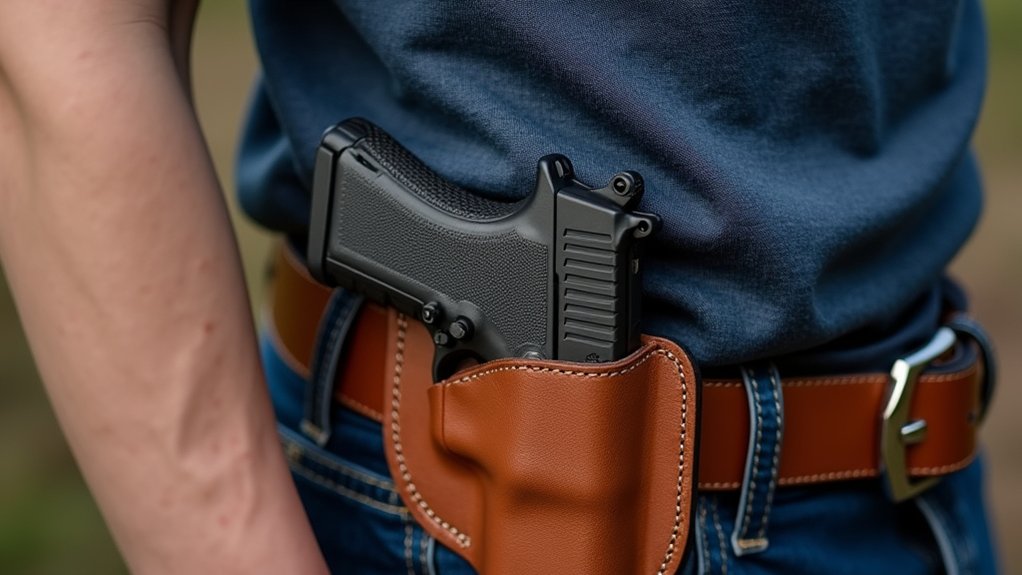
Beyond durability, the comfort you experience while carrying your firearm greatly depends on how the holster claw interacts with your body. The claw pushes the grip closer to you, reducing printing and redistributing weight to make extended wear less burdensome.
Comfort while carrying hinges on the holster claw’s ability to reduce printing and redistribute weight effectively.
You’ll notice a more secure feel, which boosts confidence and mental comfort. Adjusting the ride height and cant can further improve comfort tailored to your body type.
Consider these comfort factors when using a holster claw:
- Reduced printing means you carry more discreetly and relax knowing your firearm is concealed.
- Weight redistribution prevents discomfort and fatigue during long periods of carry.
- A secure fit keeps your firearm stable, so you feel confident moving naturally.
Comparing Popular Holster Claw Designs
Although holster claws share the common goal of improving concealment and comfort, their designs differ markedly in features and functionality.
The Raven Concealment VG Wing set the standard with a reliable mounting pattern that’s widely adopted for appendix position carry, enhancing grip tuck effectively.
The Mod Wing offers ambidextrous use and adjustable advantage but risks loosening due to its multiple parts.
Darkstar Gear’s Dark Wing features a steep angle, ideal for larger firearms, though its sharp backside can irritate your thigh.
Meanwhile, the DIY Holster Claw provides a basic, no-frills option amid supply issues but lacks unique benefits.
When choosing holster claws, consider size, material, and aggressiveness, as these factors influence performance and comfort tailored to your appendix position carry style.
Adjusting Ride Height and Cant With a Holster Claw
Since the ride height and cant of your holster claw directly affect comfort and concealment, you need to adjust them carefully.
Modifying these settings guarantees your firearm sits comfortably and remains discreet, enhancing your carry experience. You can usually adjust ride height and cant by repositioning the mounting screws on the claw. This lets you tailor the fit to your body type and carry style.
When you fine-tune these elements, you’ll reduce printing by tucking the grip closer to your body. You’ll also achieve a natural draw angle for smoother access and maximize comfort during extended wear.
Experiment systematically with ride height and cant adjustments to find what feels best.
This personalized setup is key to balancing concealment and quick, comfortable access.
Effect of the Holster Claw on Draw Speed and Technique
The holster claw actually changes the angle of your firearm’s grip, so you’ll want to tweak your draw technique a bit to keep things quick and controlled.
It helps lock the gun against your body, which can really improve how secure your grip feels.
But because of that, practicing is key—you’ll need to build smooth muscle memory to make it second nature.
With some solid training and the right adjustments, you can boost your draw speed without giving up safety.
Draw Speed Impact
Many users find that the holster claw greatly influences their draw speed by altering the firearm’s grip angle, which requires adjustments in hand placement and technique.
This change in the grip of the gun may initially slow your draw speed as you adapt, but with practice, it can lead to smoother, faster draws.
The claw pushes the grip closer to your body, enhancing stability and helping you acquire a secure grip more quickly.
To optimize your draw speed with a holster claw, consider these points:
- Initial practice develops muscle memory for consistent hand placement
- The claw’s pressure stabilizes the firearm, reducing unnecessary movement
- Adaptation can ultimately increase your draw speed in real scenarios
Mastering these aspects guarantees your draw is both swift and reliable.
Technique Adjustments Needed
Although the holster claw improves firearm stability by pushing the grip closer to your body, it demands deliberate adjustments to your draw technique to maintain speed and efficiency.
The altered grip angle requires you to modify your hand positioning during the draw, which can initially slow your access to the firearm.
To counter this, you need to practice consistently, especially during dry fire sessions, to build muscle memory for the new grip dynamics.
Over time, this adjustment leads to a more secure hold, improving both accuracy and follow-up shot speed.
Training with a qualified instructor is recommended to fine-tune your draw technique, ensuring it complements the holster claw’s design and your tactical needs without compromising rapid deployment.
Additionally, regularly checking holster positioning helps ensure that the claw maintains optimal concealment and stability during daily activities.
Holster Claw Compatibility With Various Holster Types
When you choose a holster claw, understanding its compatibility with your holster type is essential for effective concealment.
Holster claws are primarily designed for inside the waistband (IWB) holsters, including AIWB holsters, to tuck the firearm grip closer to your body and reduce printing.
Most claws fit a variety of IWB holsters, but specific models like the Raven Concealment VG Wing require matching mounting holes for proper installation.
Many claws are adjustable, letting you customize fit and angle for your body type and carry preference.
Consider these points when selecting a holster claw for your rig:
- Compatibility with your specific IWB holster brand and model
- Adjustable features for personalized concealment
- Whether your holster supports claw attachment or requires modification
This guarantees maximum concealment and comfort inside the waistband.
User Experiences and Feedback on Holster Claws
Understanding how holster claws perform in real-world use can help you gauge their value beyond technical compatibility. Users consistently report that holster claws markedly improve concealment by helping you avoid printing, keeping the gun’s grip close to your body.
Many find installing the claw straightforward, with minimal hassle. Feedback also highlights improved comfort, as the claw redistributes the gun’s weight for a more secure carry.
You’ll appreciate its versatility, effective across various carry positions, not just appendix carry. Positive user experiences show the claw boosts confidence in concealed carry by reducing worries about gun visibility under typical clothing.
Choosing the Right Holster Claw for Your Needs
How do you choose the right holster claw that fits your specific needs? Selecting a holster claw depends on your carry position, body type, and personal comfort. You want a claw that improves concealment without sacrificing ease of draw.
Choosing the right holster claw enhances concealment while maintaining comfort and quick access tailored to your body and carry style.
Consider these key factors:
- Carry position: Choose a claw designed for appendix, 3-5 o’clock, or 7-9 o’clock carry based on what suits your body type and style.
- Adjustability: Opt for claws with adjustable depth and angle to tailor fit your holster and clothing.
- Material and compatibility: Select durable composite polymers compatible with your holster model to guarantee longevity and stability.
Test different designs to find the perfect balance between comfort, concealment, and secure carry tailored to your unique body type.
Frequently Asked Question
Can a Holster Claw Be Used With Left-Handed Carry?
Yes, you can use a holster claw with left-handed holsters, but you’ll want to check holster compatibility first.
Many claws are ambidextrous or adjustable, letting you mount them on the opposite side for left-handed carry.
You can customize the angle and depth to improve comfort and concealment, just like with right-handed setups.
Always verify your specific holster model supports left-handed use before purchasing to guarantee proper fit and function.
Does a Holster Claw Add Significant Weight to the Holster Setup?
You won’t notice a significant weight increase from a holster claw since it adds only a few ounces.
Its lightweight design helps with better weight distribution, enhancing holster comfort during extended wear.
By reducing printing without making your setup cumbersome, it balances concealment and ease of carry.
Are Holster Claws Legal in All States or Regions?
Holster claw legality isn’t uniform across all states or regions. You need to check your state regulations carefully, as some places have specific rules about firearm accessories that could affect using a holster claw.
While most states allow them, especially where concealed carry is permitted, others may have restrictions.
Staying informed guarantees you comply with local laws and avoid legal trouble when using a holster claw with your setup.
How Easy Is It to Install a Holster Claw on an Existing Holster?
Installing a holster claw on your existing holster is as straightforward as assembling a simple puzzle.
With the right installation tips, you’ll find the process smooth and hassle-free.
Most claws come with custom hardware kits ensuring holster compatibility, and manufacturers usually provide clear guides.
You’ll just need a Philips head screwdriver to remove and replace screws.
Plus, you can easily adjust the claw’s depth and angle to suit your carry style perfectly.
Can a Holster Claw Cause Damage to Clothing Over Time?
Yes, a holster claw can cause clothing wear over time, especially where it constantly rubs against your fabric.
You might notice creases, stretched areas, or even fabric damage if the claw presses too hard or snags delicate materials.
To protect your clothing, consider using thicker fabrics and regularly inspect your garments for early signs of wear.
Taking these steps helps maintain fabric protection while you carry comfortably and securely.
Conclusion
Think of a holster claw as the secret anchor that keeps your firearm snug and hidden, like a shadow clinging to your side. By boosting concealment and stabilizing your carry, it transforms your holster from just a holder into a stealthy partner.
When paired with the right belt and carry position, it improves both comfort and draw speed. Choosing the right holster claw isn’t just smart; it’s essential for confident, reliable carry every day.