Understanding Parallax in Rifle Scopes – A How-To Guide
Understanding parallax in rifle scopes is essential for accurate shooting. Parallax, an optical phenomenon, can shift your reticle from the target, especially at distances over 150 yards.
To detect parallax, watch for reticle movement when shifting your head.
Use the parallax adjustment knob to align your scope with your target distance. Proper scope alignment and practice can enhance your shooting performance.
There’s a lot more to mastering parallax, so stick around for further tips and techniques to improve your accuracy.
Key Takeaways
- Parallax error occurs when the reticle shifts relative to the target during head movement, affecting shooting accuracy, especially beyond 150 yards.
- To identify parallax issues, observe reticle movement while shifting your head; noticeable movement indicates a misalignment that needs adjustment.
- Use the parallax adjustment knob to match the target distance with yardage markers, ensuring the reticle focus aligns with the target.
- Regularly verify reticle stability by conducting head movement tests after adjustments to confirm proper alignment before taking shots.
- Consistent practice with parallax adjustments enhances muscle memory, accuracy, and overall shooting performance by improving target focus.
What Is Parallax and Why Does It Matter?
Parallax can be a game-changer when it comes to shooting accuracy.
This optical phenomenon affects how the reticle appears in relation to your target, especially when your head shifts.
When you’re aiming, any misalignment—known as parallax error—can lead to significant shooting inaccuracies, particularly at distances beyond 150 yards.
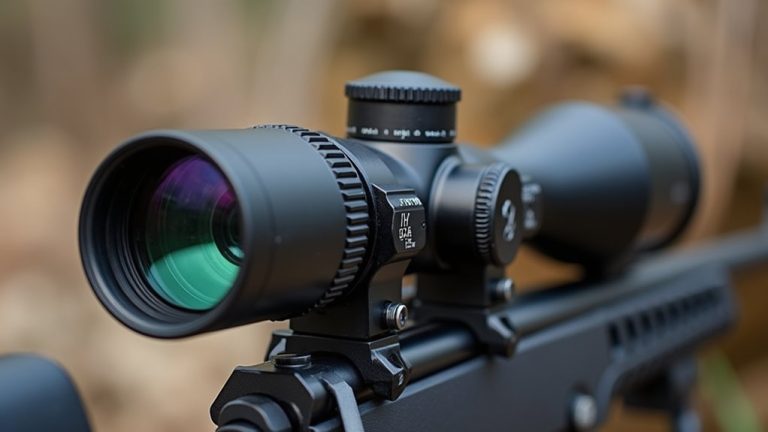
To combat this, you’ll want to use the parallax adjustment knob on your riflescope.
By adjusting the parallax setting, you align the reticle focus with the target’s focal plane, minimizing error.
This alignment is vital for target shooters seeking precision, especially when hitting small targets at varying distances.
Mastering parallax can drastically improve your overall shooting performance, making it an essential skill to develop.
Detecting Parallax Issues in Your Scope
To detect parallax issues in your scope, start by focusing on a target and observe how the reticle moves as you shift your head slightly.
If you notice the reticle changing position relative to the target, that’s a sign of parallax.
You should also adjust the parallax knob and perform this test at various distances to fully gauge any effects.
Identifying Reticle Movement
While you might think your scope is perfectly calibrated, detecting reticle movement is essential for guaranteeing accurate shooting.
To identify parallax issues, focus on a stable target and slightly move your head in different directions while keeping the rifle stationary.
If the reticle moves with your head movement, it indicates parallax, which can affect your point of impact. This issue worsens at distances over 150 yards, especially with higher magnification.
| Action | Result |
|---|---|
| Move head slightly | Observe reticle movement |
| Reticle moves | Parallax issue detected |
| Maintain target focus | Guarantee accuracy |
| Adjust for parallax | Stabilize reticle |
| Check regularly | Confirm successful management |
Head Movement Test
Detecting parallax issues in your scope is vital for maintaining accuracy, so performing a head movement test can be an effective way to identify any problems.
Begin by aiming at a stable target with your rifle stationary. Next, move your head behind the scope slightly up, down, left, and right.
If the reticle shifts in relation to the target, parallax is present. Before conducting this test, make sure you’ve adjusted the parallax knob to match the distance to the target for accurate results.
A well-adjusted scope will show no movement of the reticle during your head movements, confirming effective parallax management.
Regularly performing this test is important, especially at longer distances where parallax can greatly impact your shooting accuracy.
Adjusting Parallax Knob
Adjusting the parallax knob is essential for ensuring your rifle scope delivers accurate performance.
To detect parallax issues, focus on a stable target. Move your head slightly in various directions while observing how the reticle appears to move in relation to the target.
If it shifts, parallax is present. You’ll need to adjust the parallax knob on your scope to match the distance to your target, aligning both images on the same focal plane.
After adjustments, repeat the head movement test to confirm the reticle remains fixed, indicating successful parallax elimination.
Regularly check these settings, especially with changing shooting distances, to maintain accuracy.
| Distance (Yards) | Reticle Alignment | Action Required |
|---|---|---|
| 100 | Off | Adjust the parallax knob |
| 200 | Slightly off | Recheck focus |
| 300 | Aligned | No action needed |
| 400 | Off | Adjust & retest |
How to Adjust the Parallax Knob for Accuracy
To adjust the parallax knob for accuracy, you first need to identify any parallax issues by checking how the reticle moves as you shift your head.
After determining the distance to your target, use the yardage markers on the knob to make the necessary adjustments.
Finally, test the stability of the reticle to guarantee it stays fixed on the target before you take your shot.
Identifying Parallax Issues
Identifying parallax issues is essential for precise shooting, and it starts with a simple test.
Focus on your target image and move your head slightly left and right while keeping your rifle still. If you notice the reticle shifting relative to the target, parallax is present.
To eliminate parallax, adjust the focus using the parallax knob to match the distance to your target. After making these adjustments, repeat the head movement test to verify the reticle remains stable without any shifting.
Regularly check and adjust the knob, especially when changing shooting distances, to maintain accurate reticle alignment.
Adjusting for Distance
When you’re setting up for a shot, knowing the distance to your target is essential for adjusting the parallax knob accurately.
Here’s how to do it effectively:
- Use the yardage markers on the parallax knob to set the distance.
- Make certain your eye is behind the scope and in the correct position.
- Aim at the target without shifting your focus.
- Perform a head movement test; shift left and right to check reticle stability.
- Fine-tune until the reticle in focus remains steady, confirming the target and reticle are on the same plane.
Testing Reticle Stability
While aiming at your target, it’s crucial to guarantee that the reticle remains stable, as any movement can indicate parallax issues that might lead to inaccurate shots.
To test reticle stability, keep your rifle stationary and gently move your head left and right. If your reticle shifts relative to the target, that’s a sign of parallax.
Adjust the parallax knob on the side of your scope to verify that your reticle aligns with the target image. Remember to match the adjustments to the target distance.
After making these adjustments, repeat the head movement test to confirm your reticle stays fixed on the target. Regular practice will enhance your understanding of your scope’s adjustments and improve shooting accuracy, especially at longer distances.
The Importance of Proper Scope Alignment
Proper scope alignment is essential for any shooter looking to enhance accuracy and minimize parallax error. Misaligning your scope can lead to frustrating accuracy issues, particularly at longer shooting distances.
Here are key factors to guarantee proper scope alignment:
- Correct eye relief keeps your vision clear and prevents injury.
- Level positioning guarantees the reticle stays true to the target.
- Adjust the parallax knob based on your shooting distance for ideal reticle and target focus.
- Utilize quality mounts and rings for stable installation.
- Regularly check alignment to maintain consistent performance.
Managing Parallax for Long-Range Shooting
Managing parallax for long-range shooting is essential, as even minor shifts can lead to significant accuracy issues.
First, verify your parallax adjustment knob is set to match the distance to your target. At distances over 150 yards, incorrect settings can cause serious aiming errors.
After adjusting, conduct a head movement test; if the reticle shifts from the point of aim when you move your head, you need more adjustments.
For instance, at 300 yards, parallax can shift the reticle by about 1.5 inches.
Use the side focus dial on your scope to fine-tune this adjustment, confirming the reticle is in focus with the target image on the same focal plane, enhancing your overall field of view and shooting precision.
Tips for Practicing Parallax Adjustments
To effectively practice parallax adjustments, aim at a target and gently move your head side to side while keeping your rifle steady.
Observe any movement of the reticle in relation to the target, adjusting as needed. Here are some tips to enhance your practice:
- Use a clear backdrop, like a bright sky or white wall, to sharpen the reticle focus.
- Make small adjustments to the parallax knob, ensuring the reticle and target share the same focal plane.
- Regularly shift your head after each adjustment to confirm the reticle remains stable.
- Familiarize yourself with yardage markers on the parallax dial to match settings to your target distance.
- Consistent practice will improve your accuracy as you learn how your movements affect parallax adjustments.
Frequently Asked Questions
How Does Parallax Work on a Rifle Scope?
Parallax in a rifle scope occurs when your eye isn’t perfectly aligned with the optical center, causing the reticle to shift in relation to the target.
This misalignment can lead to inaccuracies, especially at longer distances. To correct it, you can adjust the side focus dial on your scope, aligning the reticle with the target.
What Does Parallax Setting 100 Yards Mean?
“You can’t hit what you can’t see.” A parallax setting of 100 yards means your riflescope is designed to eliminate parallax error when your target’s at that distance.
This setting aligns the reticle and target image, ensuring accuracy. If your target’s closer or farther, you’ll need to adjust the parallax knob to maintain precision.
What Is a Parallax for Dummies?
Parallax is when your reticle (the crosshairs) seems to shift away from the target when you move your head or eye.
If you’re not perfectly aligned, it can cause you to miss your shot, especially at longer distances.
To fix this, you’ll need to adjust your scope’s parallax setting to match the distance you’re shooting.
At What Distance Does Parallax Matter?
Parallax can matter considerably at distances beyond 150 yards.
If you’re hunting or shooting at shorter ranges, you may not notice it, but as you reach 300 yards, it can shift by up to 1.5 inches.
At 600 yards, that discrepancy might grow to around 3 inches.
For big game, fixed parallax scopes often suffice, but for target shooting, precise adjustments become essential to guarantee accuracy and consistency in hitting your mark.
Conclusion
In the world of shooting, mastering parallax is like fine-tuning a musical instrument—you want every note to hit just right.
By understanding and adjusting for parallax, you’re not just improving your accuracy; you’re crafting a symphony of precision with each shot.
So, take the time to practice and align your scope properly.
With patience and skill, you’ll transform your shooting experience from mere aim to an art form, where every pull of the trigger resonates with confidence in your parallax settings.