
What Is a Melee Weapon? Know All Details About It
A melee weapon is your tool for close-range combat, relying on your physical skill and stamina rather than ammunition. You’ll find them in trauma, edged, or pointed categories, each with unique impacts like blunt force or precise cutting.
Proper maintenance keeps them reliable, while specific boost gear can improve performance. There are also legal considerations you must keep in mind.
If you want a clearer tactical edge and deep insights into weapon types and uses, there’s a lot more to investigate.
Key Takeaways
- Melee weapons are close-range combat tools including trauma, edged, and pointed types used without ammunition.
- They rely on physical stamina and skill, requiring proper maintenance for durability and effectiveness.
- Categories include blunt weapons (clubs, maces), edged weapons (swords, knives), and pointed weapons (spears, javelins).
- Unique weapon effects and gear boosts like the Mechanical Glove enhance melee combat performance and strategy.
- Legal restrictions vary by location, making it essential to check laws before acquiring or using melee weapons.
Definition and Importance of Melee Weapons
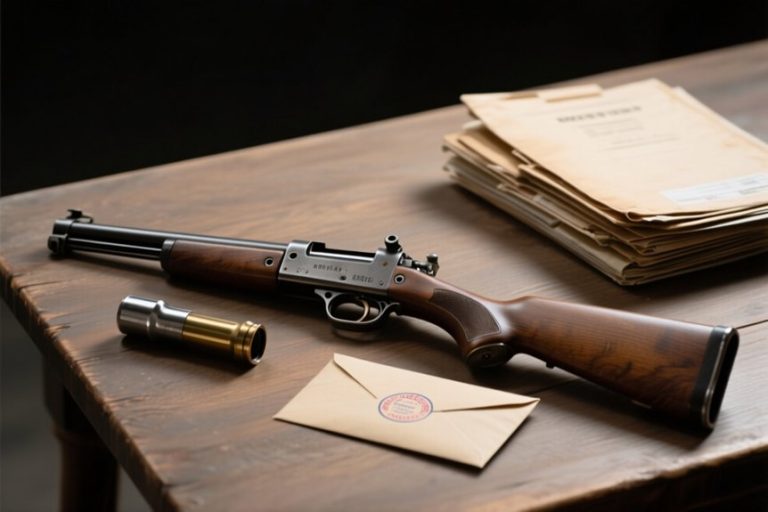
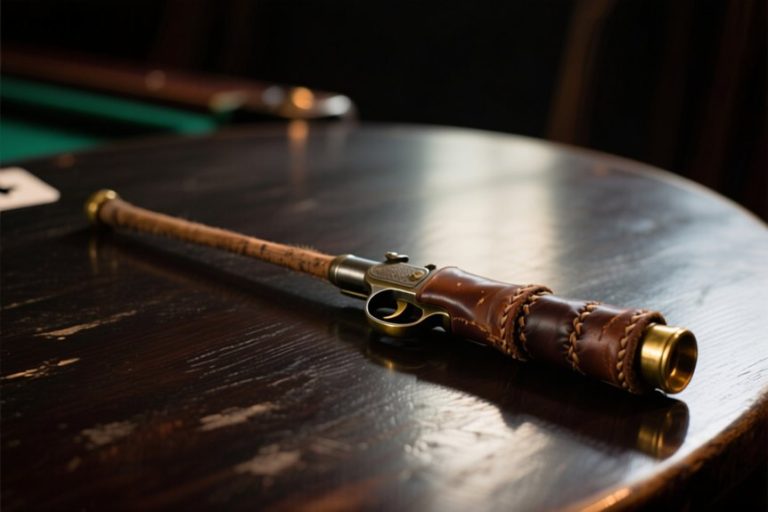
Melee weapons serve as fundamental tools for close-range combat, encompassing a range of designs from simple clubs to advanced swords. When you investigate melee weapon types, you see they include trauma weapons, edged weapons, and pointed weapons, each designed for specific combat scenarios.
The significance of melee weapons lies in their reliability and independence from ammunition, which makes them essential for survival situations where resources run low.
You must understand that using these weapons effectively demands physical stamina and skill, as they rely entirely on your energy and technique.
Additionally, maintenance plays a pivotal role; neglecting upkeep can diminish their performance.
Recognizing these factors helps you appreciate why melee weapons remain relevant despite modern firearms.
Categories of Melee Weapons
You’ll find melee weapons fall into three key categories: trauma, edged, and pointed. Each has its own unique characteristics that shape how they’re used in combat.
Trauma weapons work by delivering blunt force to incapacitate an opponent. On the other hand, edged weapons are all about cutting or slicing through targets.
Then, you’ve got pointed weapons, which excel at thrusting and sometimes throwing. Knowing these classifications really helps you understand how different designs influence effectiveness and tactical choices in a fight.
Types and Classifications
Although weapons come in many forms, they generally fall into three primary categories: trauma, edged, and pointed.
Trauma weapons, like clubs or hammers, inflict damage through blunt force, while edged weapons such as knives and swords use sharp blades to cut or slice.
Pointed weapons, including spears and pikes, serve both as melee and ranged tools, offering versatility.
Understanding melee weapon classification in criminal law is essential, as it defines legal treatment and examples of melee weapons in offenses.
Improvised weapons, made from everyday items, further complicate classification.
By grasping these types and classifications, you can better analyze combat strategies or legal contexts where weapon type influences outcomes.
This emphasizes the importance of precise categorization in both practical and judicial settings.
Weapon Characteristics
Understanding weapon characteristics is essential when evaluating their practical application and effectiveness in close combat. Melee weapons fall into three main categories: trauma weapons, edged weapons, and pointed weapons.
A blunt weapon, such as a club, belongs to the trauma category, delivering damage through blunt force trauma rather than cutting or piercing. Each category has unique traits like weight, reach, and handling that directly influence combat effectiveness.
For example, a blunt weapon offers impact force but may lack precision, while edged and pointed weapons excel in cutting and piercing, respectively. Recognizing these differences helps you select the best weapon for specific scenarios.
Moreover, improvised melee weapons can adapt everyday objects to these categories, expanding your tactical options in survival situations.
Maintenance and Risks of Using Melee Weapons
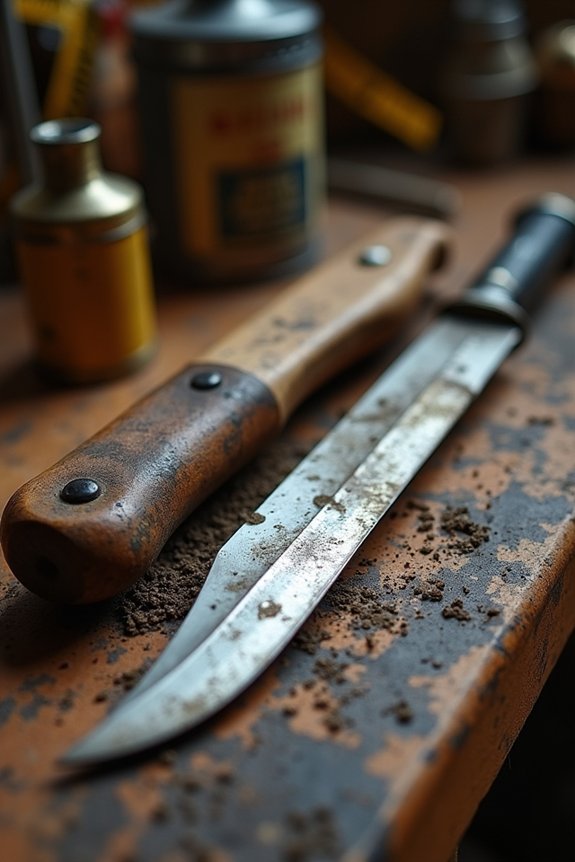
Since melee weapons demand regular maintenance like sharpening and cleaning, neglecting these tasks can compromise their effectiveness and durability. You’ll need to commit to routine upkeep to guarantee peak performance during hand-to-hand combat.
The maintenance and risks of using melee weapons go beyond just the weapon’s condition; you must consider infection risks from blood splatter or bites, making protective gear essential.
Combat fatigue also plays a critical role. Prolonged use can exhaust you, increasing vulnerability.
Selecting a weapon suited to your physical capabilities and mastering proper technique through training minimizes accidents and injury.
Understanding these factors helps you manage both the mechanical and physical challenges inherent in melee weapon use, guaranteeing safer and more effective engagement in close-quarters combat.
Types of Blunt Melee Weapons
Managing the challenges of melee weapon use means knowing which type suits your combat style and objectives. Blunt melee weapons rely on impact rather than cutting, with the club weapon being the simplest and most versatile example.
Consider these key types:
- Club Weapon: Often improvised from branches, clubs deliver forceful trauma and are easy to handle, perfect for quick, powerful strikes.
- Mace: Engineered to damage armored foes, its heavy head concentrates force to penetrate defenses, ideal against heavily protected enemies.
- War Hammer: Designed for mounted combat, it focuses impact on a small area, effectively dismounting riders and breaking armor.
Understanding these distinctions helps you select the blunt melee weapon that aligns with your tactical needs and maximizes combat efficiency.
Types of Edged Melee Weapons
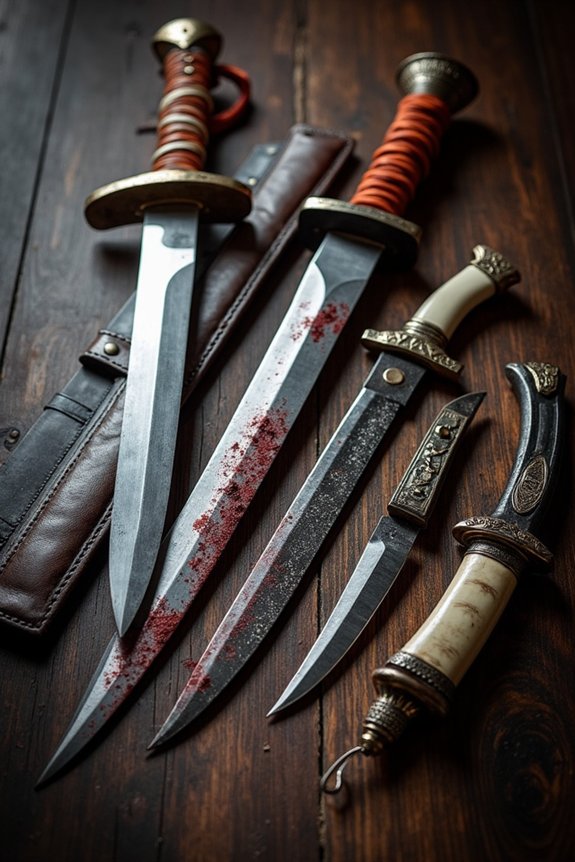
Edged melee weapons excel at cutting, slashing, and thrusting, offering a range of tactical options depending on your combat needs.
As an edged weapon, swords stand out for their versatility, from the Copper Shortsword’s modest damage to the formidable Meowmere’s 200 damage output.
Knives like the Bowie and Kukri serve as reliable cutting weapons, balancing combat effectiveness and utility.
Axes, whether hand-held or double-bit, deliver significant cutting power in close quarters and can double as throwing weapons, expanding your offensive tactics.
While spears feature pointed tips and often serve as both melee and ranged weapons, they fall outside the domain of edged cutting weapons, focusing instead on piercing damage.
Understanding these distinctions helps you select the ideal edged weapon for your combat style.
Types of Pointed Melee Weapons
You’ll find that pointed melee weapons like spears come in various forms, each offering distinct tactical advantages in combat.
It’s pretty interesting how spears can be used both for thrusting and throwing, which means you can switch things up depending on the situation.
Plus, when you think about it, even improvised pointed weapons can step in when you don’t have the usual gear at hand, giving you more options than you might expect.
Spear Varieties and Uses
Because spears combine stabbing precision with throwing capability, they stand out among pointed melee weapons for their tactical flexibility.
As a thrusting weapon, the spear extends your reach, letting you engage foes from a safer distance.
You’ll find several spear varieties, each tuned for specific combat roles:
- Pikes – Extra-long spears designed for formation fighting, maximizing reach.
- Tridents – Three-pronged spears ideal for both throwing and close-quarters combat, dealing precise piercing damage.
- Javelins – Lightweight spears optimized for throwing, effective in ranged attacks.
Some spears, like the legendary Gungnir, even add special effects such as emitting light or creating spore clouds, enhancing battlefield control.
Understanding these varieties helps you choose the right spear for your fighting style.
Improvised Pointed Weapons
While specialized spears offer distinct advantages on the battlefield, you mightn’t always have access to crafted weapons. In such cases, an improvised weapon like a sharpened stick or a spear made by affixing a sharp object to a sturdy branch can serve as an effective close quarters weapon.
These improvised pointed weapons deliver piercing damage, typically ranging from 1d4 to 1d6, depending on their size and design. Items such as ice picks or broken glass shards also qualify, offering versatility in survival scenarios.
Their makeshift nature doesn’t compromise functionality. They provide reach and can be wielded efficiently against both human opponents and zombie threats.
Understanding the construction and practical use of improvised pointed weapons guarantees you stay prepared in unpredictable combat situations.
Combat Advantages of Spears
Although spears are often seen as simple weapons, their design offers significant combat advantages, especially in maintaining distance from adversaries.
As a versatile melee weapon and polearm, the spear lets you control engagements effectively.
Here are three key advantages:
- Extended Reach: The spear’s long shaft lets you strike opponents before they close in, giving you a tactical edge in melee combat.
- Versatility: You can thrust for piercing damage or throw it to attack at range, adapting to different combat scenarios seamlessly.
- Enhanced Properties: Certain spears, like the Dark Lance or Gungnir, have unique features such as light emission or special attacks.
These boost your control on the battlefield.
Boost Gear for Enhancing Melee Combat
When you equip boost gear, such as specialized armor sets and accessories, you greatly increase your melee combat performance by raising damage, attack speed, and knockback.
For example, the Mechanical Glove improves all melee weapons, including blade weapons and martial arts weapons, by granting +12% melee speed and damage while enabling autoswing.
Armor sets tailored for melee combat can further elevate your offensive or defensive capabilities depending on their materials.
Melee-focused armor sets boost offense or defense, enhancing combat effectiveness based on their unique materials.
Accessories like the Magma Stone add elemental effects, inflicting the On Fire! debuff to increase damage over time.
By strategically combining multiple accessories, you create synergistic effects that maximize your effectiveness in close combat.
This layered approach to gear optimization guarantees you remain formidable when wielding any melee weapon in varied combat scenarios.
Unique Effects and Combat Strategies With Melee Weapons
Because melee weapons often come with unique effects, understanding these can greatly elevate your combat strategies. For example, some weapons like the Terra Blade emit projectiles, while others such as the Death Sickle can pass through blocks, altering battle dynamics.
When planning your approach, consider combining weapons with accessories like the Fire Gauntlet to boost damage and knockback. Also, utilizing buffs from potions can temporarily increase speed and melee efficiency. Experimenting with different gear setups helps maximize unique effects.
Note that certain melee weapons are prohibited in the USA by state, so always check local laws before acquisition.
Mastering these nuances lets you utilize melee weapons more effectively, making combat both strategic and adaptive.
Frequently Asked Question
Are Melee Weapons Legal to Carry in Public?
Whether you can legally carry melee weapons in public depends heavily on where you are. Many places restrict or ban carrying weapons like swords or knives, especially if they’re considered dangerous or intended for harm.
Some weapons, like brass knuckles or switchblades, are often outright illegal.
You’ll need to check local laws carefully because carrying rules, concealment requirements, and penalties vary widely, and misinterpretation could lead to serious legal trouble.
How Are Melee Weapons Historically Significant in Different Cultures?
You’ll find melee weapons historically significant because they shaped warfare and symbolized cultural identity.
In Japan, samurai swords represented honor and discipline, while European knights’ swords signified chivalry and power.
Many indigenous tribes used weapons in rituals, blending combat with spirituality.
Their craftsmanship showcased artistry reflecting societal values.
Understanding these weapons reveals how cultures expressed strength, tradition, and social hierarchy through close-combat tools.
Can Melee Weapons Be Used Effectively in Modern Self-Defense?
Yes, you can use melee weapons effectively in modern self-defense if you train properly and understand their tactical advantages.
They let you strike immediately without relying on ammunition, which is essential in emergencies.
You’ll appreciate their discreet nature, especially where carrying firearms isn’t feasible.
However, you must know your local laws and handle these weapons responsibly to avoid escalating situations or legal trouble.
What Are the Best Materials for Crafting Durable Melee Weapons?
You’ll find high-carbon steel ideal for durable melee weapons since it stays sharp and resists wear.
Damascus steel offers toughness and flexibility, thanks to its layered composition, perfect for premium blades.
If you want something lightweight and corrosion-resistant, titanium works well, though it sacrifices some edge retention.
For blunt weapons, look to reinforced composites or high-density polyethylene for strength without extra weight.
Hardwood handles like oak provide comfort and shock absorption during use.
How Do Melee Weapons Compare to Ranged Weapons in Combat Training?
When you train with melee weapons, you focus heavily on footwork, positioning, and close-range tactics like blocking and grappling, which demand physical conditioning and stamina.
In contrast, ranged weapon training prioritizes accuracy, aiming, and understanding projectile trajectories.
You’ll notice melee combat requires quick adaptability and situational awareness, while ranged combat emphasizes consistent shooting techniques and strategic target engagement from a distance.
Both require distinct skill sets tailored to their combat style.
Conclusion
Grasping a melee weapon is like wielding the pulse of close combat itself. Each strike echoes your intent and skill. As you investigate its categories and nuances, you’ll see how maintenance sharpens not just the blade, but your readiness.
Understanding risks tempers your judgment. Enhancing gear and mastering unique effects aren’t mere upgrades; they symbolize your evolution from novice to tactician. This transforms every encounter into a calculated dance of power and precision.