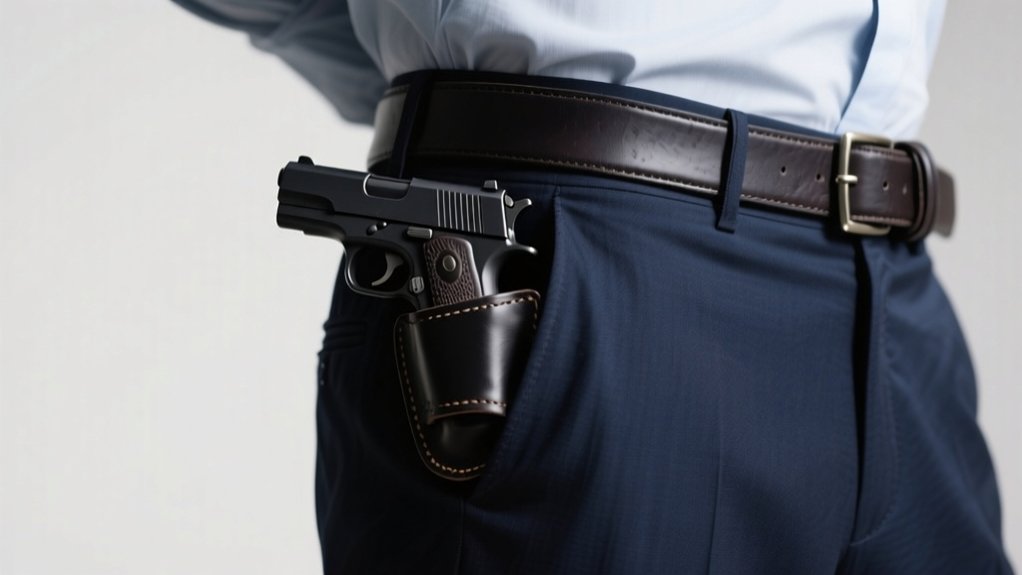
How to Wear an Inside the Waistband Holster?
To wear an inside the waistband (IWB) holster, first choose a holster that fits your firearm and attach it securely inside your waistband using sturdy belt clips on a reinforced gun belt. Position it at your preferred carry spot, commonly the strong-side hip or appendix, then adjust ride height and cant for comfort and accessibility.
Verify the trigger guard is fully covered and test retention for security. Mastering these basics prepares you to investigate advanced concealment tips and safe carry techniques.
What Is an Inside the Waistband Holster?
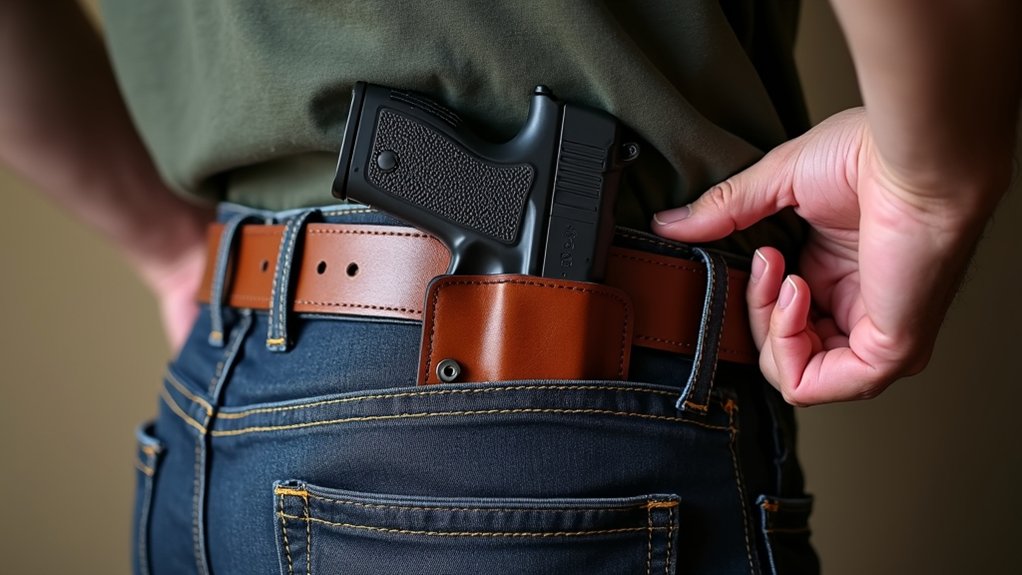
An Inside the Waistband (IWB) holster fits snugly inside your pants’ waistband, offering a discreet and secure way to carry your firearm. This type of IWB holster is specifically designed for concealed carry, keeping your gun low-profile and hidden under clothing.
It attaches firmly to your gun belt using strong clips, ensuring stability throughout the day.
You’ll appreciate the comfort of an IWB holster because many models allow you to adjust the cant, the angle at which your gun sits, so you can tailor the fit to your body type and carry preference.
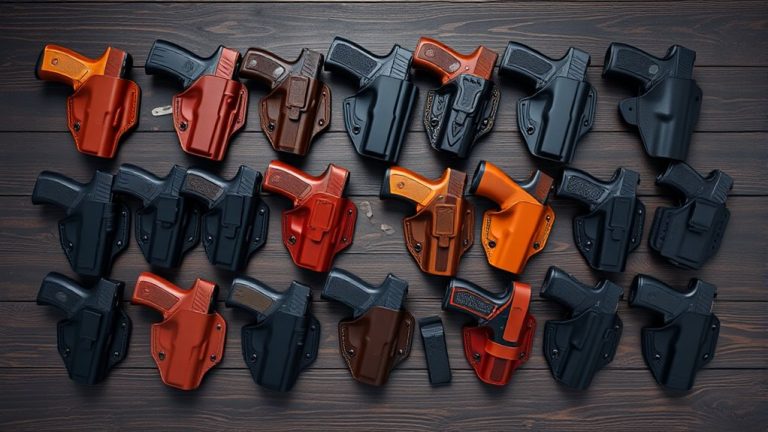
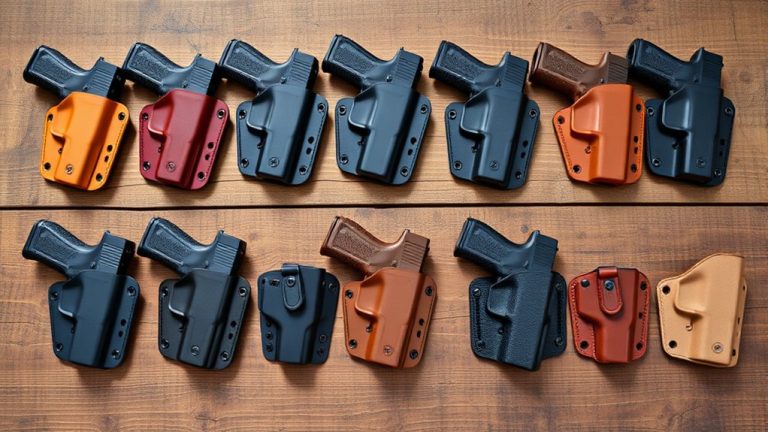
Whether you prefer leather for comfort or Kydex for a slim, durable profile, an IWB holster provides a versatile option that works well with various clothing styles, including tucked shirts.
Some IWB holsters also feature holster claws, which help reduce printing by pressing the grip of your firearm closer to your body for enhanced concealment.
Benefits of Using an IWB Holster
While choosing a concealed carry method, you’ll find that IWB holsters offer unmatched discretion and comfort.
IWB holsters come in low-profile designs that let you carry your firearm securely without printing through clothing. Their adjustable ride height and cant allow you to customize the position for ideal comfort and accessibility, fitting your body shape perfectly.
The tuckable meaning feature means you can tuck your shirt over the holster, maintaining a professional look.
Made from durable materials, these holsters let you draw without resistance while staying secure during daily activities.
Pairing your IWB holster with a quality gun belt guarantees stability by preventing sagging and keeping your firearm in place.
This combination makes IWB carry both practical and discreet for everyday use.
Additionally, many IWB holsters are designed with specific firearm models in mind, ensuring a snug fit and reliable retention for safe daily carry.
Selecting the Right Holster for Your Firearm
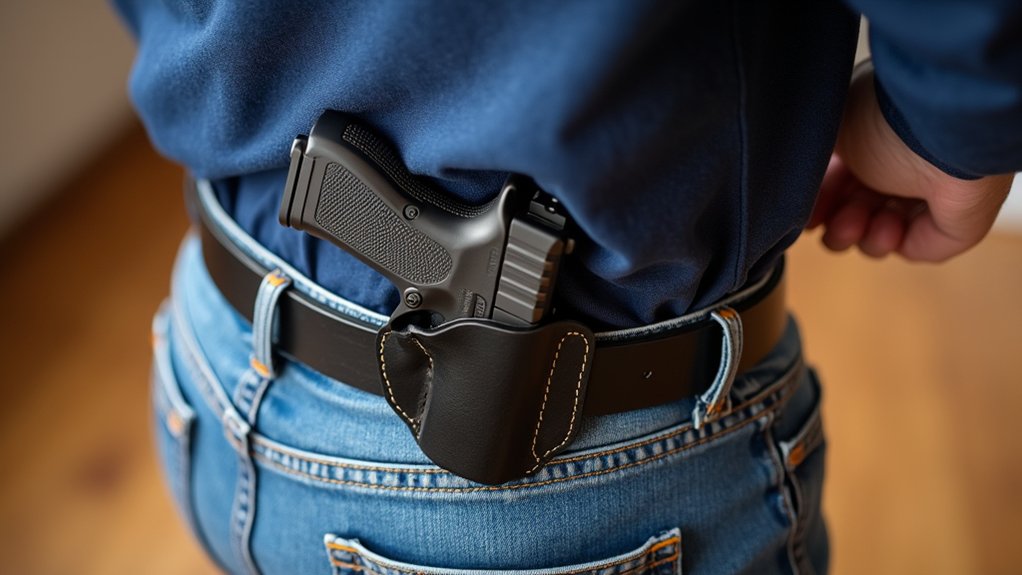
Choosing the right IWB holster starts with ensuring it fits your specific firearm model perfectly, providing secure retention and thorough trigger guard protection.
This fit is essential for safety and smooth draw.
Opt for materials like Kydex for durability and a slim profile, or hybrid designs that blend leather and Kydex for added comfort.
Look for adjustable retention features so you can customize how tightly your firearm is held, balancing security and quick access.
Also, consider tuckable holsters that allow you to wear a tucked-in shirt, enhancing concealment without sacrificing draw speed.
Finally, verify your holster accommodates any firearm accessories, such as optics or lights, ensuring a proper fit.
Selecting the right IWB holster optimizes concealment, retention, and reliable draw every time.
Understanding IWB Carry Positions
When you’re carrying inside the waistband (IWB), think of your belly button as 12 o’clock. This way, you can easily talk about and adjust where your firearm sits.
For example, if you’re right-handed, carrying at 3 o’clock is common because it allows quick access. On the flip side, if you’re left-handed, you’ll probably prefer 9 o’clock since it feels more natural and controlled.
Now, some positions like appendix carry can be super fast to draw from, but they might need a bit of tweaking to stay comfortable throughout the day.
On the other hand, carrying at the small of your back isn’t the best idea—you could run into safety issues and it’s harder to get to your gun quickly. So, it’s usually best to steer clear of that spot.
When selecting your carry position, it’s important to ensure the trigger guard coverage is complete for safety and to regularly practice drawing to build confidence and muscle memory.
Common Carry Positions
Because comfort and accessibility vary from person to person, understanding common inside the waistband (IWB) carry positions is essential for effective concealed carry.
You’ll find carry positions referenced like a clock, with your belly button at 12 o’clock, helping you identify where to place your holster clips for ideal draw speed and comfort.
Here are three common IWB carry positions to evaluate:
- Appendix carry (1-2 o’clock): Offers quick access but requires careful handling to avoid discomfort.
- Strong-side hip (3 o’clock): Favored by right-handed shooters for balance between accessibility and concealment.
- Kidney carry (4-5 o’clock): Prioritizes concealment but may reduce accessibility.
Test these positions with your holster clips to find what suits your body and lifestyle best.
Avoid small-of-back carry due to safety concerns.
Right vs. Left Handed
Understanding how your dominant hand influences IWB carry positions helps you optimize both comfort and accessibility.
If you’re right-handed, you’ll typically place your IWB holster on your strong side around 3 o’clock for easy access.
Left-handed shooters mirror this setup at 9 o’clock, ensuring the firearm is positioned for a smooth, natural draw.
Alternative carry spots include appendix carry at 1-2 o’clock for right-handers and 11 o’clock for left-handed users, offering rapid access but requiring comfort consideration.
The kidney carry at 4-5 o’clock for right hand and 7-8 o’clock for left-handed balances concealment and comfort well.
Avoid the small-of-back position due to safety risks.
Safety and Accessibility
Although you might be enthusiastic to choose the most accessible IWB carry position, prioritizing safety is essential to avoid injury and secure a smooth draw. Understanding the position of your carry holster on the clock face helps balance accessibility with safety.
For instance, the appendix carry (1-2 o’clock) offers quick draw access but demands caution to prevent injury. Strong-side carry at 3 o’clock (right-handed) or 9 o’clock (left-handed) is widely regarded for comfort and safety.
Avoid the small-of-back position (5-6 o’clock) due to spinal risks and poor accessibility.
To optimize safety and accessibility, test these key points:
- Choose a position that allows a natural, unobstructed draw.
- Confirm the holster securely covers the trigger for safety.
- Prioritize comfort to maintain consistent carry and muscle memory.
When selecting your IWB position, consider how clothing choices—such as fitted, breathable clothes—can affect both concealment and comfort throughout daily activities.
Preparing to Wear Your IWB Holster
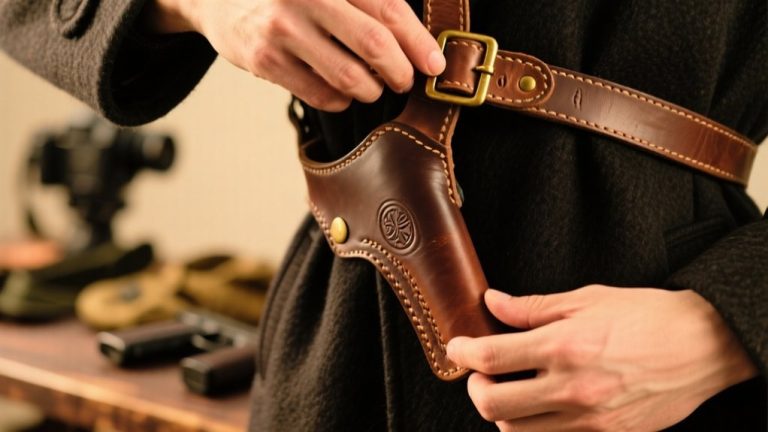
Before you start wearing your IWB holster, make certain you have a sturdy, reinforced gun belt that can support your firearm’s weight without sagging.
Next, select a comfortable carry position, commonly the strong-side hip or appendix carry, based on your accessibility and comfort preferences.
Choose a carry position that balances comfort and quick access, such as the strong-side hip or appendix carry.
Position the holster inside your waistband, securing it firmly with belt clips. Adjusting the cant, or angle of the holster, is vital for both concealment and quick access, so tweak it until you find what works best.
Always begin with an unloaded firearm, double-checking it’s clear before inserting it into the holster.
Slowly slide your firearm in place, making sure the trigger guard is fully covered. Establishing these steps guarantees a secure, comfortable carry and readiness before you step out.
For best results, make sure your gun belt is at least 1.5 inches wide and reinforced to prevent sagging or twisting during daily wear.
Step-by-Step Guide to Wearing an IWB Holster
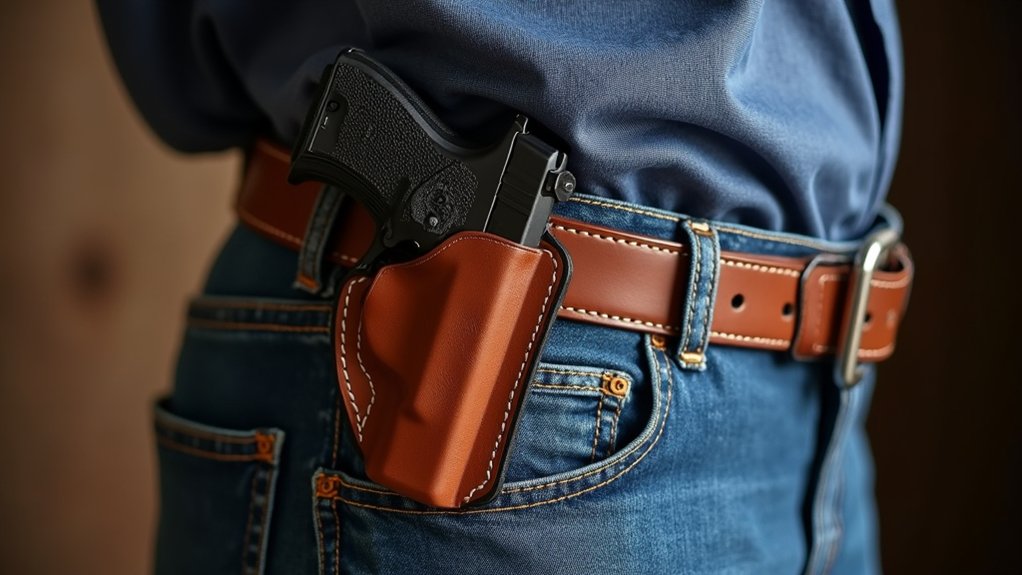
Start by positioning the IWB holster inside your waistband at your preferred carry spot.
Make sure it sits comfortably and discreetly.
Then, clip the holster securely onto your gun belt.
This will guarantee firm retention and easy access.
Proper placement and a solid attachment are essential for both comfort and quick, reliable draws.
Holster Placement Basics
Properly positioning your IWB holster is essential for comfort, security, and quick access.
Holster placement depends on your draw style, body type, and comfort preferences.
Follow these steps for effective IWB concealed carry:
- Unhook and loosen your belt, then slide the holster inside your waistband at your preferred position. Make sure it rests comfortably against your body.
- Clip the holster to your gun belt for stability. Then fasten your pants and tighten the belt to secure the setup.
- Insert the unloaded firearm slowly, confirming the trigger guard is fully covered. After that, adjust ride height, cant, and retention to match your body type and draw style.
This approach guarantees a secure, comfortable holster placement that suits your individual needs.
Securing Holster Properly
To secure your IWB holster effectively, follow a precise sequence that guarantees stability and comfort throughout the day.
Begin by unhooking and loosening your belt and unbuttoning your pants if needed. Slide the holster inside your waistband at your chosen carry location, aligned with your dominant hand for quick access.
Next, secure the holster by firmly clipping it onto your gun belt; make sure the clips attach solidly to prevent any shifting while moving.
Once positioned, fasten your pants and tighten your belt to lock the holster and unloaded firearm in place, maintaining concealment.
Finally, insert the unloaded firearm into the holster, verifying the trigger guard is fully covered and that nothing obstructs the draw.
Properly securing the holster guarantees safety, comfort, and reliable carry. For added security and to minimize movement during activity, ensure the retention hook is properly engaged behind your belt or pants.
Adjusting Ride Height, Cant, and Retention
When you adjust your IWB holster’s ride height, cant, and retention, you tailor your carry setup for maximum comfort, concealment, and quick access.
Start by setting the ride height to position the firearm just right. Choose higher for easier grip and faster draw, or lower to boost concealment while avoiding awkward angles.
Next, modify the cant, or holster angle, so the grip aligns naturally with your hand. Typically, a slight forward tilt works best for comfort and a smooth draw.
Finally, fine-tune retention to securely hold the firearm without hindering your draw. Test this by inverting the holster to verify the gun stays put.
- Adjust ride height via clips or cam-locks in half-inch steps for comfort and access.
- Set cant to a forward angle to align the grip naturally.
- Test retention regularly, adjusting resistance as needed.
Choosing the Proper Gun Belt for Support
After fine-tuning your holster’s ride height, cant, and retention, the next step is guaranteeing your setup stays firmly in place throughout the day.
Choosing the proper gun belt is vital for providing reliable support to your firearm. Unlike regular belts, a good gun belt is thicker and stiffer, preventing sagging or shifting as you move.
Look for durable materials like leather or nylon that balance comfort with longevity. An adjustable gun belt lets you find the perfect tightness, keeping your holster stable without causing discomfort.
Features such as a smooth, flat back prevent irritation against your skin, while a secure buckle maintains positioning.
Investing in the right gun belt guarantees your firearm remains securely supported and comfortable during daily wear.
Tips for Concealing Your IWB Holster Effectively
To conceal your IWB holster effectively, start by paying attention to what you wear. Choosing looser, thicker fabrics or patterned shirts can really help mask the holster’s bulk and keep printing to a minimum.
It’s all about creating that little bit of extra space and distraction so the holster doesn’t stand out.
Also, don’t be afraid to try out different carry positions. Moving your holster somewhere between the 3 and 5 o’clock spots allows you to figure out what feels most comfortable while still staying hidden.
Everyone’s body is different, so experimenting a bit is key to finding that sweet spot for both comfort and concealment.
Clothing Choices Matter
Although carrying an IWB holster offers excellent concealment, your clothing choices play a critical role in keeping your firearm discreet. To effectively conceal your IWB holster, focus on selecting garments that minimize printing and maintain comfort throughout the day.
Here’s what you should keep in mind:
- Opt for looser-fitting shirts or untucked button-ups made from thicker fabrics; these help disguise the holster’s outline.
- Avoid clingy athletic materials, which highlight the firearm’s shape, and instead choose layered clothing like vests or sweaters for added coverage.
- Use a sturdy gun belt designed to keep the holster stable and prevent sagging, ensuring your setup stays concealed and secure.
Positioning for Concealment
Choosing the right position for your IWB holster is essential for both concealment and quick access. Position it at your strong-side hip (3 o’clock) to balance accessibility and comfort while keeping it hidden under clothing.
You can experiment with appendix carry (1-2 o’clock) for faster draw efficiency, but watch for discomfort when sitting or bending.
Adjust the cant, or angle, of your IWB holster to a slight forward tilt. This aligns the grip with your body, improving both concealment and draw speed.
Wear looser or untucked shirts to minimize printing and guarantee the holster remains discreet.
Finally, invest in a sturdy gun belt to prevent sagging, maintaining the holster’s position for consistent concealment and maximum accessibility throughout your day.
Practicing Safe Draw and Reholstering Techniques
Since handling a firearm demands the utmost caution, you must always confirm your weapon is unloaded before practicing draw and reholstering techniques.
Prioritize safety by using a consistent grip and draw method to build muscle memory for quick access.
When reholstering, keep the firearm pointed in a safe direction and stay aware of your surroundings to prevent accidents.
To effectively practice drawing and reholstering, consider these steps:
Consider clothing, movement drills, and consistent safety focus when practicing drawing and reholstering techniques.
- Use the clothing you plan to carry with to assess accessibility and comfort.
- Perform movement drills like sitting, bending, and walking to confirm the holster’s stability.
- Always maintain focus on firearm safety throughout your practice sessions.
Frequently Asked Question
Can I Wear an IWB Holster While Sitting for Long Periods?
Yes, you can wear an IWB holster while sitting for long periods, but you’ll need to adjust it carefully.
Try changing the ride height and cant to prevent the muzzle from pressing uncomfortably against you.
Test different positions, like sitting in a car or at a desk, to find the best fit.
Using a compact firearm and a sturdy gun belt can also improve comfort and stability during extended sitting sessions.
How Do I Prevent Skin Irritation From IWB Holsters?
To prevent skin irritation from IWB holsters, choose breathable materials like leather or Kydex with smooth, rounded edges to reduce friction.
Wear a moisture-wicking undershirt between your skin and the holster to absorb sweat and minimize direct contact.
Adjust the holster regularly to avoid pressure points during long wear.
Applying anti-chafing creams on friction-prone areas adds extra protection, helping you stay comfortable while carrying concealed.
Are IWB Holsters Suitable for All Body Types?
Imagine you have a larger waistline and find appendix carry uncomfortable.
Yes, IWB holsters can suit all body types, but you’ll need to adjust positions and materials.
For example, you might prefer strong-side carry with a leather holster for better comfort and concealment.
Test different ride heights and cants over several days to find your best fit.
Customizing your setup guarantees both comfort and accessibility, no matter your shape.
Can I Wear an IWB Holster While Exercising?
Yes, you can wear an IWB holster while exercising, but you’ll want one that’s lightweight, breathable, and designed for active use.
Choose a holster with adjustable ride height and cant to keep it secure and comfortable during movement.
Use a snug-fitting gun belt to maintain stability.
Practice drawing and reholstering in your exercise gear to guarantee safety.
Tailor your choice to your workout type, especially if it involves lots of bending or twisting.
How Do I Clean and Maintain My IWB Holster?
To clean and maintain your IWB holster, wipe it down regularly with a damp cloth and mild soap, focusing on areas that touch your firearm.
For leather holsters, apply conditioner occasionally to keep the material supple and prevent cracks, avoiding excess water.
Inspect your holster for wear and tighten any loose screws or clips to guarantee a secure fit.
Store it in a cool, dry place away from sunlight to prolong its life.
Conclusion
Wearing an inside the waistband holster is like planting a sturdy tree in your daily routine. Root it well with the right belt, position, and adjustments, and it’ll provide reliable, concealed support no matter the conditions.
Just as a tree bends but doesn’t break, mastering your draw and reholster keeps you steady and prepared. Commit to these steps, and your IWB holster becomes your steadfast ally, blending security with discretion seamlessly.