
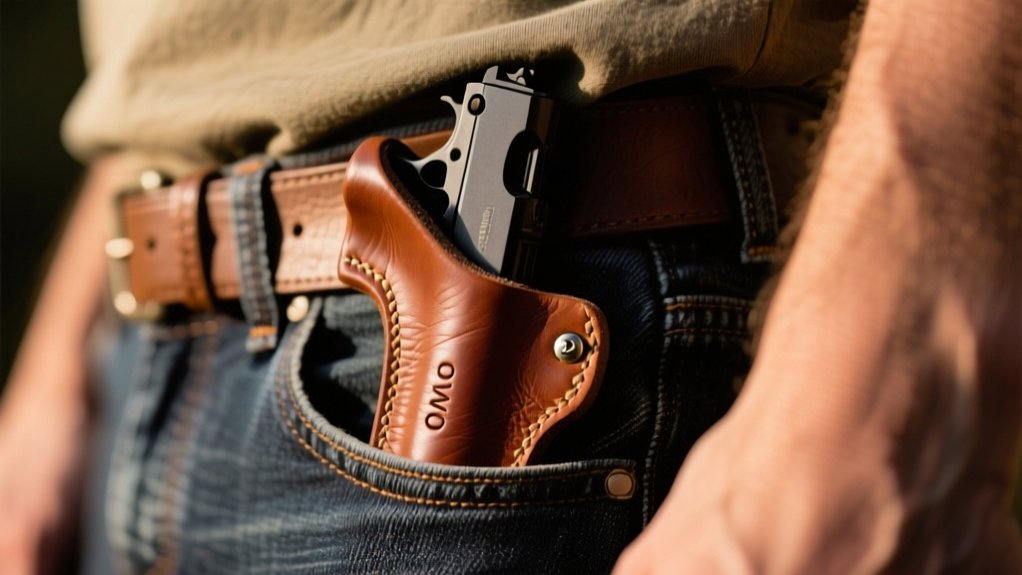
What Does OWB Holster Mean?
An OWB (Outside the Waistband) holster means you carry your firearm on the outside of your belt. This provides quicker access and increased comfort during extended wear.
It sits externally on your hip or back, often secured with a sturdy gun belt to keep it stable and safe. OWB holsters come in various styles like pancake, paddle, or belt slide. Many also support attachments like lights for added versatility.
Understanding positioning, materials, and safety can improve your carry experience further.
Definition of OWB Holster
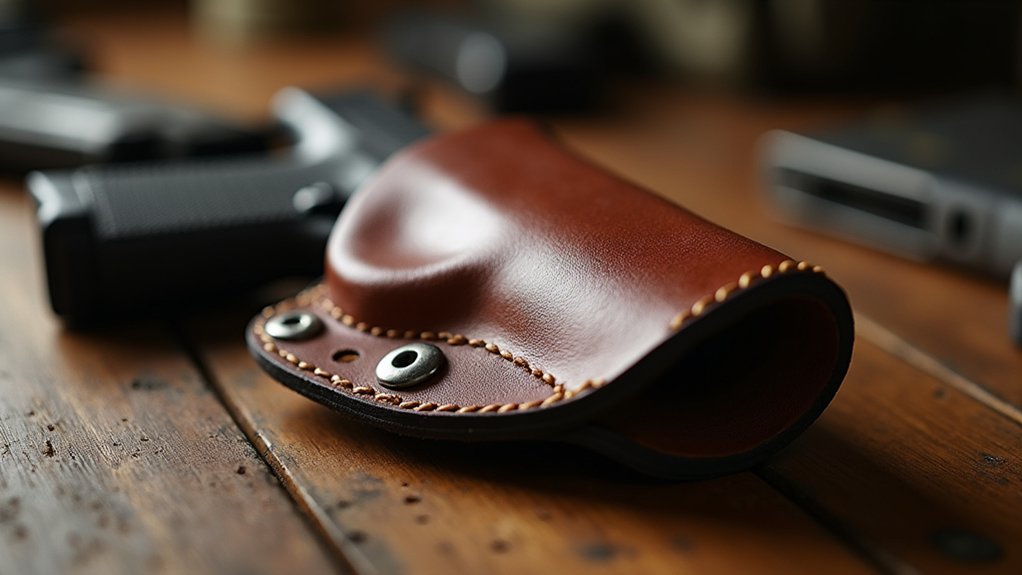
An Outside the Waistband (OWB) holster sits on the outside of your belt, giving you quicker and easier access to your firearm compared to Inside the Waistband (IWB) options.
OWB holsters position the gun externally, typically on your hip, kidney, or back, and require a sturdy gun belt to maintain stability and safety.
Common OWB designs include pancake, paddle, and belt slide, each offering different levels of comfort and accessibility.
While OWB carry is often preferred for open carry, you can use it for concealed carry if you wear loose clothing or a jacket to cover the firearm.
Since the gun doesn’t press against your body, OWB holsters provide improved comfort, making them practical for longer wear periods in various situations.
Advantages of Using an OWB Holster
When you choose an OWB holster, you get quicker access to your firearm and enjoy greater comfort since it sits outside your waistband.
Plus, you can pick from various styles like pancake or paddle to match your preference and daily needs.
This flexibility means you stay both ready and comfortable, even during extended wear.
Enhanced Comfort and Access
Although concealed carry often emphasizes discretion, OWB holsters excel by offering improved comfort and rapid access to your firearm.
Unlike inside the waistband (IWB) holsters, OWB designs keep the whole thing outside your pants, so the gun doesn’t press against your body. This means you’ll feel a little bit more comfortable during long wear.
You can position the holster from 3 to 5 o’clock, tailoring placement for your ease of draw and comfort. The sturdy build and solid attachment options guarantee the firearm stays secure without shifting weight uncomfortably.
While OWB holsters usually require a cover garment, they still allow quick access, making them a practical choice when comfort and speed matter most.
Versatile Holster Styles
Comfort and quick access are just the starting points for OWB holsters; their real strength lies in the variety of styles available to suit different carry preferences and situations.
You can select from pancake, paddle, or belt slide designs, each offering unique benefits tailored to how you want to carry.
Holster material choices like leather, Kydex, or hybrid blends affect durability, retention, and comfort, so choose what matches your daily needs.
Carry position adjustments are straightforward, allowing you to find the ideal spot on your belt for balance and ease of draw.
Moreover, accessory compatibility options enable you to attach lights or mag carriers seamlessly.
With these versatile choices, you can customize your OWB setup to maximize comfort, security, and functionality.
For the best performance and stability, it’s important to use a sturdy gun belt designed to handle the holster’s weight and prevent sagging or shifting during movement.
Common Positions for OWB Carry
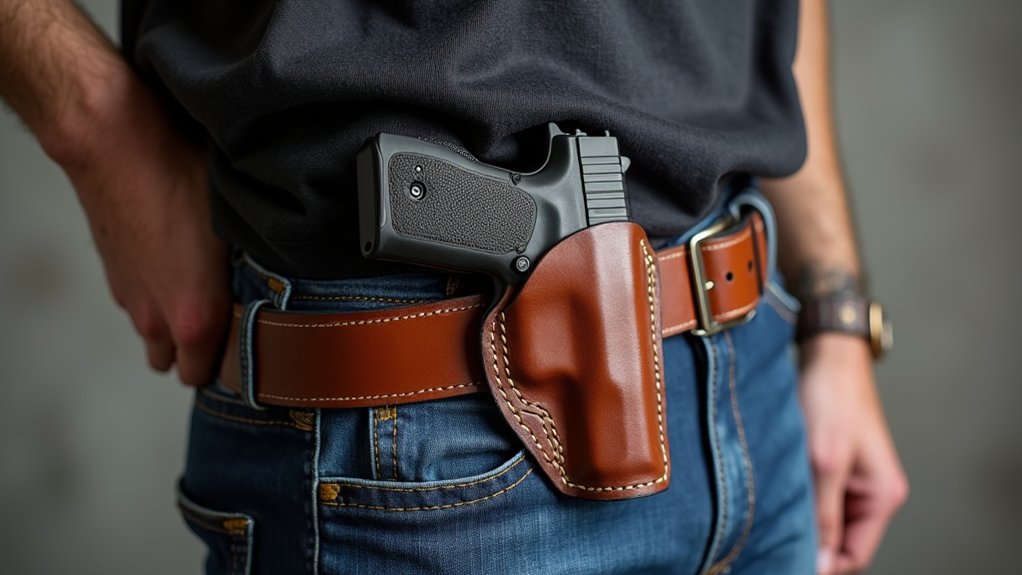
When you’re carrying an OWB holster, you’ll usually want to position it somewhere between the 3 and 5 o’clock spots on your hip or kidney area.
The exact placement really makes a difference—it affects how quickly you can draw, how comfortable it feels, and how well you can conceal your firearm.
So, it’s important to find the angle and spot that work best for your body and your gun.
Getting to know these common positions will help you strike the right balance between easy access and staying discreet.
Hip and Kidney Placement
Two of the most common positions for OWB holsters are at the hip and the kidney area, typically between the 3 o’clock and 5 o’clock spots on your body.
With hip carry, you benefit from a natural draw technique that feels fluid and comfortable during extended wear.
Kidney carry, on the other hand, offers improved concealment under clothing, making it ideal when discretion is a priority.
Both placements demand a sturdy gun belt to keep the holster stable through your movements.
Fine-tuning the cant angle in either position improves both comfort and accessibility, allowing you to customize the draw technique to your preference.
Choosing between hip carry and kidney carry depends on your priorities, whether you want ease of access or better concealment.
3 to 5 O’clock
Although less common than hip or kidney placements, the 5 o’clock position offers a strategic balance of concealment and accessibility by situating the OWB holster on your lower back.
This holster positioning allows for a comfortable 5 o’clock draw, providing easy access whether you’re seated or standing.
You’ll appreciate how this spot keeps the firearm discreet under clothing, reducing printing and enhancing concealment.
Moreover, placing the holster at 5 o’clock prevents interference with your daily movements, improving carry comfort throughout the day.
Ascertain your holster is adjustable to secure the firearm without digging into your lower back, maintaining both stability and comfort.
Choosing the 5 o’clock position means you get a practical, accessible carry option suited for discreet everyday use.
Comparison Between OWB and IWB Carry
Because OWB and IWB carry methods each offer distinct advantages, understanding their differences is essential for choosing the right holster setup.
When comparing OWB vs IWB, consider your carry preferences carefully.
OWB holsters sit outside the waistband, providing quicker access and greater comfort since they don’t press against your body.
However, they typically require a cover garment for concealment.
IWB holsters tuck inside the waistband, offering superior concealment if you wear well-fitting clothing but may sacrifice some comfort and accessibility.
Accessibility factors play a vital role: OWB carry enables faster draws, while IWB prioritizes discretion.
Ultimately, your choice hinges on balancing comfort, concealment, and accessibility to suit your daily needs and lifestyle.
Types of OWB Holsters
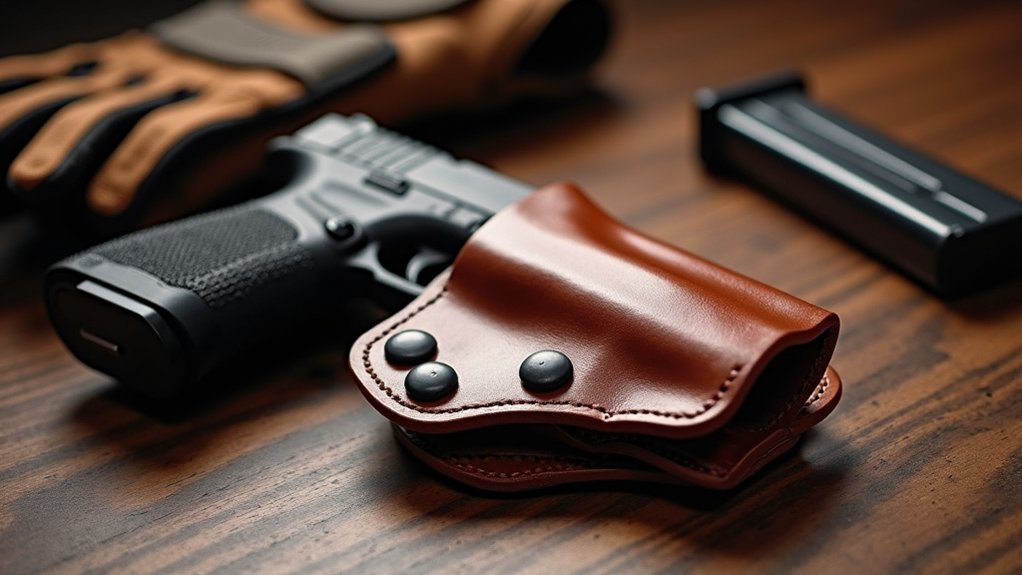
You’ll find OWB holsters mainly come in pancake, paddle, and belt slide types. Each one offers its own unique advantages.
Pancake holsters, for example, provide a slim profile by sandwiching your firearm between two pieces of material.
On the other hand, paddle and belt slide holsters differ in how they attach to your belt. This affects convenience and stability when you’re wearing them.
Knowing these differences can really help you pick the right holster that balances comfort with quick access.
Pancake Holster Features
Pancake holsters offer a streamlined design that securely sandwiches your firearm between two layers of material, creating a slim profile that stays close to your body for discreet carry.
The pancake holster benefits include even weight distribution across your waistband, which improves comfort during extended wear.
Made from durable pancake holster materials like leather or high-quality synthetics, these holsters resist wear and guarantee longevity.
You’ll appreciate pancake holster customization options, such as adjustable belt loops that let you tailor ride height and cant angle for a peak draw.
Versatile enough for both inside and outside the waistband carry, pancake holsters combine security, comfort, and discretion.
That makes them an excellent choice if you want reliable, customizable OWB carry without sacrificing concealment.
Paddle vs. Belt Slide
Several key differences distinguish paddle and belt slide holsters, two popular types of outside-the-waistband (OWB) carry options.
Paddle holsters offer easy attachment and removal without unthreading your belt, making adjustments quick and effortless.
Belt slide holsters, however, require threading your belt through, ensuring a tighter, more secure fit against your body for better concealment and stability.
When deciding on holster selection, consider:
- Versatility: Paddle holsters let you change positions without removing your belt.
- Stability: Belt slide holsters provide a firmer hold and less movement.
- Accessibility: Paddle holsters allow faster on-and-off, ideal for quick draws.
Your choice depends on comfort, use, and how accessible you want your firearm to be.
Materials Used in OWB Holsters
Although OWB holsters come in various styles, the materials used in their construction play an essential role in performance and comfort. When conducting a holster material comparison, leather, plastic, and nylon emerge as the primary options.
Leather offers a classic, comfortable fit that molds to your body over time, excelling in comfort assessment.
Plastic holsters, meanwhile, provide superior weather resistance and lighter weight, contributing to durability analysis.
Nylon stands out for affordability, flexibility, and casual use, though it may sacrifice some retention strength.
High-quality OWB holsters incorporate double stitching and reinforced seams to boost durability.
Understanding these material differences helps you evaluate which holster will best balance retention, longevity, and comfort for your specific needs.
How to Choose the Right OWB Holster
When you’re picking out the right OWB holster, the first thing to do is figure out what type suits you best. Are you leaning toward a pancake, paddle, or belt slide style? Each one offers different levels of comfort and draw speed, so think about what matters most to you.
Next, pay close attention to how it fits and feels. Look for features like adjustable ride height and cant, and make sure it works well with your belt. This way, you’ll have a secure carry and be able to draw quickly when needed.
It’s also a good idea to try the holster on with the clothes you usually wear. That way, you can check how well it conceals and if it’s easy to use in everyday situations.
Taking these steps will help you find a holster that’s just right for you.
Holster Types Overview
Choosing the right Outside Waistband (OWB) holster depends on your priorities for comfort, accessibility, and concealment. Understanding holster types helps you match your needs with the right holster materials and carry positions while addressing safety considerations.
Pancake holsters sandwich your firearm, offering a slim profile that hugs your body for better concealment.
Paddle holsters clip onto your belt, providing quick on-and-off access without removing your belt. It’s a great choice for flexibility.
Belt slide holsters secure firmly by allowing your belt to slide through, ensuring stability during movement.
Each type serves different comfort and concealment goals, so consider your daily activities and cover garment options carefully. This way, you can select the holster that best fits your lifestyle and safety requirements. When choosing a paddle holster, it’s important to adjust the holster’s cant for comfort and efficient draw, ensuring the holster remains stable and secure throughout daily activities.
Fit and Comfort Factors
Since comfort and fit directly impact how often you’ll carry your firearm, you need to prioritize these factors when selecting an Outside Waistband (OWB) holster. Employ fit adjustment techniques like cant and ride height modifications to tailor the draw angle to your body.
Comfort improvement strategies include choosing materials that suit your preferences: leather for tradition or nylon for lightness. Weight distribution methods are vital. Make certain your holster’s belt loops or clips spread the firearm’s weight evenly on a sturdy gun belt to prevent discomfort.
| Factor | Description | Benefit |
|---|---|---|
| Fit Adjustment | Cant and ride height settings | Personalized draw angle |
| Comfort Improvement | Material choice (leather/nylon) | Reduced skin irritation |
| Weight Distribution | Belt loops/clips and gun belt | Even weight, secure hold |
| Holster Type | Pancake, paddle, belt slide | Comfort and accessibility |
Importance of a Sturdy Gun Belt for OWB
Although OWB holsters offer ease of access, you won’t experience their full benefits without a sturdy gun belt to support them. A quality gun belt guarantees belt durability, which is vital for securely holding your holster and firearm without sagging or shifting during movement.
Its wider design improves weight distribution by spreading the firearm’s mass evenly across your hips. This boosts stability and quick accessibility.
Consider these gun belt benefits:
- Reliable support that keeps your firearm in place, preventing dangerous shifts.
- Improved rigidity for faster draws and safer re-holstering.
- Durable materials like reinforced leather or nylon that stand up to daily wear.
Investing in a proper gun belt transforms your OWB carry into a secure, efficient experience you can trust.
Comfort Considerations for OWB Carry
A sturdy gun belt not only supports your OWB holster but also plays a key role in how comfortable you feel throughout the day. To optimize comfort, consider holster adjustments and comfort improvements such as padding or sweat guards.
The choice of carry positions—hip, appendix, or back— affects both access and pressure distribution. Selecting the right holster type, like a pancake or paddle design, further influences comfort by how it fits your body.
Wearing a loose cover garment also prevents chafing and boosts comfort.
When selecting a holster, it’s important to consider ride height and cant adjustments, as these factors can greatly impact both comfort and concealment for different body types and daily activities.
| Factor | Comfort Impact |
|---|---|
| Holster Adjustments | Customize fit, reduce movement |
| Comfort Improvements | Padding, sweat guards |
| Carry Positions | Balance access and pressure |
| Holster Type | Weight distribution, fit |
These elements combined guarantee you carry comfortably and securely all day.
Concealment Tips When Using an OWB Holster
When using an OWB holster, you’ll want to prioritize concealment without sacrificing accessibility. Implementing effective concealment techniques is crucial for discreet carry.
Start by selecting clothing choices that support your goal: loose-fitting, thicker fabrics like jackets or untucked shirts help mask the firearm’s outline and reduce printing.
Position your holster between 3 and 5 o’clock to balance concealment and draw speed. Use a sturdy gun belt designed for OWB to prevent sagging or shifting that could reveal your weapon.
Finally, integrate regular practice routines to draw smoothly and discreetly while wearing your concealment outfit.
Remember these key tips:
Choose loose, thick garments to obscure your firearm
Position your holster strategically for quick access
Practice drawing regularly to guarantee confidence and stealth
Popular OWB Holster Brands and Models
Since choosing the right OWB holster affects both comfort and performance, you should consider trusted brands known for quality and innovation.
Galco’s KingTuk OWB holster, crafted from premium saddle leather, offers durability and comfort with an open-top design for fast draw techniques.
Galco’s KingTuk OWB holster combines premium leather durability with an open-top design for quick, reliable draws.
Safariland’s 7TS Series stands out with lightweight polymer construction and adjustable retention systems, giving you versatile control over security.
Blackhawk’s Serpa Tactical holster features a unique auto-locking retention system, enhancing security without sacrificing quick access.
Alien Gear’s Cloak Mod OWB holster lets you customize cant and ride height, improving comfort and accessibility.
Many of these models support holster accessories, allowing you to tailor your setup perfectly.
When choosing, prioritize retention systems and draw techniques that align with your specific needs.
OWB Holster Compatibility With Firearm Lights
Many top OWB holsters not only prioritize retention and draw speed but also accommodate firearms equipped with weapon lights. When you choose an OWB holster with light attachment options, you guarantee a secure fit without sacrificing quick access.
Tactical holster designs often incorporate open-top styles, allowing you to draw smoothly even with a light mounted. Holster retention mechanisms are calibrated to hold your firearm firmly, preventing accidental dislodgement while keeping the draw fluid.
For example, the C633 L Patterson OWB holster perfectly fits the Inforce Wild 1 light, balancing security and accessibility. Remember to select a holster tailored to your specific gun and light combination to maximize performance and safety.
Key features to look for include:
- Precise fit for light-equipped firearms
- Reliable retention without added bulk
- Streamlined tactical design for rapid deployment
Safety Features in OWB Holsters
Although OWB holsters offer quick access and comfort, they incorporate vital safety features to protect both you and your firearm.
Retention mechanisms like thumb breaks and adjustable tension screws secure your weapon firmly, preventing accidental discharges.
Retention features such as thumb breaks and tension screws ensure your firearm stays securely in place, enhancing safety.
Material durability plays a significant role; holsters made from leather or Kydex shield the trigger guard effectively, reducing risk during movement.
Accessibility features such as open-top designs enable rapid draws but are thoughtfully crafted to avoid unintended trigger contact.
Additional elements like sweat guards and raised backs stabilize your firearm, minimizing shifting while active.
Finally, proper belt attachment using sturdy clips or loops guarantees the holster stays firmly in place, maintaining safety and reliability throughout your daily carry.
Legal Considerations for OWB Carry
While safety features in OWB holsters protect you and your firearm during carry, understanding the legal framework governing their use is just as vital. You must navigate varying state regulations that dictate if permits are needed and how visible your firearm can be. Ignoring these rules could lead to serious legal ramifications.
Key considerations include complying with laws on firearm visibility, which often require cover garments during OWB carry. You also need to avoid restricted areas like schools, government buildings, or private properties that ban firearms.
Plus, make sure your OWB holster securely holds your firearm to meet legal standards.
Stay informed on evolving laws to avoid penalties and carry responsibly. Mastering these legal nuances not only protects you but also reinforces your commitment to safe, lawful firearm ownership. In addition, some states enforce age restrictions on holster purchases, so it’s important to know your local requirements before acquiring or carrying an OWB holster.
Maintaining and Caring for Your OWB Holster
To guarantee your OWB holster remains reliable and safe, you need to commit to regular maintenance and proper care.
Start with holster maintenance tips like cleaning it routinely using a damp cloth and mild soap to remove dirt and sweat.
For leather holsters, apply leather care techniques by conditioning them with a suitable leather conditioner to prevent cracking and retain flexibility.
Use recommended cleaning supplies that are gentle and effective.
Always inspect your holster for any wear, focusing on stitching and hardware to ascertain safety.
Store it in a cool, dry place away from direct sunlight to avoid material damage.
Finally, use a dedicated gun belt designed for OWB carry to maintain holster position, preventing sagging and assuring quick accessibility.
Frequently Asked Question
Can OWB Holsters Be Used for Competitive Shooting?
Yes, you can definitely use OWB holsters for competitive shooting. Their design offers key OWB holster advantages like quick draw and comfortable wear, which align perfectly with competitive shooting techniques.
You’ll appreciate how adjustable cant and ride height let you tailor your setup, boosting your performance in competitions.
Plus, many events require OWB holsters, so choosing one helps you comply with rules while optimizing your draw speed and stability.
Are OWB Holsters Suitable for Left-Handed Shooters?
Imagine drawing your firearm smoothly with your dominant hand. That’s exactly what left-handed options in OWB holsters offer you.
These holsters prioritize shooter comfort by providing adjustable cant and height, ensuring a perfect fit for your draw style.
With improved holster accessibility, you won’t struggle during critical moments.
Many models are specifically designed or ambidextrous, so you can confidently choose a holster that feels natural and reliable every time you carry.
How Do Weather Conditions Affect OWB Holster Performance?
You need to contemplate moisture resistance carefully because rain or humidity can degrade leather and cause slippage if your holster isn’t designed for wet conditions.
Temperature impact also matters: extreme heat can warp plastics, while cold may thicken your clothing, slowing your draw.
Make seasonal adjustments by choosing materials suited for the weather.
Synthetics work well for sun exposure and moisture, while leather is best for dry, moderate climates.
This helps maintain your OWB holster’s performance and reliability year-round.
Can You Customize the Color or Design of an OWB Holster?
Want your OWB holster to reflect your style? You can absolutely investigate customization options, choosing from various color choices like black, tan, or saddle brown.
Many brands even let you pick stitching colors, materials, and add logo engravings.
Keeping up with design trends, some offer “build your own” setups where you select holster components and finishes.
Just check with your preferred manufacturer to see what’s available for your model.
Do OWB Holsters Work Well With Different Clothing Styles?
Yes, OWB holsters offer excellent clothing versatility, but their compatibility depends on your outfit choice.
They work best with loose-fitting clothes like oversized shirts or jackets for effective concealment.
For fitted clothing, you’ll need a longer cover garment to hide the holster’s outline.
You can also integrate OWB holsters into tactical or utility vests for seamless style integration.
Remember to use a sturdy belt to support your holster properly.
Conclusion
Choosing an OWB holster is like selecting a steadfast shield, offering you quick access, comfort, and security. It stands as a reliable partner in your daily carry, balancing protection with readiness.
By understanding its advantages, positions, and care, you guarantee your holster not only carries your firearm but also your confidence. Welcome the OWB holster as a symbol of preparedness, where safety and practicality unite to empower every step you take.


