Does a Paddle Holster Go Inside the Pants?
You don’t wear a paddle holster inside your pants because it’s designed for outside-the-waistband (OWB) carry. Its molded paddle fits securely between your belt and body, providing stability and quick access without threading your belt.
Trying to wear it inside compromises comfort, retention, and draw speed. The paddle’s shape contours to your hip for a snug fit and adjustable cant.
If you want to investigate holster placement and benefits further, there’s more to know.
Understanding Paddle Holster Design
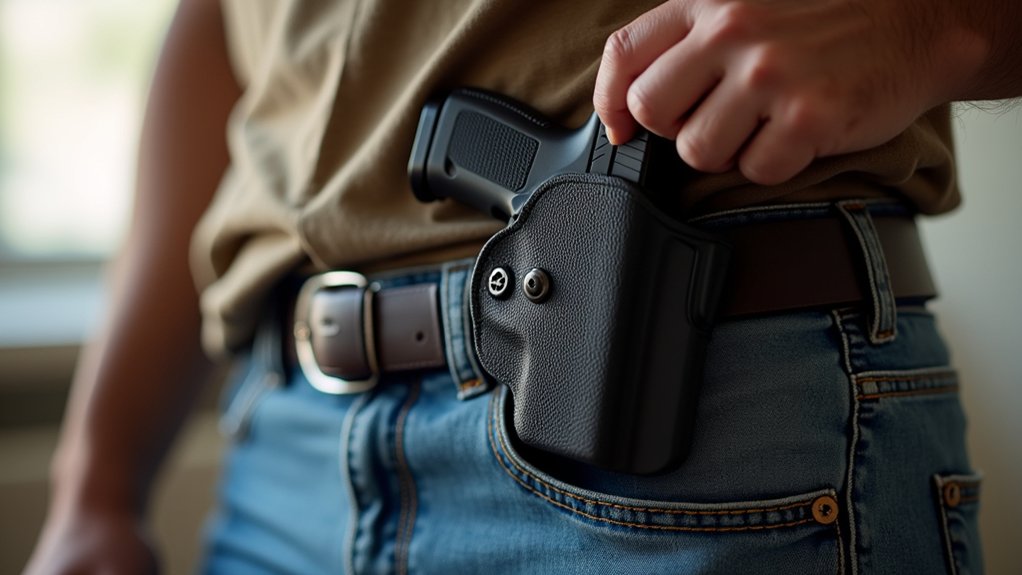
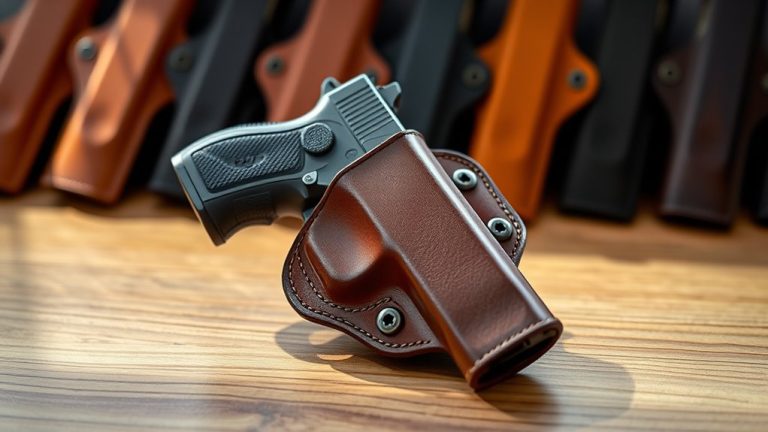
Paddle holsters offer a straightforward design that makes carrying your firearm outside the waistband both stable and comfortable.
Paddle holsters provide a simple, secure, and comfortable way to carry your firearm outside the waistband.
These holsters feature a molded polymer paddle that fits snugly between your belt and body, eliminating the need to thread through your belt loops.
This design lets you quickly attach or remove the holster without taking off your belt, making it ideal for frequent disarming.
Typically positioned at the 3 or 4 o’clock on your hip, paddle holsters allow you to adjust the cant to suit your draw style and comfort.
While perfect for outside the waistband carry, paddle holsters aren’t the best choice for concealed carry due to their external placement, which makes concealment more challenging compared to inside-the-waistband options.
For added security and comfort, it’s important to ensure the retention hook is locked behind the belt or pants for a snug fit.
How Paddle Holsters Attach to the Body
A secure fit comes from sliding the holster’s molded paddle behind your waistband, where a retention lip presses it firmly against your belt or pants. This design lets the paddle attach securely without needing to thread through a belt, making it quick to put on or remove.
The paddle contours to your hip, ensuring the holster stays pressed against your body for outside-the-waistband (OWB) carry. A small hook on the paddle anchors it firmly, preventing unwanted shifting as you move.
Moreover, you can adjust the cant and draw angle to suit your comfort and accessibility. This combination lets the paddle holster work efficiently, providing stability and ease of use without compromising on quick access or comfort.
Proper Placement of a Paddle Holster
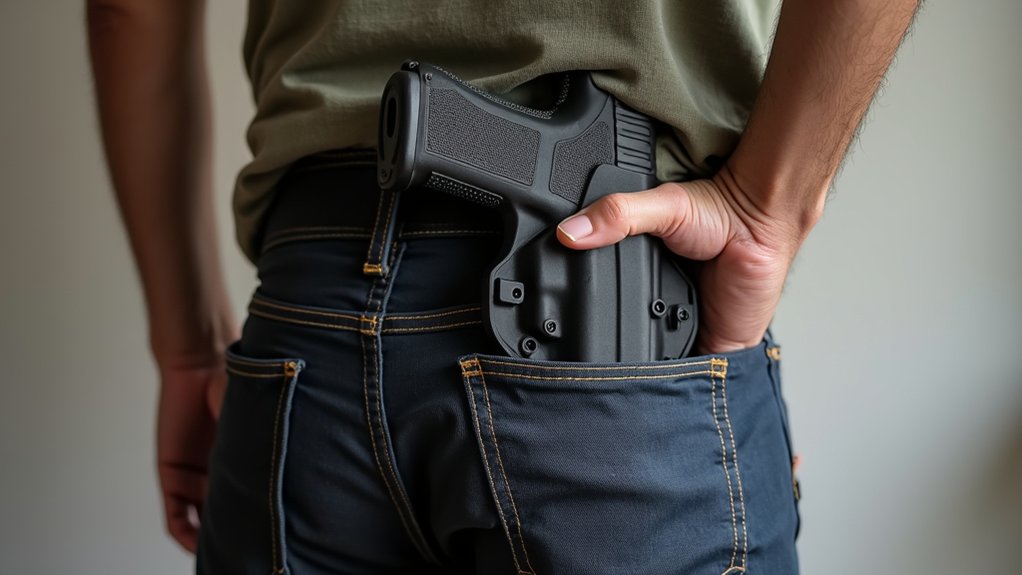
To place your paddle holster properly, start by positioning the paddle inside your waistband at your preferred angle—usually around 3 or 4 o’clock.
Make sure the retention lip locks securely behind your belt or pants to keep it stable when you move.
Next, adjust the cant so it feels comfortable and allows for quick access.
Finally, give it a little test to check that the holster stays firmly in place without shifting around.
That way, you’re all set for both comfort and security.
Inside Waistband Fit
Understanding the proper placement of a paddle holster is essential for comfort and accessibility. Unlike an inside the waistband holster, a paddle holster is primarily designed as an OWB holster, worn outside your pants for easy attachment and removal.
Trying to fit a paddle holster inside the waistband compromises stability and comfort because the paddle isn’t meant to be secured between your belt and pants. Instead, position the paddle firmly against your hip, guaranteeing it stays close to your body for maximum retention.
Aim for a carry angle around 3 to 4 o’clock to balance accessibility and concealment. If concealment concerns you, wear looser clothing to reduce printing.
Proper use of a paddle holster guarantees quick draw and reliable comfort without the complications of an inside waistband fit. For best results, always pair your paddle holster with a sturdy gun belt to ensure maximum security and prevent sagging during daily use.
Paddle Positioning Options
Three key positioning options help you refine your paddle holster’s placement for comfort, security, and quick access.
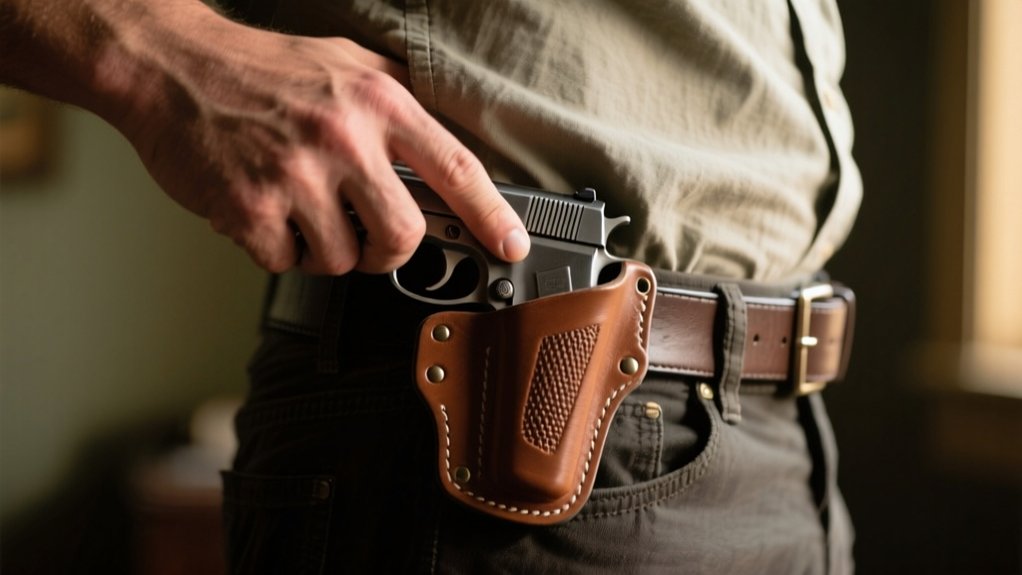
Typically, you’ll position the paddle holster outside the pants, attaching the curved paddle around your hip between the 3 o’clock and 4 o’clock positions for ideal draw.
Some users experiment by placing the paddle between the belt and pants, blending outside and inside waistband carry for a unique fit.
In all cases, confirm the paddle’s lip sits behind your belt or pant material to keep the holster secure during movement.
Adjusting the cant lets you customize the draw angle, enhancing speed and comfort.
Understanding these paddle positioning options lets you tailor your carry setup precisely to your needs without sacrificing accessibility or stability.
Stability and Comfort
Although paddle holsters are designed to sit outside your pants, proper placement is essential for both stability and comfort.
To guarantee paddle holsters work effectively, follow these steps:
- Insert the paddle behind your waistband at your preferred carry angle, typically near 3 o’clock or 4 o’clock.
- Make sure the retention lip sits securely behind your belt or pant material to prevent shifting.
- Adjust the cant to suit your draw style, enhancing both comfort and accessibility.
- Test for movement during activity; the holster should feel integrated and not lift or shift.
Advantages of Outside-the-Waistband Carry
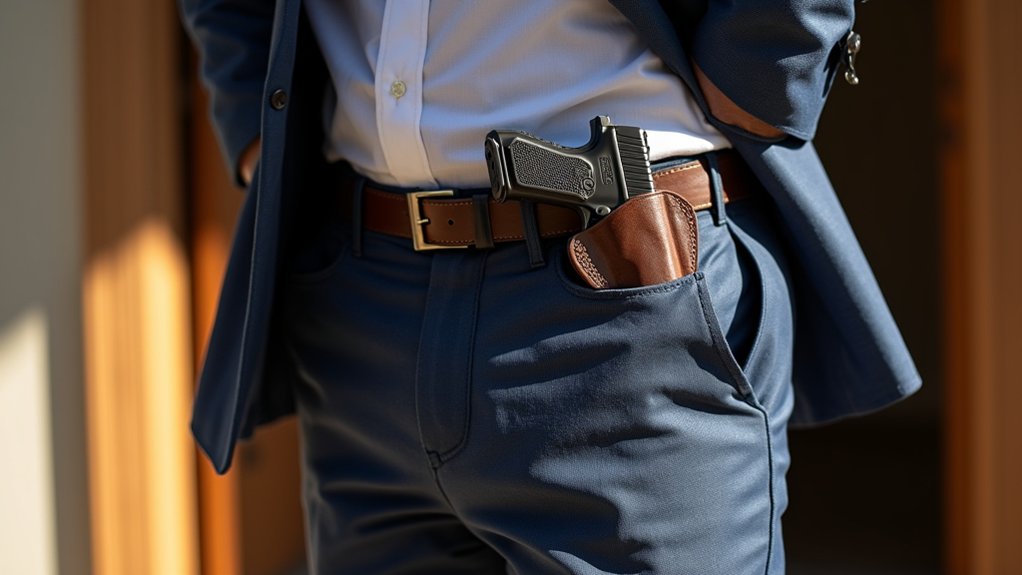
Outside-the-waistband (OWB) carry with a paddle holster gives you quick access and a stable, comfortable fit.
Designed to clip securely outside your pants, the paddle holster wraps around your hip, eliminating the need for belt threading. This design not only guarantees stability during daily activities but also improves ventilation, reducing discomfort from heat buildup.
With the firearm positioned externally, you benefit from faster draw times, which is vital when every second counts.
Moreover, OWB carry with a paddle holster allows better concealment under looser clothing like jackets or shirts, balancing accessibility with discretion.
If you want a reliable, comfortable, and efficient carry method that prioritizes quick access, outside-the-waistband paddle holsters deliver unmatched advantages.
Unlike IWB holsters with holster claws for concealment, paddle holsters are optimized for external carry and prioritize accessibility and comfort over minimizing printing.
Common Misconceptions About Paddle Holster Positioning
You might think you can position a paddle holster inside your waistband for better concealment, but doing so actually compromises retention and stability.
See, the paddle is designed to fit securely outside the waistband, wrapping around your hip to give you both comfort and quick access.
Getting the placement right is really important because it helps you balance comfort, concealment, and reliable retention all at once.
Paddle Holster Placement
Where should you position a paddle holster for the best stability and comfort? Proper paddle holster placement means wearing it outside the waistband (OWB), with the paddle resting snugly against your body.
Avoid placing it between your belt and pants because that compromises stability and comfort. Follow these guidelines for ideal positioning:
- Position the paddle outside the waistband, ensuring the paddle anchors securely behind the belt.
- Place the holster at the 3 o’clock or 4 o’clock position on your dominant side for quick access.
- Keep the paddle flush against your body to prevent shifting during movement.
- Remember, paddle holsters aren’t designed for inside the pants use. For deep concealment, consider IWB options.
If you are seeking discreet carry under clothing, an IWB holster is a more suitable choice due to its design and placement.
Sticking to proper placement maximizes both comfort and functionality.
Retention and Stability
Although many believe paddle holsters need to be worn inside the pants for secure retention, quality models are engineered to hold firmly while positioned outside the waistband. The paddle presses against your hip, providing excellent stability and preventing shifting during movement.
Proper cant adjustment and guaranteeing the paddle sits correctly behind your belt further improve retention and stability. Low-quality holsters may lack these features, leading to security issues.
| Factor | Impact on Retention & Stability |
|---|---|
| Paddle Design | Secures holster outside waistband |
| Cant Adjustment | Optimizes draw angle and stability |
| Fit Quality | Guarantees firm hold without shifting |
| Material | Affects durability and retention |
| Belt Positioning | Critical for preventing unintentional loss |
Holster retention relies not only on paddle design but also on the use of passive retention mechanisms, which provide additional firearm security without compromising accessibility.
Trust a well-made paddle holster for reliable retention and stability without going inside your pants.
Comfort and Concealment
Retention and stability aside, comfort and concealment play significant roles in how you carry a paddle holster.
Remember, paddle holsters are designed to be worn outside the waistband for maximum comfort and easy access. Here’s what you need to know:
- Positioning the paddle holster inside your pants compromises comfort and stability.
- The paddle’s molded shape fits your hip contour, enhancing comfort and secure fit.
- For effective concealment, you’ll often need looser clothing or an extra cover garment.
- Paddle holsters can print under tight attire, making concealment challenging without proper clothing.
Understanding these points helps you avoid common misconceptions and guarantees your paddle holster performs efficiently in both comfort and concealment.
Comfort and Stability Considerations
Three key factors determine the comfort and stability of a paddle holster: secure paddle placement, adjustable cant, and quality materials.
You want the paddle to sit firmly behind your waistband, pressing against your body to prevent shifting or lifting during movement. This secure placement improves both comfort and stability.
Next, adjusting the holster’s cant is essential. It lets you customize the angle for a smooth draw and a natural fit aligned with your body contours.
Finally, choosing a paddle holster made from high-quality materials with adjustable features guarantees durability and personalized comfort.
This combination keeps the holster stable outside your pants and lets you carry confidently without sacrificing ease of use or comfort throughout the day.
Clothing Choices and Concealment Tips
When you wear a paddle holster, your clothing choices play an essential role in effective concealment.
Since paddle holsters sit outside the pants, you’ll need to take into account concealment tips carefully to avoid printing or discomfort.
Here are four key points to keep in mind:
- Opt for looser clothing or cover garments to mask the holster’s outline.
- Choose styles like sweatpants or cargo shorts that naturally accommodate the holster’s profile.
- Use a reinforced belt to improve holster stability and prevent shifting during movement.
- Adjust the paddle’s placement between your belt and pants to find the most discreet position.
Situations Ideal for Paddle Holster Use
Choosing the right clothing helps you conceal a paddle holster effectively, but understanding where and when to use this type of holster can improve its benefits even more. A paddle holster worn outside the pants provides quick access, which is ideal for training, outdoor activities, or casual wear. Its adjustable cant and retention make it versatile without a permanent setup.
| Situation | Benefit | Clothing Type |
|---|---|---|
| Training Sessions | Quick draw and removal | Athletic or loose wear |
| Outdoor Activities | Comfort with heavy gear | Cargo pants, shorts |
| Casual Wear | Easy on/off, comfort | Sweatpants, loose tees |
| Change Zones | Rapid holster removal | Flexible, layered wear |
| Hunting/Backcountry | No belt needed | Durable outdoor wear |
Use a paddle holster outside the pants when you need speed, comfort, and adaptability.
Comparing Paddle Holsters With Other Carry Options
Although paddle holsters offer quick attachment and comfort by sitting outside the waistband, you’ll find they trade off some concealment compared to inside-the-waistband (IWB) holsters.
When comparing paddle holsters with other carry options, consider these points:
- Paddle holsters provide easy on/off without belt threading, enhancing convenience.
- IWB holsters excel at concealed carry by positioning the firearm inside the pants, reducing printing.
- Paddle holsters require looser clothing or extra cover to maintain concealment.
- Comfort-wise, paddle holsters often cause less skin contact, making them better for extended wear.
Frequently Asked Question
Can Paddle Holsters Be Used With All Types of Firearms?
You can’t use paddle holster types with all firearms because firearm compatibility depends on the holster’s design.
Each paddle holster is molded for specific makes and models, so you need to prioritize holster selection carefully.
Always check if the paddle holster fits your firearm’s size and shape to ascertain secure retention and quick access.
Choosing the right model guarantees safety and usability, so don’t settle for a generic fit regarding your firearm.
How Durable Are Paddle Holsters Compared to Leather Holsters?
You might be surprised, but paddle holsters outlast leather in many ways. Thanks to paddle holster materials like Kydex, they resist wear, moisture, and impacts far better than traditional leather.
While leather holster benefits include comfort and style, its durability can falter with stretching and moisture absorption.
When you weigh the durability comparison, paddle holsters offer consistent retention and require less maintenance, making them a tougher, more reliable choice for everyday carry.
Are Paddle Holsters Suitable for Left-Handed Users?
Yes, paddle holsters are excellent for left-handed comfort.
Many paddle holster styles are specifically designed to fit left-handed users, aligning with your natural draw technique for quick, smooth access.
These holsters offer adjustable retention and cant, so you can customize how your firearm sits, enhancing both comfort and security.
Just make sure you pick a model compatible with your gun to maintain ideal retention and ease during your draw.
What Maintenance Is Required for a Paddle Holster?
You might think paddle holster care is complicated, but it’s simple if you clean regularly. Wipe it down with a damp cloth to remove dirt and sweat, maintaining ideal cleaning frequency. Aim for weekly if you wear it daily.
For material maintenance, check the retention system and paddle attachment often to guarantee security. If it’s Kydex, apply a silicone-based lubricant inside for smooth draws.
Store it in a cool, dry place to prevent damage over time.
Can Paddle Holsters Be Adjusted for Different Body Sizes?
Yes, paddle holsters can be adjusted for different body sizes.
You’ll find many models come with adjustable clips and retention systems, allowing you to customize the fit to your comfort level.
This flexibility helps the holster sit securely and comfortably, whether you have a larger or smaller frame.
Conclusion
Think of a paddle holster as a sturdy anchor that sits outside your pants, securing your firearm with ease and comfort. It’s designed to clip onto your waistband, not tuck inside your pants.
Wearing it properly guarantees quick access and stable carry without sacrificing comfort. By understanding its correct placement, you’ll avoid common mistakes and maximize concealment.
This makes your carry feel as natural and reliable as a well-fitted glove.