How to Carry Without a Holster
You can carry without a holster by securely tucking your firearm inside your waistband. Make sure the trigger guard is fully covered to prevent accidental discharge.
Always point the muzzle in a safe direction. Choose a compact gun with a manual safety for added protection.
Use a sturdy belt to keep your firearm in place and wear loose clothing for concealment. Practice your draw regularly.
Understanding legal requirements and safety tips will help you carry confidently and responsibly.
Holsterless Carry Techniques
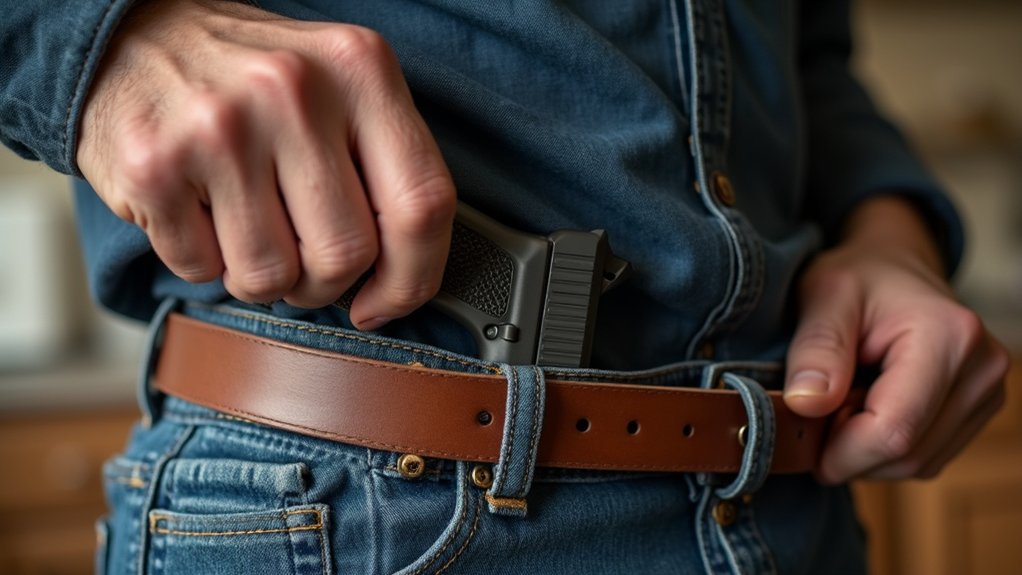
Although some may find holsterless carry techniques like tucking a firearm into the waistband or pocket carry convenient, you should understand these methods carry significant safety risks.
Holsterless carry offers no guaranteed retention, increasing the chances your firearm may shift or fall, potentially causing an accidental discharge.
Carrying without a holster risks your firearm shifting or falling, increasing accidental discharge chances.
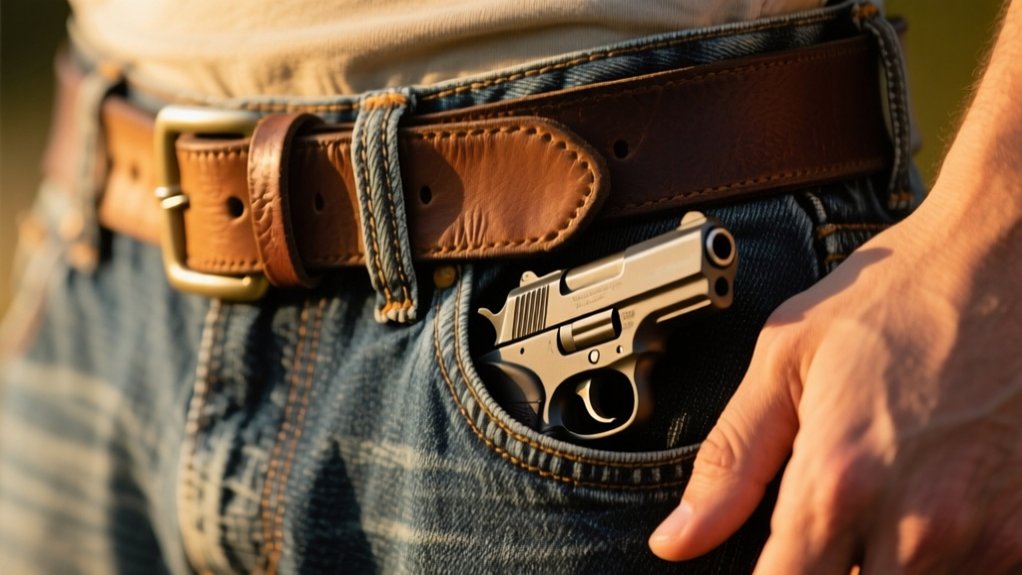
Pocket carry poses its own risks; fabric can snag the trigger guard, leading to a negligent discharge if the firearm isn’t secured properly.
Always point the firearm in a safe direction to minimize harm if a discharge occurs.
The risks associated with these methods often outweigh convenience.
Remember, local laws may also restrict holsterless carry or require a holster that covers the trigger.
Prioritize securing your firearm safely to prevent negligent or accidental discharges.
Using a holster with a holster claw can greatly improve both safety and concealment by keeping the firearm stable and reducing printing under clothing.
Legal Considerations for Carrying Without a Holster
When you carry a firearm without a holster, you must understand that laws vary considerably by state and locality. Some states, like Texas, require a firearm to be secured in a belt or shoulder holster, while Kansas mandates holsters covering the trigger guard.
Others, including California, Florida, and New York, prohibit public handgun carry altogether.
These legal considerations are critical to avoid serious penalties. Before deciding to carry without a holster, you must thoroughly research local laws and consult legal experts.
Safety Risks and Precautions
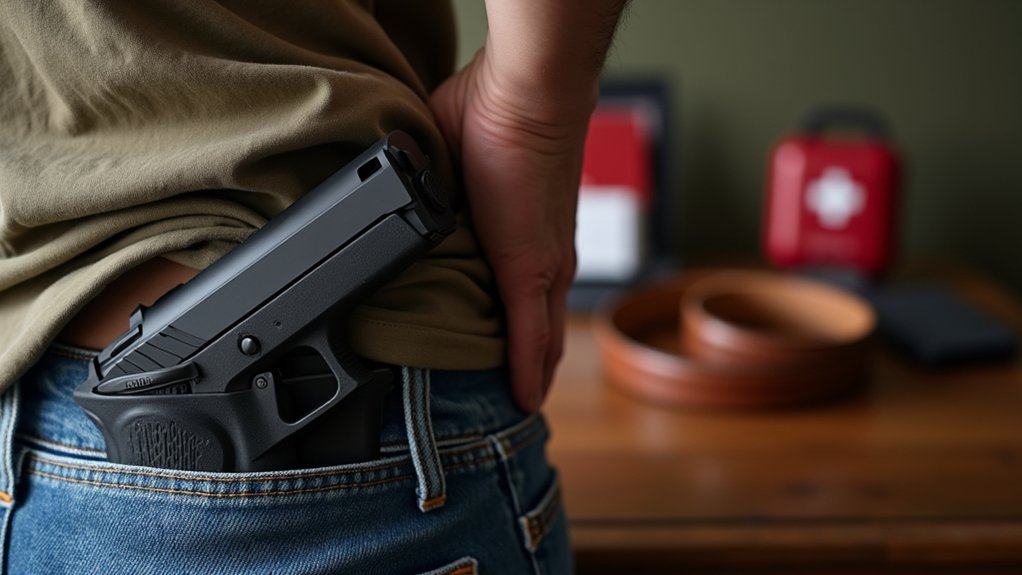
Because carrying a firearm without a holster leaves the trigger exposed, you increase the risk of accidental discharge every time you move or adjust your clothing.
The primary safety risks include unintentional discharges caused by fabric snagging the trigger and accidental drops due to loss of control.
Without proper trigger protection, your firearm becomes a hazard not only to yourself but to others nearby. You must also consider local laws, as many jurisdictions mandate secure holster use to prevent negligent discharges.
Moreover, methods like waistband or pocket carry can cause discomfort and distraction, compromising your ability to respond swiftly in emergencies.
While carrying without a holster might seem convenient, the dangers outweigh the benefits. Always prioritize proper holster use to maintain safety and control.
Recommended Firearms for Holsterless Carry
If you’re thinking about carrying without a holster, go for compact firearms like the Glock 43 or the Smith & Wesson Shield.
These models are easier to conceal and handle when you’re not using a holster.
It’s also a smart idea to pick guns that have manual safeties.
This extra feature helps reduce the risk of accidental discharge, especially when you’re carrying the firearm loose.
And don’t forget, make sure the trigger guard is fully covered.
That way, you keep things safe and avoid any unintentional trigger pulls while you’re on the move.
Compact Firearm Choices
Compact firearms excel in holsterless carry due to their reduced size and weight, which make them easier to conceal and handle discreetly.
When selecting a concealed firearm for holsterless carry, prioritize models known for reliable performance, such as the Glock 43, Smith & Wesson M&P Shield, or Sig Sauer P365.
A secure grip is vital to prevent the firearm from slipping during self-defense situations.
Opt for compact firearms with a shorter barrel length to increase comfort and reduce shifting while carried without a holster.
Consider firearms equipped with manual safety features, like the Ruger LC9s or Springfield XD-S, to add security and minimize accidental discharge risks.
Your choice should balance concealment, accessibility, and safety to guarantee effective and responsible holsterless carry.
Manual Safety Importance
When carrying without a holster, guaranteeing your firearm has a manual safety can greatly improve control and reduce accidental discharges. A manual safety provides an external safety mechanism that must be disengaged before firing. This enhances firearm readiness while minimizing risks during holsterless carry.
Compact models with reliable manual safeties, like some Glock, Sig Sauer, and Smith & Wesson variants, are ideal for this purpose. To maintain safe handling, you must regularly practice engagement and disengagement of the safety.
Focus on these key aspects:
- Choose compact models featuring a dependable manual safety for holsterless carry
- Consistently practice safe handling to master manual safety engagement
- Use the external safety to prevent accidental discharges and maintain control over firearm readiness
This discipline guarantees you carry responsibly without a holster.
Trigger Guard Protection
One of the most critical factors in holsterless carry is ensuring your firearm offers robust trigger guard protection to prevent accidental engagement. You must select a handgun with manual safety features and a secure method of retention to avoid negligent discharges.
Compact handguns with double-action triggers or heavier trigger pulls reduce the risk of unintentional firing. Proper trigger guard design blocks foreign objects from contacting the trigger, enhancing safe carry without a holster. Always practice safe drawing techniques to maintain control.
For those considering holsterless carry, understanding retention mechanisms and security features is essential to maintain both safety and accessibility.
| Concern | Solution |
|---|---|
| Accidental discharge | Robust trigger guard protection |
| Negligent discharges | Manual safety features |
| Unintended trigger pull | Double-action or heavier trigger |
| Size and manageability | Compact handguns |
| Retention security | Secure method of retention |
Alternatives to Traditional Holsters
Although traditional holsters remain popular, you can investigate several effective alternatives that balance safety and convenience. Exploring options like pocket carry, ankle carry, and shoulder holsters lets you tailor your method to your lifestyle while prioritizing personal safety.
Always consider local laws before choosing your carry style.
Pocket carry: Quick access but requires caution to avoid trigger snagging and retention issues.
Ankle carry: Offers discreet concealment but may hinder draw speed and comfort over time.
Shoulder holsters: Distribute weight evenly and improve accessibility, especially when seated or driving.
Additionally, concealed carry bags and tactical fanny packs provide secure, minimalist options.
Each method demands careful evaluation of safety and legal compliance for effective, responsible carry.
Tips for Secure and Comfortable Carry
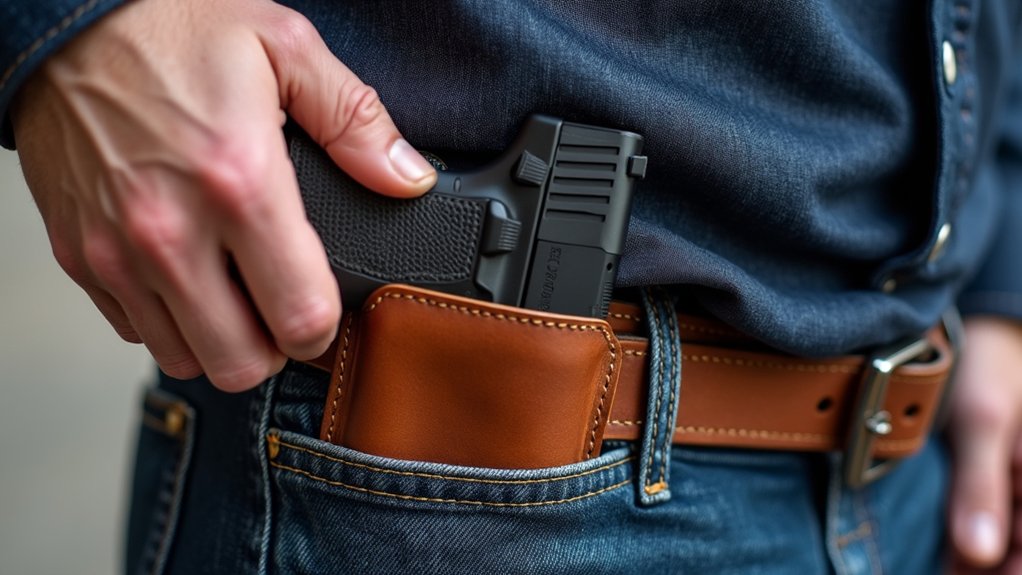
You want to make sure your firearm is secured firmly so it doesn’t shift around or accidentally drop, especially if you’re carrying without a holster.
Comfort is key, too—try to pick carry positions that don’t put too much pressure on you and still let you reach your firearm easily.
And don’t forget to always engage the safety features, keep the muzzle pointed in a safe direction, and practice your draw regularly to stay as safe as possible.
Secure Carry Techniques
When carrying without a holster, prioritize secure retention by tucking your firearm firmly into your waistband to prevent shifting or falling out.
Practice drawing your firearm regularly to guarantee smooth access and reinforce muscle memory.
Always protect the trigger by positioning the firearm so that clothing or body parts don’t accidentally engage it.
Keep the muzzle pointed in a safe direction to minimize risks during concealed carrying.
Investigate alternative carry methods if a suitable holster isn’t an option.
Key secure carry techniques include:
- Firmly securing the firearm in your waistband, avoiding looseness
- Using firearms with manual safeties for added security
- Considering tactical bags or fanny packs designed for concealed carry
Master these steps to safely carry a firearm without a holster.
Comfort Optimization Tips
To optimize comfort while carrying without a holster, select a firearm equipped with a manual safety and pair it with loose-fitting clothing that conceals effectively without restricting movement.
Wearing loose-fitting clothing improves comfort and reduces printing, which is vital when carrying a firearm without a proper holster.
Secure the gun with a sturdy belt to keep it firmly in place, preventing unwanted shifting.
Prioritize a manual safety feature to minimize accidental discharges, especially since trigger protection may be compromised when tucking the firearm into your waistband.
Regularly practice your draw and re-holstering techniques to build muscle memory, which boosts comfort and confidence.
For added stability and security, consider using a reinforced gun belt designed to prevent sagging and maintain proper firearm positioning throughout the day.
These steps guarantee secure, comfortable carry without sacrificing safety or concealment.
Safety Precautions
Although carrying without a holster offers convenience, you must prioritize safety to prevent accidents. To carry your firearm securely using holsterless methods, follow essential safety precautions that reduce the risk of accidental and negligent discharges.
Always make certain your firearm is unloaded and the chamber is clear before carry. Be mindful of local laws, as some require a holster covering the trigger guard. Maintain constant situational awareness to prevent drops or shifts in firearm position. Regular practice improves your draw and control.
- Verify the firearm is unloaded and chamber cleared before carry
- Understand and comply with local laws regarding trigger guard coverage
- Stay alert to your environment, preventing accidental shifts or drops
Adhering to these guidelines promotes safer, more responsible holsterless carry.
Frequently Asked Question
Can Carrying Without a Holster Damage My Firearm?
Yes, carrying your firearm without a holster can damage it.
Without proper protection, your gun is vulnerable to scratches, impacts, and environmental exposure that can cause rust or wear.
It’s also more likely to shift, fall, or collect dirt in the trigger area, which compromises reliability and safety.
To keep your firearm in ideal condition, always use a holster designed to secure and protect it during carry.
How Do I Clean My Gun After Holsterless Carry?
Wondering how to clean your gun after holsterless carry? First, disassemble it following the manufacturer’s instructions.
Use a cleaning solvent and soft cloth to remove debris, especially around the trigger guard and slide.
Scrub the barrel inside with a cleaning rod and brush to eliminate lint or dirt.
Finally, apply a light coat of gun oil on all metal surfaces to prevent rust.
Regularly inspect wear areas to keep your firearm in top condition.
What Clothing Works Best for Holsterless Carry?
You want loose-fitting clothes that hide your firearm’s outline and let you move freely.
Choose heavier fabrics like denim to keep your gun secure when tucked in.
Layering works well. Wear an untucked shirt over a fitted tank top to conceal and access easily.
Avoid tight waistbands or elastic, which can shift or dislodge your firearm.
Jackets or vests with internal pockets offer excellent concealment and quick access without a holster.
Does Holsterless Carry Affect Firearm Longevity?
Yes, carrying your firearm without a holster can negatively affect its longevity.
Without proper protection, your gun is exposed to dirt, moisture, and body oils, which accelerate wear and corrosion.
Furthermore, impacts and frequent handling can cause scratches and mechanical misalignments.
To preserve your firearm’s reliability and lifespan, you should use a quality holster that shields it from damage and keeps it securely in place during daily activities.
How to Discreetly Carry Without a Holster in Summer?
To discreetly carry without a holster in summer, choose lightweight, loose-fitting clothes to reduce printing and stay cool.
Use a belly band or compression shirt designed for concealed carry to securely hold your firearm close.
Opt for a smaller, easily concealable gun to fit comfortably in your waistband or pocket.
Off-body options like tactical fanny packs blend with summer styles.
Always prioritize safety and know your local laws before carrying without a holster.
Conclusion
Carrying without a holster demands your full attention to safety and legality. Don’t let shortcuts become a ticking time bomb. You’ve learned the importance of a secure grip, suitable firearms, and alternative methods to traditional holsters.
Always prioritize comfort and quick access while respecting local laws. Remember, carrying holsterless isn’t just about convenience; it’s about responsibility. Treat it like carrying a fragile treasure. Handle with care, and you’ll stay safe and prepared.