What Is Considered an Assault Weapon? Briefly Discusion
If you want to know what’s considered an assault weapon, it’s typically a semi-automatic firearm defined more by its cosmetic features, like pistol grips or flash suppressors, than by firing function. Unlike assault rifles, which can fire fully automatically, assault weapons fire one shot per trigger pull.
Definitions vary widely across states and have caused confusion in laws and enforcement. Recognizing these distinctions is essential if you’re looking to understand their regulation and the ongoing debates surrounding them.
Key Takeaways
- Assault weapons are generally semi-automatic firearms with specific features like pistol grips and detachable magazines, differing from fully automatic assault rifles.
- Definitions of assault weapons vary widely by jurisdiction, often focusing on cosmetic traits rather than functionality.
- The 1994 Federal Assault Weapons Ban listed certain features and models but had limited impact on reducing violent crime.
- State laws differ significantly, with some states regulating by specific features, models, or magazine capacities.
- Public confusion arises from media conflating assault weapons with assault rifles, complicating debates and legal clarity.
Origin and Evolution of the Term
Although the term “assault weapon” originated in a 1984 ad by Handgun Control, Inc., it quickly deviated from its military counterpart, “assault rifle,” which refers specifically to automatic firearms capable of selective fire.
You should understand that unlike assault rifles, assault weapons are generally semi-automatic, firing one round per trigger pull.
However, the assault weapon definition varies widely, lacking technical consistency. The 1994 Federal Assault Weapons Ban further complicated matters by focusing on cosmetic features rather than functionality, blurring the line between classification and perception.
The assault weapon definition lacks consistency, with laws emphasizing appearance over actual functionality.
As you navigate debates around this term, recognize that its ambiguity fuels legislative challenges and public confusion.
Whether you view it as a necessary label or a manufactured construct, clarity in the assault weapon definition remains essential for informed discourse.
Characteristics Defining Assault Weapons
When you examine what defines an assault weapon, you’ll find that the criteria often hinge on specific features rather than just the firearm’s function.
Typically, assault weapons are semi-automatic firearms that accept detachable magazines and include features like pistol grips, flash suppressors, or adjustable stocks.
These characteristics have become focal points in assault weapon regulation, as lawmakers aim to identify weapons that facilitate rapid firing or tactical use.
However, definitions vary considerably by state, with places like California and New York setting stricter standards based on particular models and features.
Understanding these characteristics is essential because assault weapon regulation depends less on the weapon’s firing mechanism and more on the presence of these distinctive components.
Lawmakers associate these features with improved combat utility and potential public safety risks.
Differences Between Assault Weapons and Assault Rifles
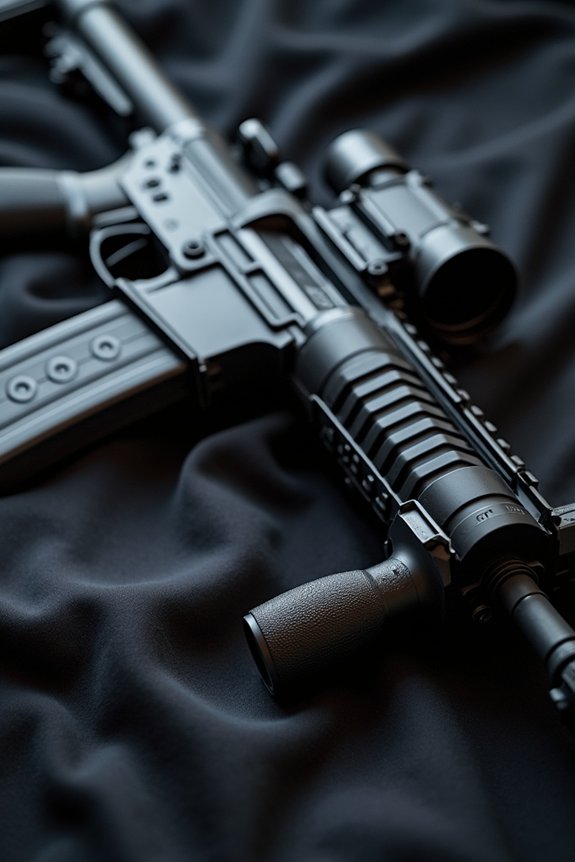
You need to understand that assault weapons typically refer to semi-automatic firearms with specific cosmetic features.
On the other hand, assault rifles are defined by their capability for both semi-automatic and fully automatic fire.
It’s important to recognize the functional difference between semi-automatic and automatic operation for a clear discussion.
This distinction really shapes how regulations classify and control these firearms.
Assault Weapon Definition
Understanding the difference between assault weapons and assault rifles is essential for informed discussions about firearm regulations.
Assault rifle vs assault weapon distinctions hinge on functionality and legal definitions.
Assault rifles are selective-fire firearms capable of semi-automatic and fully automatic modes. In contrast, assault weapons typically are semi-automatic firearms with detachable magazines and specific features like pistol grips or flash suppressors. These features often serve as legislative criteria rather than indicators of automatic capability.
The 1994 Federal Assault Weapons Ban highlighted this by focusing on cosmetic traits, causing inconsistent definitions across states. Media confusion between these terms fuels public misunderstanding, complicating policy debates.
When you grasp these precise differences, you better navigate the complexities of firearm classification and contribute to clearer, fact-based conversations about gun laws.
Assault Rifle Features
Distinguishing assault rifles from assault weapons requires a clear examination of their defining features.
While assault weapons are identified mainly by cosmetic traits, assault rifles differ fundamentally in operation. Understanding assault weapon features versus assault rifle features sharpens your grasp of firearm classification.
- Assault rifles have selective-fire capability (semi-automatic and fully automatic), unlike assault weapons limited to semi-automatic fire.
- Assault weapons often include features like pistol grips, flash suppressors, and adjustable stocks, which are cosmetic and regulatory markers.
- Assault rifles function as military-grade firearms, emphasizing operational complexity over aesthetic features.
- The term “assault weapon” lacks uniform definition, whereas “assault rifle” refers to a specific functional class.
Semi-Automatic Vs Automatic
How do semi-automatic assault weapons differ from automatic assault rifles in operation? You’ll find that a semi-automatic firearm fires one round per trigger pull. An automatic assault rifle can switch between semi-automatic and fully automatic firing modes.
This distinction is essential in understanding firearm classification and legislation.
| Feature | Semi-Automatic Assault Weapon | Automatic Assault Rifle |
|---|---|---|
| Firing Mode | Semi-automatic only | Selective-fire (semi & full) |
| Legal Definition | Varies; often cosmetic-based | Defined by National Firearms Act |
| Operation Complexity | Simple trigger pull per round | Can fire continuously with hold |
Understanding this difference helps clarify debates and policies surrounding assault weapons.
The Federal Assault Weapons Ban of 1994
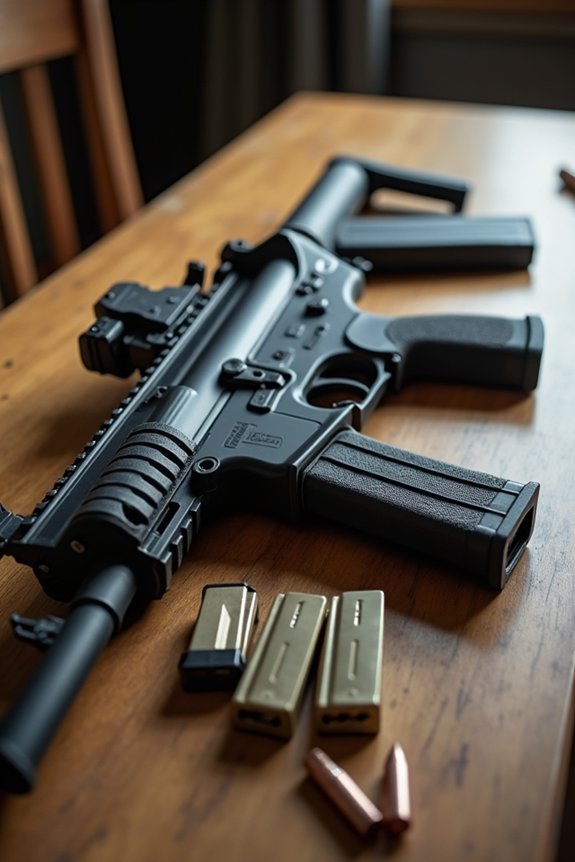
You need to understand how the Federal Assault Weapons Ban of 1994 defined and limited specific semi-automatic firearms with features like pistol grips and detachable magazines.
It was designed to target those particular features thought to make guns more dangerous. While the ban aimed to reduce gun violence, studies showed it didn’t greatly impact crime rates or mass shootings.
So, even though the intention was clear, the actual effect seemed limited. Now that the law expired in 2004, its effectiveness remains an essential point in ongoing legislative debates.
People still argue about whether bringing back a similar ban would help or not.
Ban Definition and Scope
Although the Federal Assault Weapons Ban of 1994 targeted semi-automatic firearms with detachable magazines and specific features like pistol grips and flash suppressors, it left several gaps that continue to influence today’s firearm regulations.
You should understand the ban’s precise definition and scope:
- It restricted semi-automatic guns equipped with a detachable magazine plus two or more defining features (e.g., pistol grip, flash suppressor).
- Fully automatic weapons were excluded, regulated separately under the National Firearms Act.
- The ban expired in 2004, creating regulatory uncertainty and sparking debates on its reinstatement.
- States have since crafted varied assault weapon definitions, often straying from the federal standard.
Knowing these nuances clarifies why the ban’s impact and legacy remain contested in current policy discussions.
Impact on Crime Rates
Since the Federal Assault Weapons Ban of 1994 specifically targeted certain semi-automatic firearms and large-capacity magazines, many expected a measurable drop in violent crime.
However, research consistently shows the ban had little to no effect on reducing violent crime rates.
Studies, including the 1997 Urban Institute report, found no significant decline in gun violence linked to the prohibition of firearms with military-style features.
Furthermore, rifles with such features accounted for only a small portion of violent crimes compared to handguns.
Even mass shootings didn’t decrease during the ban’s enforcement.
This evidence suggests that focusing solely on military-style features in assault weapon bans doesn’t substantially impact overall crime, challenging assumptions that these bans are an effective tool for reducing violence.
Legislative Expiration Effects
When the Federal Assault Weapons Ban expired in 2004 without renewal, it marked a pivotal shift in firearm regulation and intensified debates over assault weapon definitions.
You should understand that the lapse influenced firearm availability, legal frameworks, and political dynamics greatly:
- Civilian ownership of semi-automatic rifles, including AR-15 variants, surged to an estimated 16–44 million by 2021.
- Studies showed the federal assault weapons ban had minimal impact on reducing violent crime rates.
- States responded with diverse laws, reflecting differing interpretations of “assault weapons.”
- Attempts to reinstate or introduce similar federal bans face strong opposition, highlighting enduring political contention.
Recognizing these effects helps you grasp why the federal assault weapons ban’s expiration remains a critical factor in ongoing firearm policy debates.
State-Level Definitions and Regulations
Because assault weapon regulations vary so widely across the United States, understanding state-level definitions is essential if you want to navigate legal compliance effectively.
State laws on assault weapons differ greatly, with states like California, Connecticut, and New York imposing distinct criteria based on specific firearm models and features such as detachable magazines or pistol grips.
For example, California lists particular models and features. Connecticut regulates both selective-fire and designated semi-automatic firearms, and New York’s SAFE Act enforces stricter registration and magazine capacity limits.
These variations reflect differing political climates and influence ongoing legislative debates.
If you want to comply with state laws on assault weapons, you must carefully study each jurisdiction’s unique definitions and regulations, as failing to do so can lead to serious legal consequences.
Public Perception and Media Influence
Although the term “assault weapon” lacks a consistent definition, media coverage often blurs it with “assault rifle,” which misleads the public about firearm classifications. This confusion shapes your perception, especially when high-profile shootings dominate headlines.
You should consider these key points:
- Media narratives frequently exaggerate the threat posed by assault weapons, fueling fear rather than clarity.
- Public opinion remains divided; only 27% believe past bans effectively prevented mass shootings.
- Semi-automatic rifles constitute a small fraction of violent crime, contradicting common portrayals.
- Gun rights advocates argue that fear-driven media coverage pushes for restrictions that don’t address root causes.
Understanding these influences helps you critically evaluate the discourse surrounding assault weapons and avoid misconceptions.
Ongoing Debates and Legislative Challenges
As debates over assault weapons persist, you’ll find that the lack of a clear, consistent definition complicates both public understanding and legislative efforts.
Without consensus on what constitutes prohibited firearm features, lawmakers struggle to draft effective regulations.
Consensus on prohibited firearm features is crucial for lawmakers to create clear and effective regulations.
Attempts to regulate assault weapons often stall due to political resistance, as seen in Illinois’s 2013 failed proposal.
Additionally, varying state laws create a fragmented legal landscape, making enforcement and compliance challenging.
Public opinion remains divided; many doubt past bans’ effectiveness in preventing mass shootings.
Studies reinforce this skepticism, showing minimal impact on crime rates from earlier bans.
To move forward, you must recognize that addressing prohibited firearm features with precision is essential to create coherent, enforceable laws that balance public safety and legal clarity.
Frequently Asked Question
Are All Semi-Automatic Rifles Classified as Assault Weapons?
No, not all semi-automatic rifles are classified as assault weapons.
You need to understand that the term specifically targets firearms with certain features like detachable magazines and pistol grips.
Just because a rifle fires semi-automatically doesn’t automatically make it an assault weapon.
Different states have varied definitions, so what counts in one place mightn’t in another.
You should always check your local laws to know exactly how these terms apply.
Can Pistols Ever Be Considered Assault Weapons?
Yes, pistols can be considered assault weapons if they’ve specific features like detachable magazines and pistol grips.
While not all states agree, some include certain semi-automatic pistols in their assault weapon definitions.
You should know that federal laws typically focus on rifles and shotguns, but ongoing debates push for broader classifications.
Understanding these nuances helps you engage more effectively in firearm policy discussions.
Do Assault Weapon Bans Affect Gun Ownership Rights?
Yes, assault weapon bans do affect your gun ownership rights by limiting the types of firearms you can legally buy or keep.
For example, after the 1994 Federal Assault Weapons Ban, many owners had to surrender or modify their semi-automatic rifles with certain features.
While the ban aimed to reduce crime, it sparked debates on constitutional rights and led to ongoing legal challenges.
You should weigh these restrictions carefully if you value firearm ownership freedom.
How Do Assault Weapon Features Impact Firearm Lethality?
You might think assault weapon features greatly increase firearm lethality, but evidence says otherwise.
While detachable magazines and pistol grips can boost firing speed and control, studies show these features don’t considerably raise overall harm potential.
Most gun violence involves handguns, not rifles with such traits.
Are Assault Weapon Definitions Consistent Internationally?
No, assault weapon definitions aren’t consistent internationally.
You’ll find countries like the UK focus on fully automatic firearms, while Australia bans semi-automatic rifles altogether.
Canada classifies many U.S.-defined assault weapons as prohibited, and the UN’s push for common standards hasn’t unified these definitions.
If you want clarity, you must understand each country’s unique legal and cultural framework shaping their firearm regulations.
This inconsistency complicates global policy efforts.
Conclusion
Understanding what counts as an assault weapon is like maneuvering through a maze. It’s complex and ever-changing. You need to recognize how definitions shift across laws and states, influenced by history and public opinion.
By staying informed, you can see why these terms matter in debates about safety and rights. Only then can you engage thoughtfully in discussions and advocate for policies that balance protection with individual freedoms.